Little Italy in Chicago in Cook County, Illinois — The American Midwest (Great Lakes)
The Demolition of the Jane Addams Homes
Photographed by Sean P. Flynn, December 6, 2025
1. The Demolition of the Jane Addams Homes Marker
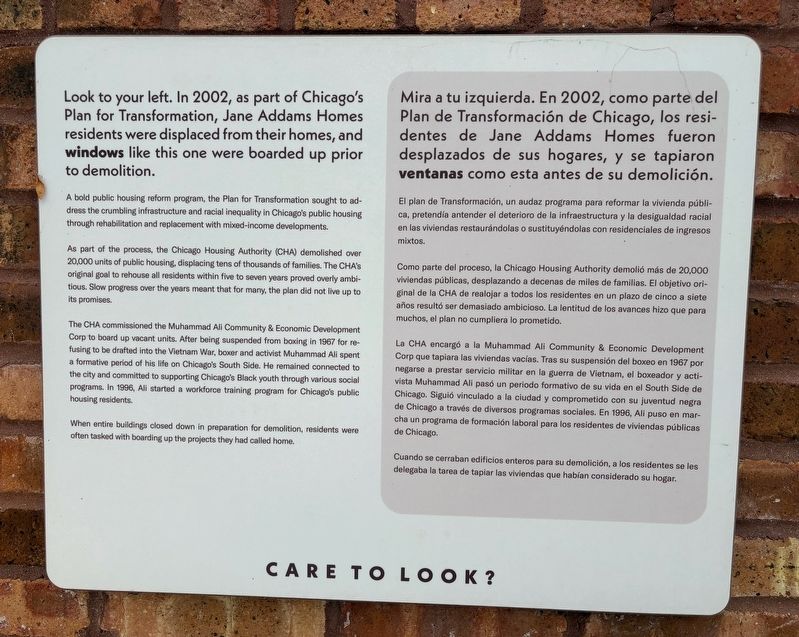
A bold public housing reform program, the Plan for Transformation sought to address the crumbling infrastructure and racial inequality in Chicago's public housing through rehabilitation and replacement with mixed-income developments.
As part of the process, the Chicago Housing Authority (CHA) demolished over 20,000 units of public housing, displacing tens of thousands of families. The CHA's original goal to rehouse all residents within five to seven years proved overly ambitious. Slow progress over the years meant that for many, the plan did not live up to its promises.
The CHA commissioned the Muhammad Ali Community & Economic Development Corp to board up vacant units. After being suspended from boxing in 1967 for refusing to be drafted into the Vietnam War, boxer and activist Muhammad Ali spent a formative period of his life on Chicago's South Side. He remained connected to the city and committed to supporting Chicago's
this page online
When entire buildings closed down in preparation for demolition, residents were often tasked with boarding up the projects they had called home.
Mira a tu izquierda. En 2002, como parte del Plan de Transformación de Chicago, los residentes de Jane Addams Homes fueron desplazados de sus hogares, y se tapiaron ventanas como esta antes de su demolición.
El plan de Transformación, un audaz programa para reformar la vivienda pública, pretendía antender el deterioro de la infraestructura y la desigualdad racial en las viviendas restaurándolas o sustituyéndolas con residenciales de ingresos mixtos.
Como parte del proceso, la Chicago Housing Authority demolió más de 20,000 viviendas públicas, desplazando a decenas de miles de familias. El objetivo original de la CHA de realojar a todos los residentes en un plazo de cinco a siete años resultó ser demasiado ambicioso. La lentitud de los avances hizo que para muchos, el plan no cumpliera lo prometido.
La CHA encargó a la Muhammad Ali Community &
Photographed by Sean P. Flynn, December 6, 2025
2. The Demolition of the Jane Addams Homes Marker
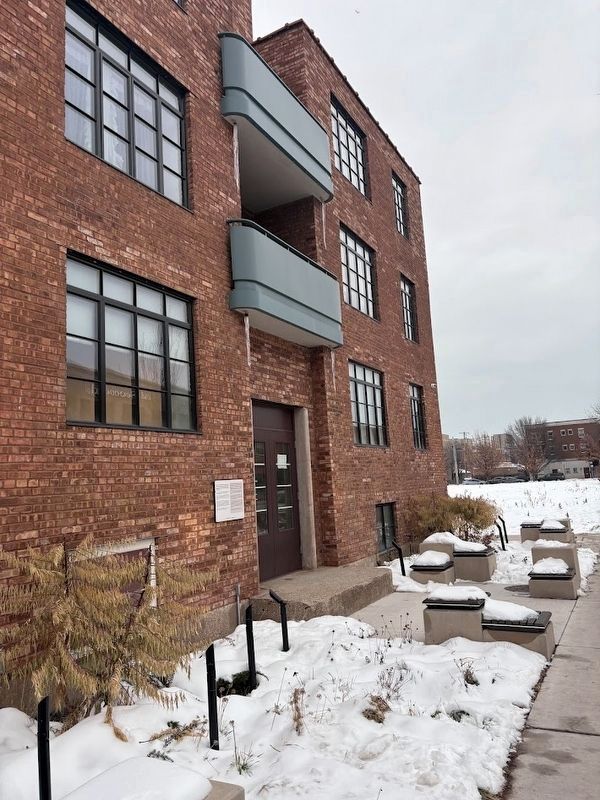
As can be seen on the right side of this photo, much of the land that was the Jane Addams Homes remains vacant as of 2025, more than 23 years after the housing project was demolished.
Cuando se cerraban edificios enteros para su demolición, a los residentes se les delegaba la tarea de tapiar las viviendas que habían considerado su hogar.
Erected 2025 by National Public Housing Museum.
Topics. This historical marker is listed in these topic lists: African Americans • Notable Buildings • Sports • War, Vietnam. A significant historical year for this entry is 2002.
Location. 41° 52.171′ N, 87° 39.583′ W. Marker is in Chicago, Illinois, in Cook County. It is in Little Italy. It is on Taylor Street near Ada Street, on the right when traveling west. The marker is on the wall next to the southeast doorway at the
Photographed by Sean P. Flynn, December 6, 2025
3. The historical marker and the Muhammad Ali-branded boarded-up window
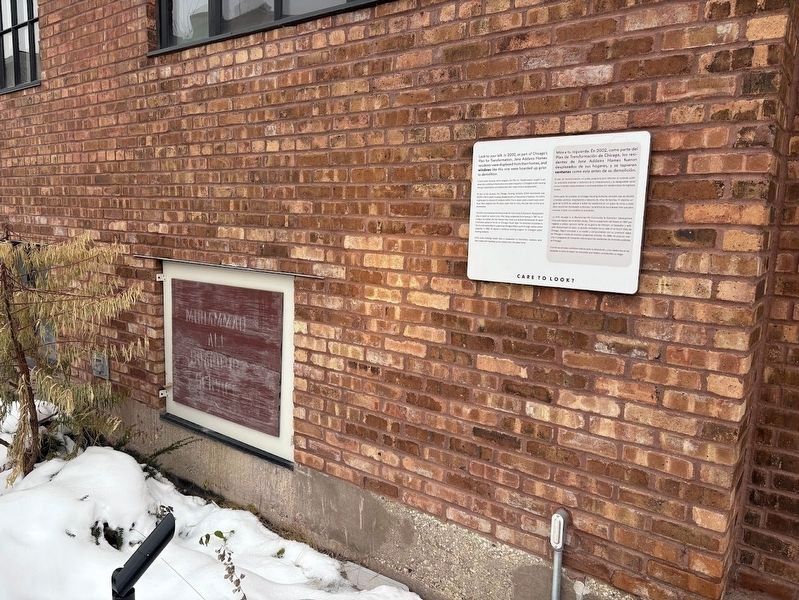
To the left is a boarded window, with "Muhammad Ali Boarding Service" printed on it.

Regionally, this marker is on Chicago’s West Side. It is also in the American Midwest. Globally, it is in North America, on the Great Lakes, in the Western Hemisphere, in the Western World, and in the Anglosphere. Historically, it finds itself in what was once the Viceroyalty of New France, the territory of the Mississippian Culture, and the Northwest Territory.
Other nearby markers. At least 8 other markers are within walking distance of this marker: Jane Addams Homes (here, next to this marker); Still Here: Zhegagoynak, A Monument and Memorial (a few steps from this marker); Joseph Lovings (a few steps from this marker); Deverra Beverly (a few steps from this marker); Deverra Beverly's Quilt (a few steps from this marker); Benedict Kabakow (within shouting distance of this marker); Jane Addams Homes Garden (within shouting distance of this marker); Saint Frances Xavier Cabrini (approx. 0.2 miles away). Touch for a list and map of all markers in
Photographed by Sean P. Flynn, December 6, 2025
4. National Public Housing Museum
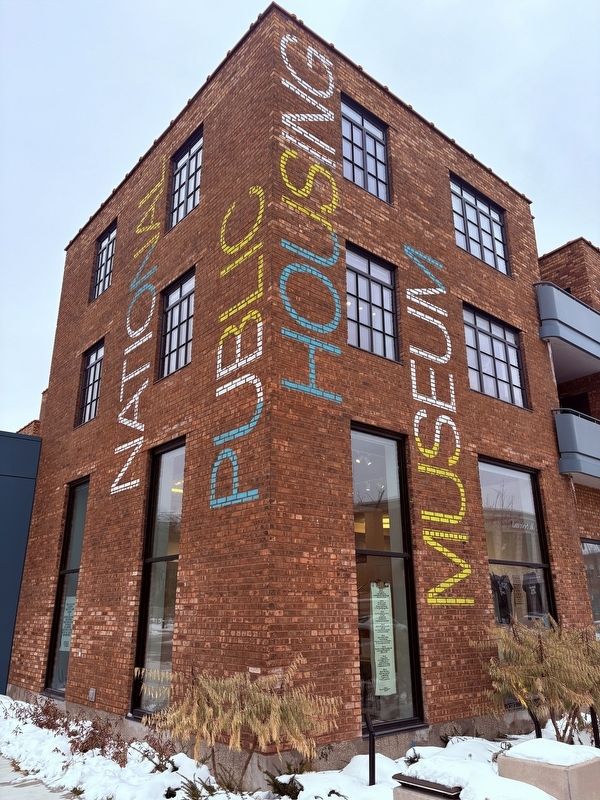
More about this marker. The Jane Addams Homes closed in 2002, and soon thereafter 31 of its 32 buildings were demolished. This one at the corner of Taylor and Ada was the only one left standing. After remaining vacant for more than two decades, it reopened in 2025 as the National Public Housing Museum.
The boarded window referenced on this sign is just to its left; "Muhammad Ali Boarding Service" is printed on the wood.
Regarding The Demolition of the Jane Addams Homes. The Jane Addams Homes, in the heart of Chicago's Little Italy neighborhood on the Near West Side, opened in 1938 as Chicago's first public housing project. Named after the social reformer who had founded the landmark Hull House settlement house a short distance away in Greektown, the development included more than 1,000 residential units spread across 32 buildings, funded by the Public Works Administration. Most of the original inhabitants were Italian and Jewish families who had been living in squalid conditions in and around this neighborhood during the Depression. The Addams Homes were the first of four Chicago Housing Authority projects known

Over the years, CHA housing projects across the city became as well known for their squalor as for the homes being provided to the poor. These projects in Little Italy faced particular pressure, due to their close-in location just two miles from downtown Chicago, and, sometime later, because they sat in the middle of a rapidly gentrifying area close to the University of Illinois at Chicago.
In the 1990s, after several high-profile crimes at CHA properties, Mayor Richard J. Daley proposed demolishing CHA projects, and by 1995 some of the more notorious buildings around the city began coming down. The 1999 Plan for Transformation formalized those efforts, calling for many projects to be demolished and replaced with housing in mixed-income developments.
The Jane Addams Homes came down in 2002, with only one building (now the National Public Housing Museum) left standing. The replacement half of the plan has been much slower to come to fruition; most estimates find that, almost three decades later, the city still has less public housing than it did before. While the Roosevelt Square development has been built nearby on the site of part of the ABLA Homes, much of the Jane Addams Homes site still remains largely vacant as of 2025.
Also see . . .
1. How the Plan for Transformation Started — And How It’s Going. From the City Cast Chicago website, a 2025 look at Chicago's Plan for Transformation more than a quarter-century after it was put into action.
Excerpt: "Impact for Equity recently found that more than 100 acres of CHA-owned land and buildings remain vacant. Meanwhile, the city’s housing commissioner says Chicago needs another 100,000 affordable units to address need. Some progress? Recently, ground broke on one phase of Legends South, a mixed-income, affordable housing complex at the former Robert Taylor Homes site. Lathrop Homes, near Bucktown, is also being redeveloped into a mixed-income rental community, with two phases now complete."(Submitted on December 8, 2025, by Sean P. Flynn of Oak Park, Illinois.)
2. Rich history of Jane Addams Homes as ‘hallowed ground’ is worth remembering. A 2023 commentary published by the Chicago Sun-Times.
Excerpt: “In calling this site 'hallowed ground,' Lightfoot spoke more truth than perhaps she realized. For over 180 years, the property has been in the service of the neighborhood, with a rich history that is worth remembering.”(Submitted on December 8, 2025, by Sean P. Flynn of Oak Park, Illinois.)
3. CHA residents have Ali in their corner. This 1996 article in the Chicago Tribune highlights a visit by Muhammad Ali to the Robert Taylor Homes, a public housing project that once stood on Chicago's South Side.
Excerpt: “Ali’s visit gave Taylor residents a taste of the same thrill that he afforded the Atlanta Olympics. Beyond that, however, it underscored the plodding but significant changes under way at the CHA. Until now, the main sign of his presence in the CHA’s troubled system were the ubiquitous plywood squares stenciled with the words 'Muhammad Ali Foundation' that were used to board up thousands of vacant units.”(Submitted on December 8, 2025, by Sean P. Flynn of Oak Park, Illinois.)
Credits. This page was last revised on August 11, 2026. It was originally submitted on December 8, 2025, by Sean P. Flynn of Oak Park, Illinois. This page has been viewed 183 times since then and 143 times this year. Photos: 1, 2, 3. submitted on December 8, 2025, by Sean P. Flynn of Oak Park, Illinois. 4. submitted on December 6, 2025, by Sean P. Flynn of Oak Park, Illinois. 5. submitted on August 11, 2026, by Sean P. Flynn of Oak Park, Illinois.
