
Città Antica in Verona in Provincia di Verona, Venetia, Italy — Southern and Western Europe (Mediterranean)
Torre dei Lamberti
(secolo XII)
⎯⎯⎯
Lamberti Tower
(12th century)

Photographed by James Hulse, June 11, 2025
1. Torre dei Lamberti / Lamberti Tower Marker

Eretta nel 1172 dai Lamberti, nel periodo in cui le famiglie nobiliari e mercantili circondarono piazza delle Erbe con le loro torri e case-torri gareggiando le une con le altre, domina lo skyline con i suoi 83 metri di altezza. La costruzione rispondeva a finalità difensive ma ospitò anche un carcere. Probabilmente la fece costruire Bozeno de Lamberto, il maggior esponente della famiglia. Un ventennio più tardi fu inglobata nel romanico Palazzo della Ragione. La costruzione iniziale, più bassa, fu sottoposta a vari innalzamenti successivi. In seguito a un fulmine che nel 1403 abbatté la parte terminale, venne innalzata tra il 1448 e il 1463 la cella campanaria ottagonale in pietra sopra le trifore e la torre divenne la più alta di Verona. Autore delle colonnine e dei capitelli sarebbe stato, secondo la tradizione, certo "spezaprea", come veniva chiamato il Maestro Antonio di San Bastian del lago di Como. Nel 1779 fu inserito l'orologio a tutt'oggi funzionante. La parte più antica, conforme ai canoni del romanico veronese nel paramento a conci di tufo alternati a mattoni, è separata dalla cella ottagonale di fattura veneziana da una zona in cotto. Sopra la trifora sono posti gli stemmi del podestà e del capitano veneziani. La salita alla cima della torre (con comodo ascensore) permette anche di ammirare le due campane, fuse più volte, che dal 1295 scandiscono i tempi della vita cittadina. La più grande, il Rengo (da arengo, luogo delle assemblee del popolo), fusa nel 1557 dai Bonaventurini, dalla cella ottagonale chiamava a raccolta per i consigli cittadini o in caso di pericolo. Per dimensioni, nel Veneto è inferiore solo alla campana maggiore del Duomo di Verona. I rintocchi della Marangona (marangon in veneto significa falegname) dalla cella inferiore avvertivano gli artigiani della fine del turno di lavoro e segnalavano gli incendi.
Didascalie
(Foto #1) Il Rengo
(Foto #2) Paolo Ligozzi, Verona città celeberima..., 1620-1630, particolare con la Torre dei Lamberti, Verona, Biblioteca Civica
(Foto #3) La Marangona
The Lamberti family built their tower in 1172, during a time when nobles and merchants were surrounding Piazza delle Erbe with towers and house-towers, each competing to overcome the other: at 83 metres, the Lamberti Tower still dominates the skyline. The building was intended for defences but also housed a jail. It was probably commissioned by Bozeno de Lamberto, the most important figure in the family. Two decades later it was incorporated into the Romanesque Palazzo della Ragione. The original building was shorter but was raised in a series of stages. After a 1403 lighting strike, an octagonal upper bell chamber was constructed (1448-1463), supported on triple-lancet windows, making the tower the highest in Verona. Tradition has it that the author of the columns and capitals was Master Antonio of San Bastian, on Lake Como, also known as Spezaprea (the Blocksplitter). In 1779 a clock was inserted, still in operation today. The oldest part of the structure shows typical Verona Romanesque style in the walls of stone blocks alternating with brick masonry. This is separated from the later Venetian bell chamber by an intervening band in terra cotta. Above the lancet windows are the arms of the podestà city lord and the Venetian captain in charge. The climb to the top of the tower (now with elevator) permits a view of the two bells: these have rung the hours for the city since 1295, although they have been re-cast several times. The largest, the "Rengo" (from arengo, the name of the electors' assembly hall), was cast in 1557 by the Bonaventurini foundry, and was used to call the citizens in case of danger. Among all the bells of the Veneto region, the Rengo is second in size only to the great bell of the Verona Cathedral,. The peal of the smaller "Marangona" (from marangon, Veneto for carpenter), in the lower bell chamber, signalled the end of the artisans' work-day or an alarm of fire.
Captions
(Photo #1) The Rengo
(Photo #2) Paolo Ligozzi, Verona, a Most Famous City..., 1620-1630, detail with the Lamberti Tower, Verona, Civic Library
(Photo #3) The Marangona
Erected by City
this page online
Topics. This historical marker is listed in this topic list: Industry & Commerce. A significant historical year for this entry is 1172.
Location. 45° 26.59′ N, 10° 59.873′ E. Marker is in Verona, Veneto (Venetia), in Provincia di Verona. It is in Città Antica. It is at the intersection of Via della Costa and Piazza dei Signori, on the right when traveling east on Via della Costa. The marker is located at the base of the tower. Touch for map. Marker is at or near this postal address: Via della Costa 1, Verona, Veneto 37121, Italy. Touch for directions.

Regionally, it is in Europe, the European Union, the Schengen Area, a coastal Mediterranean country, and the Western World. Historically, it finds itself in what was once the Roman Empire and specifically also the Holy Roman Empire.
Other nearby markers. At least 8 other markers are within walking distance of this marker: Dante Alighieri a Verona: il Paradiso dedicato a Cangrande della Scala (within shouting distance of this marker); Cansignorio della Scala (within shouting distance of this marker); Palazzo del Governo, già Reggia Scaligera (secolo XIV) (within

Photographed by James Hulse, June 11, 2025
2. The view of the marker along the street
Photographed by James Hulse, June 11, 2025
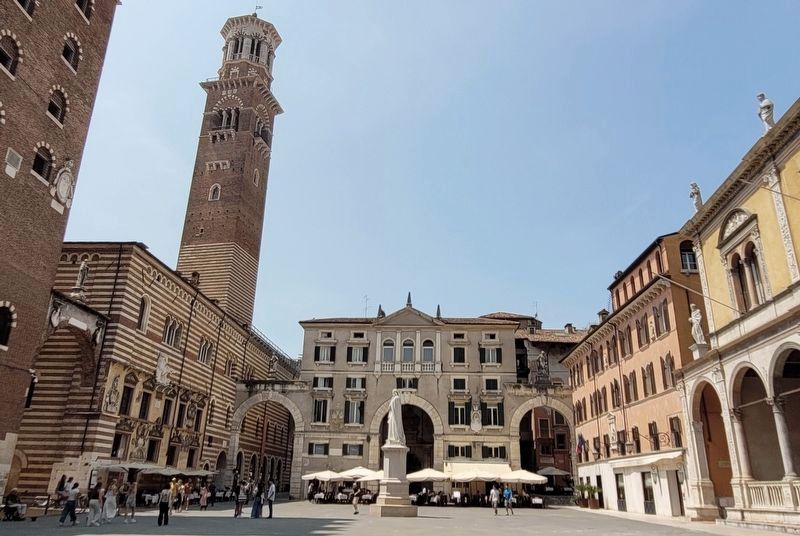
3. The view of the Lamberti Tower in the Piazza dei Signori
Photographed by James Hulse, June 11, 2025
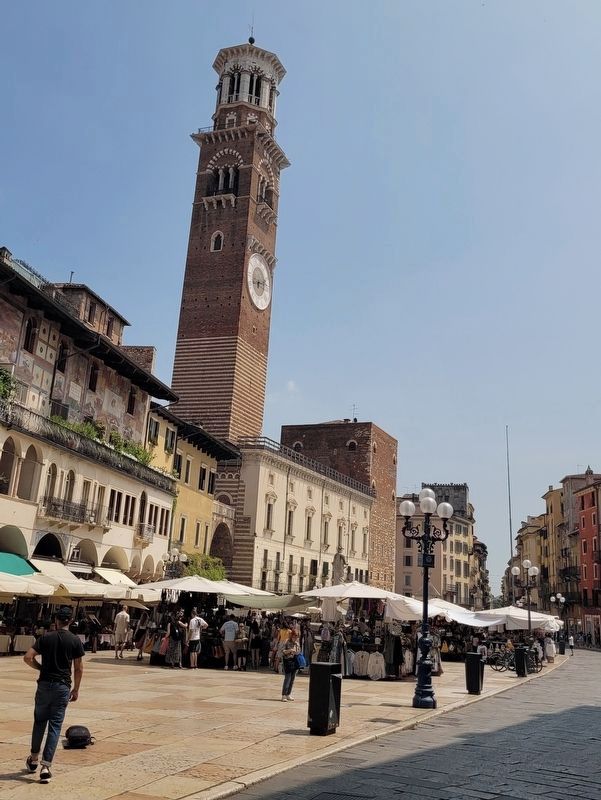
4. The view of the Lamberti Tower from the Piazza delle Erbe
Credits. This page was last revised on December 8, 2025. It was originally submitted on December 8, 2025, by James Hulse of Medina, Texas. This page has been viewed 70 times since then and 40 times this year. Photos: 1, 2, 3, 4. submitted on December 8, 2025, by James Hulse of Medina, Texas.
