Leadville in Lake County, Colorado — The American Mountains (Southwest)
Annunciation Church
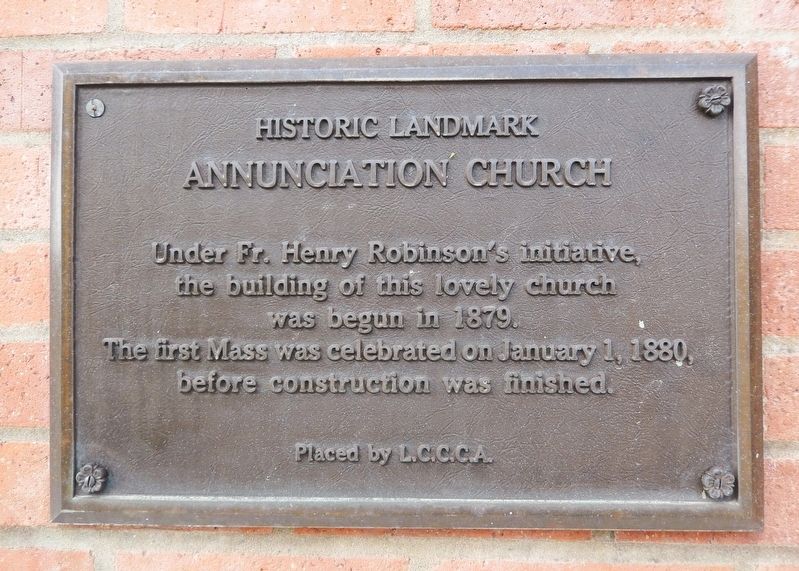
Historic Landmark
Photographed by Cosmos Mariner, July 27, 2025
1. Annunciation Church Marker
Under Fr. Henry Robinson’s initiative, the building of this lovely church was begun in 1879. The first mass was celebrated on January 1, 1880, before construction was finished.
Erected by Lake County Civic Center Association.
Topics and series. This historical marker is listed in these topic lists: Architecture • Notable Buildings • Religion & Religious Structures. In addition, it is included in the National Register of Historic Places (NRHP) series list. A significant historical date for this entry is January 1, 1880.
Location. 39° 14.993′ N, 106° 17.404′ W. Marker is in Leadville, Colorado, in Lake County. It is at the intersection of Poplar Street and East 7th Street, on the left when traveling north on Poplar Street. The marker is on the east side of the church, near the northeast corner tower. Touch for map. Marker is at or near this postal address: 609 Poplar Street, Leadville CO 80461, United States of America. Touch for directions.

Regionally, this marker is in the Arkansas River Valley, in the Colorado High Rockies and on the Continental Divide. It is also in the American Mountain West. Globally, it is
this page online
Other nearby markers. At least 8 other markers are within walking distance of this marker: Welcome to Leadville, CO! / ¡Bienvenido a Leadville, CO! (about 600 feet away, measured in a direct line); Golden Burro Cafe (about 600 feet away); Tabor Grand Hotel (about 700 feet away); Leadville City Hall (about 700 feet away); Headframe (approx. 0.2 miles away); Gravity Stamp Mill (approx. 0.2 miles away); Crib (approx. 0.2 miles away); Shaker Concentrating Table (approx. 0.2 miles away). Touch for a list and map of all markers in Leadville.
Regarding Annunciation Church. Contributing property, Leadville Historic District, National Register of Historic Places № 66000248. Also Colorado State Register of Historic Properties Site № 5LK.40.
From the National Register Nomination prepared by Joseph Scott Mendinghall, 12/18/1975:
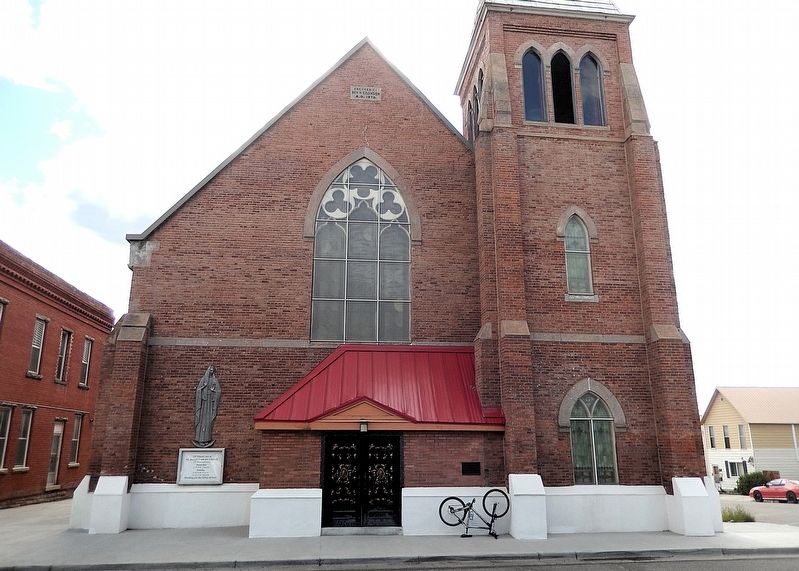
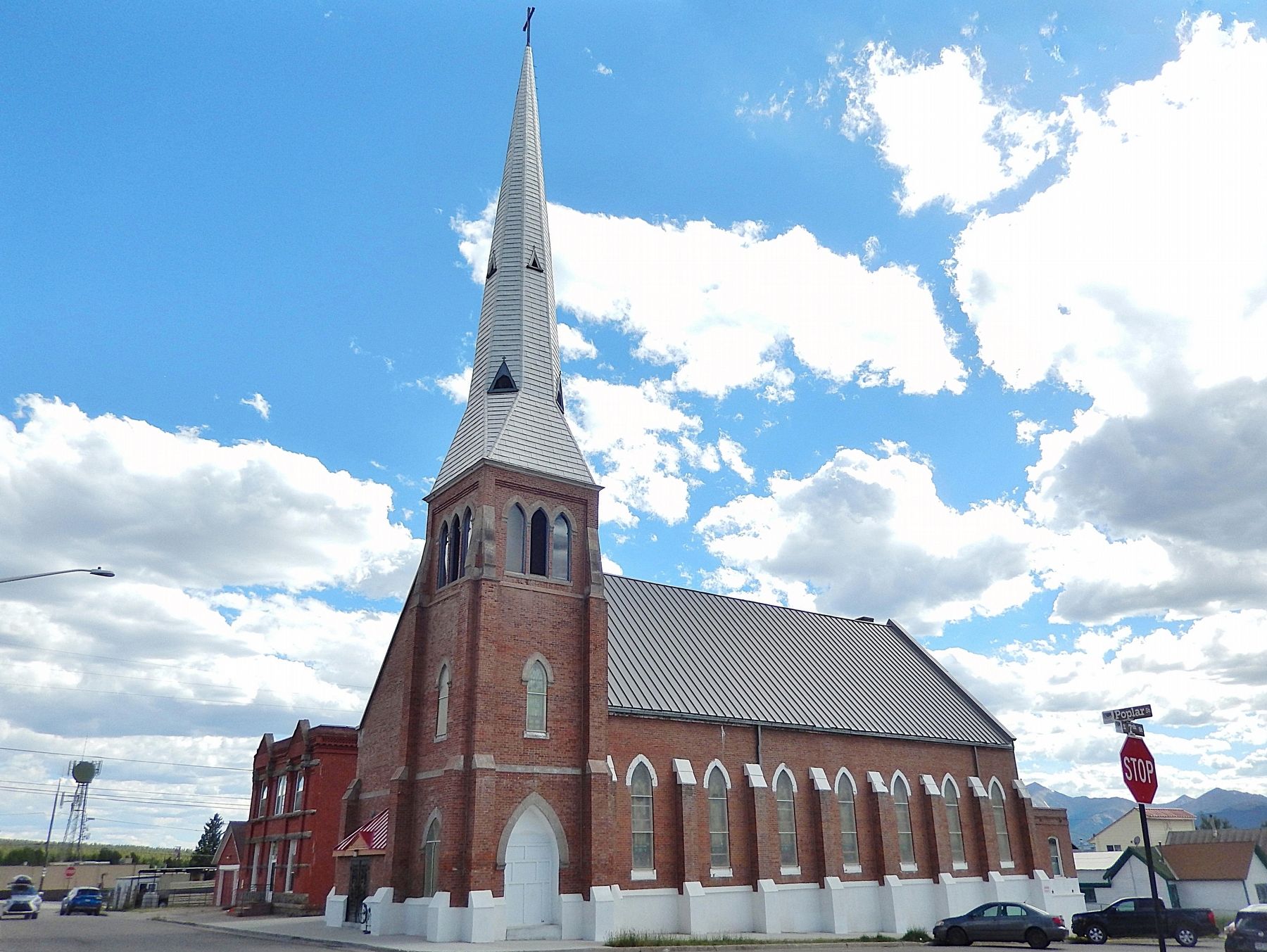
Annunciation Church is an impressive brick structure constructed before the turn of the century. The church has a steep gabled roof and buttresses located along its length. There is a corner towerwith enclosed arcaded belfry. A massive spire rises above the church.Photographed by Cosmos Mariner, July 27, 20252. Annunciation Church MarkerThe marker is mounted at eye level on the east side of the church, just to the right of the east entrance.
—————
The first Leadville boom took place in the early 1860's with the discovery of rich placer gold diggings, but the surface deposits were quickly exhausted. The second boom in the 1870's ushered in the silver era. One of the most spectacular strikes in Colorado mining annals, it began with a series of incredibly rich discoveries along California Gulch. Almost overnight the desolate pine flat just below timberline sprouted into a rowdy, rugged mining camp with the usual assortment of pine bough shelters, tent hotels, banks, grocery stores, beer gardens, and mine dumps. The extravagance and gaudy taste of the richest miners equaled or surpassed that of their counterparts in other mining camps.
In 1880, Leadville's population was estimated at from 25,000 to 40,000 and it was proud of its reputation as a wide-open mining town, with 100 licensed saloons and a dozen gambling houses operating around the clock. It has been estimated that the district produced some $136,000,000 in silver between 1879 and 1888.
Below the silver-bearing strata, quartz veins heavily seamed withgold were discovered, and in spite of the panic of 1893, which ended the silver boom, Leadville prospered again as a gold camp until the end of the century. Since that time, lead, zinc, manganese, and molybdenum have been mined in the district.Photographed by Cosmos Mariner, July 27, 20253. Annunciation Church
Leadville, today, is one of the largest of the old mining towns. The north side of the town has been developed with modern commercial and residential buildings. There remain, however, along the Harrison Avenue corridor, a number of historic structures. The Leadville Historic District encompasses a scattered group of distinctive and important historic buildings of the central architectural theme associated with late 19th-century mining towns of the West.
Also see . . .
1. Annunciation built 140 years ago (Herald Democrat).
(by Marcia Martinek, Herald Editor, Sep 18, 2019 Updated May 23, 2023) Excerpt: Much of the early history of Annunciation is contained in the brochure, “100 years of Faith,” which was published at the time of the church’s 100th anniversary. It was under Robinson’s direction that the building of Annunciation Church was begun in 1879 and completed in 1881.(Submitted on December 10, 2025, by Cosmos Mariner of Cape Canaveral, Florida.)
The church marks Jan. 1, 1880, as its anniversary date because that is the day the first mass was celebrated at the building. The church came first; the steeple was built later, and the huge bell, weighing 3636 pounds and named “St. Mary,” was not installed until 1885. The church and rectory cost $40,000 to build. Robinson was the fundraiser, visiting all the mines to obtain contributions. It is said that most Catholic miners contributed a day’s wages ($2 to $3 for a 10-hour shift) to the building fund. The history of the church notes that Annunciation was heated for many years by a large furnace in the back of the church which may account for the tendency of parishioners to sit in the back.
2. Annunciation Church (Historic Leadville Walking Tour).
Excerpt: The steeple is a masterpiece of intricate carpentry, a weblike interweaving of timbers built to last for centuries. The prominent “Unsinkable Molly Brown” was married in the church on September 1, 1886, and the funeral services for Baby Doe Tabor were held here in 1935. In every photo of Leadville, the spire is a directional landmark. The church is generally unlocked and you are welcome to visit being careful not to interrupt any services which may be taking place.(Submitted on December 10, 2025, by Cosmos Mariner of Cape Canaveral, Florida.)
3. Leadville Historic District (Wikipedia).
Excerpt: The Leadville Historic District is in the mining town of Leadville, Colorado. The National Historic Landmark District includes 67 mines in the mining district east of the city up to the 12,000-foot level, and a defined portion of the village area. It was designated in 1961. Then, when the National Register of Historic Places (NRHP) program was started in 1966, Leadville's National Historic District was included in its first day's listings. The NRHP district was later expanded, adding a number of structures along the Harrison Avenue corridor.(Submitted on December 10, 2025, by Cosmos Mariner of Cape Canaveral, Florida.)
Annunciation Roman Catholic Church:
Annunciation’s great bell, the “St. Mary”, weighs 3,026 pounds and is 11,000 feet above sea level. The church hosted the 1886 wedding of the woman who became known as "the unsinkable Molly Brown."
4. Leadville Historic District (History Colorado).
Excerpt: The Leadville mining district ranks as one of the country’s richest mineral regions. The first gold mining boom occurred in 1860, bringing approximately 10,000 miners to the area. The second boom began in 1878 with the discovery of extensive silver deposits. The fortunes of Leadville’s best known silver king, H.A.W. Tabor, crashed along with silver prices in 1893.(Submitted on December 10, 2025, by Cosmos Mariner of Cape Canaveral, Florida.)
Credits. This page was last revised on December 10, 2025. It was originally submitted on December 9, 2025, by Cosmos Mariner of Cape Canaveral, Florida. This page has been viewed 71 times since then and 31 times this year. Photos: 1, 2, 3. submitted on December 10, 2025, by Cosmos Mariner of Cape Canaveral, Florida.
