
Città Antica in Verona in Provincia di Verona, Venetia, Italy — Southern and Western Europe (Mediterranean)
Palazzo del Governo, già Reggia Scaligera (secolo XIV)
Palazzo del Governo, formerly the Scaliger Royal Palace (14th century)
Photographed by James Hulse, June 11, 2025
1. Palazzo del Governo, già Reggia Scaligera (secolo XIV) Marker

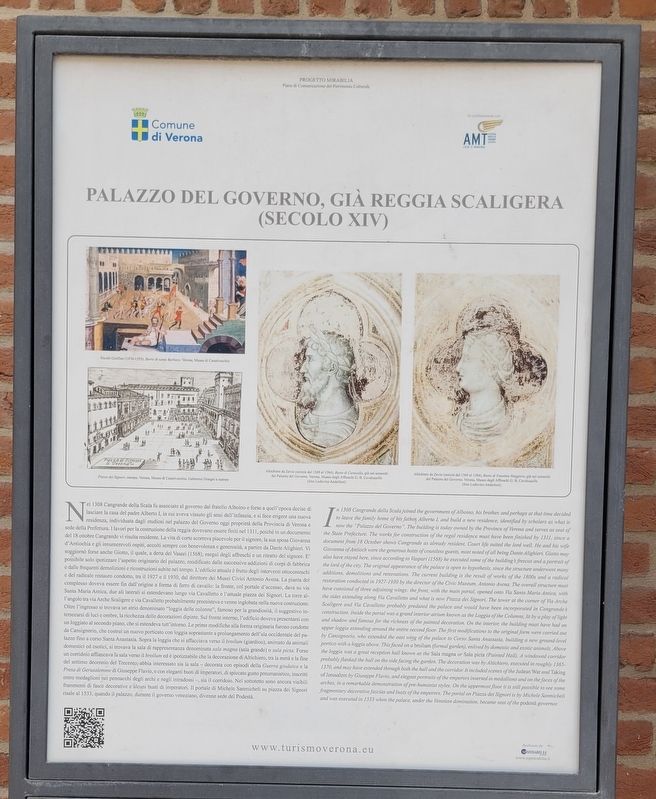
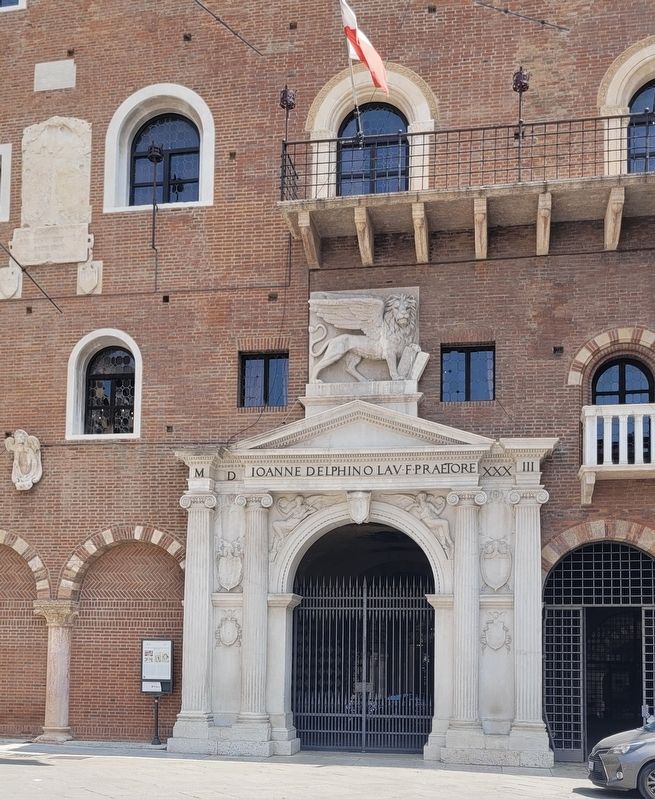
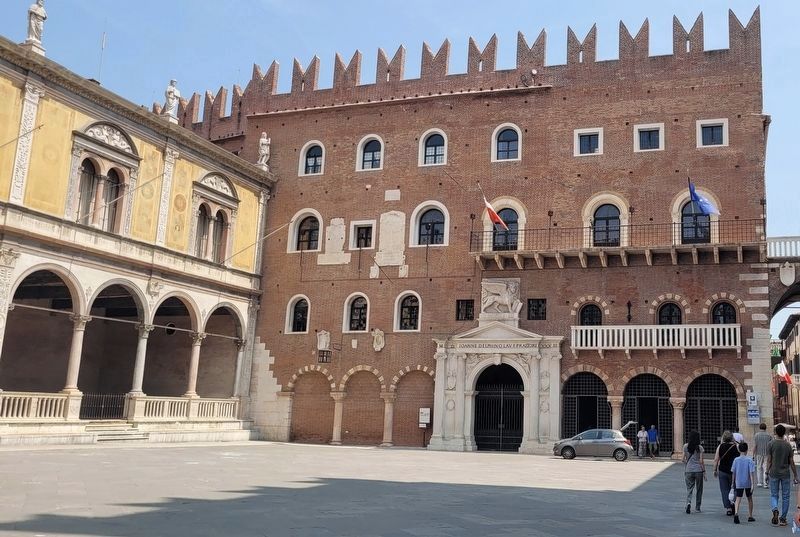
Nel 1308 Cangrande della Scala fu associato al governo dal fratello Alboino e forse a quell'epoca decise di lasciare la casa del padre Alberto I, in cui aveva vissuto gli anni dell'infanzia, e si fece erigere una nuova residenza, individuata dagli studiosi nel palazzo del Governo oggi proprietà della Provincia di Verona e sede della Prefettura. I lavori per la costruzione della reggia dovevano essere finiti nel 1311, poiché in un documento del 18 ottobre Cangrande vi risulta residente. La vita di corte scorreva piacevole per il signore, la sua sposa Giovanna d'Antiochia e gli innumerevoli ospiti, accolti sempre con benevolenza e generosità, a partire da Dante Alighieri. Vi soggiornò forse anche Giotto, il quale, a detta del Vasari (1568), eseguì degli affreschi e un ritratto del signore. È possibile solo ipotizzare l'aspetto originario del palazzo, modificato dalle successive addizioni di corpi di fabbrica e dalle frequenti demolizioni e ricostruzioni subite nel tempo. L'edificio attuale è frutto degli interventi ottocenteschi e del radicale restauro condotto, tra il 1927 e il 1930, dal direttore dei Musei Civici Antonio Avena. La pianta del complesso doveva essere fin dall'origine a forma di ferro di cavallo: la fronte, col portale d'accesso, dava su via Santa Maria Antica, due ali laterali si estendevano lungo via Cavalletto e l'attuale piazza dei Signori. La torre all’angolo tra via Arche Scaligere e via Cavalletto probabilmente preesisteva e venne inglobata nella nuova costruzione. Oltre l'ingresso si trovava un atrio denominato "loggia delle colonne", famoso per la grandiosità, il suggestivo intersecarsi di luci e ombre, la ricchezza delle decorazioni dipinte. Sul fronte interno, l'edificio doveva presentarsi con un loggiato al secondo piano, che si estendeva tutt'intorno. Le prime modifiche alla forma originaria furono condotte da Cansignorio, che costruì un nuovo porticato con loggia soprastante a prolungamento dell'ala occidentale del palazzo fino a corso Santa Anastasia. Sopra la loggia che si affacciava verso il broilum (giardino), animato da animali domestici ed esotici, si trovava la sala di rappresentanza denominata sala magna (sala grande) o sala picta. Forse un corridoio affiancava la sala verso il broilum ed è ipotizzabile che la decorazione di Altichiero, tra la metà e la fine del settimo decennio del Trecento, abbia interessato sia la sala decorata con episodi della Guerra giudaica e la Presa di Gerusalemme di Giuseppe Flavio, e con eleganti busti di imperatori, di spiccato gusto preumanistico, inscritti entro medaglioni nei pennacchi degli archi e negli intradossi, sia il corridoio. Nel sottotetto sono ancora visibili frammenti di fasce decorative e alcuni busti di imperatori. Il portale di Michele Sanmicheli su piazza dei Signori risale al 1533, quando il palazzo, durante il governo veneziano, divenne sede del Podestà.
Didascalie
(Foto #1) Nicolò Giolfino (1476-1555), Storie di santa Barbara. Verona, Museo di Castelvecchio
(Foto #2) Piazza del Signori, stampa. Verona, Museo di Castelvecchio, Gabinetto Disegni e stampe
(Foto #3) Altichiero da Zevio (notizie dal 1369 al 1384), Busto di Caracalla, già nei sottarchi del Palazzo del Governo. Verona, Museo degli Affreschi G. B. Cavalcaselle (foto Ludovico Anderloni)
(Foto #4) Altichiero da Zevio (notizie dal 1369 al 1384), Busto di Faustina Maggiore, già nei sottarchi del Palazzo del Governo. Verona, Museo degli Affreschi G. B. Cavalcaselle (foto Ludovico Anderloni)
In 1308 Cangrande della Scala joined the government of Alboino, his brother, and perhaps at that time decided to leave the family home of his father, Alberto I, and build a new residence, identified by scholars as what is now the "Palazzo del Governo". The building is today owned by the Province of Verona and serves as seat of the State Prefecture. The works for construction of the regal residence must have been finished by 1311, since a document from 18 October shows Cangrande as already resident. Court life suited the lord well. He and his wife Giovanna of Antioch were the generous hosts of countless guests, most noted of all being Dante Alighieri. Giotto may also have stayed here, since according to Vaspari (1568) he executed some of the building's frescos and a portrait of the lord of the city. The original appearance of the palace is open to hypothesis, since the structure underwent many additions, demolitions and renovations. The current building is the result of works of the 1800s and a radical restoration conducted in 1927-1930 by the director of the Civic Museum, Antonio Avena. The overall structure must have consisted of three adjoining wings: the front, with the main portal, opened onto Via Santa Maria Antica, with the sides extending along Via Cavalletto and what is now Piazza dei Signori. The tower at the corner of Via Arche Scaligere and Via Cavalletto probably predated the palace and would have been incorporated in Cangrande's construction. Inside the portal was a grand interior atrium known as the Loggia of the Columns, lit by a play of light and shadow and famous for the richness of the painted decoration. On the interior, the building must have had an upper loggia extending around the entire second floor. The first modifications to the original form were carried out by Cansignorio, who extended the east wing of the palace to Corso Santa Anastasia, building a new ground-level portico with a loggia above. This faced on a broilum (formal garden), enlived by domestic and exotic animals. Above the loggia was a great reception hall known as the Sala magna or Sala picta (Painted Hall). A windowed corridor probably flanked the hall on the side facing the garden. The decoration was by Altichiero, executed in roughly 1365-1370, and may have extended through both the hall and the corridor. It included scenes of the Judean War and Taking of Jerusalem by Giuseppe Flavio, and elegant portraits of the emperors inserted in medallions and on the faces of the arches, in a remarkable demonstration of pre-humanist styles. On the uppermost floor it is still possible to see some fragmentary decorative fascias and busts of the emperors. The portal on Piazza dei Signori is by Michele Sanmicheli and was executed in 1533 when the palace, under the Venetian domination, became seat of the podestà governor.
Captions
(Photo #1) Nicolò Giolfino (1476–1555), Stories of Saint Barbara. Verona, Castelvecchio Museum.
(Photo #2) Piazza dei Signori, print. Verona, Castelvecchio Museum, Drawings and Prints Cabinet.
(Photo #3) Altichiero da Zevio (active between 1369 and 1384), Bust of Caracalla, formerly in the arches of the Palazzo del Governo. Verona, G. B. Cavalcaselle Museum of Frescoes (photo by Ludovico Anderloni).
(Photo #4) Altichiero da Zevio (active between 1369 and 1384), Bust of Faustina the Elder, formerly located in the arches beneath the Palazzo del Governo. Verona, G. B. Cavalcaselle Museum of Frescoes (photo by Ludovico Anderloni)
Erected by City
this page online
Topics. This historical marker is listed in this topic list: Notable Buildings. A significant historical year for this entry is 1308.
Location. 45° 26.622′ N, 10° 59.905′ E. Marker is in Verona, Veneto (Venetia), in Provincia di Verona. It is in Città Antica. It is on Piazza dei Signori east of Via Dante Alighieri, on the left when traveling east. The marker is located at the entrance to building in the Piazza dei Signori. Touch for map. Marker is at or near this postal address: Piazza dei Signori 1, Verona, Veneto 37121, Italy. Touch for directions.

Regionally, it is in Europe, the European Union, the Schengen Area, a coastal Mediterranean country, and the Western World. Historically, it finds itself in what was once the Roman Empire and specifically also the Holy Roman Empire.
Other nearby markers. At least 8 other markers are within walking distance of this marker: Cansignorio della Scala (within shouting distance of this marker); Arche degli Scaligeri (secolo XIV) / The Scaliger Tombs (14th century) (within shouting distance of this marker); Chiesa di Santa Maria Antica (secolo XII) / Church of Santa Maria Antica (12th century)
Photographed by James Hulse, June 11, 2025
2. The entrance to the building and Marker
Photographed by James Hulse, June 11, 2025
3. The view of the Palazzo del Governo building
Credits. This page was last revised on December 11, 2025. It was originally submitted on December 10, 2025, by James Hulse of Medina, Texas. This page has been viewed 46 times since then and 19 times this year. Photos: 1, 2, 3. submitted on December 11, 2025, by James Hulse of Medina, Texas.
