
Città Antica in Verona in Provincia di Verona, Venetia, Italy — Southern and Western Europe (Mediterranean)
Chiesa di Santa Maria Antica (secolo XII)
⎯⎯⎯
Church of Santa Maria Antica (12th century)

Photographed by James Hulse, June 11, 2025
1. Chiesa di Santa Maria Antica (secolo XII) / Church of Santa Maria Antica (12th century) Marker

Posta nel cuore della città, a pochi passi dal Palazzo del Comune, questa piccola chiesa fin dall'origine dedicata a Maria Vergine, era anticamente annessa ad un monastero femminile, fondato tra il 744 e il 745 da due sorelle di origine germanica, Auctonda e Natalia. L'area fino al X secolo era priva di abitazione e l'orto delle monache si estendeva fino al cortile del Tribunale. Nel 1024 l'abate di Santa Maria in Organo, Inghelperto, vi insediò 15 chierici da lui dipendenti e il cenobio benedettino cessò di esistere. Risale probabilmente all'XI secolo l'impianto di un cimitero. Il 9 novembre del 1185 una nuova chiesa, eretta in forme romaniche in sostituzione del più antico oratorio, veniva consacrata dal patriarca di Aquileia, Gotifredo, come si legge in un'iscrizione murata presso l'abside sinistra. Nel Duecento la chiesa divenne la cappella di famiglia degli Scaligeri che abitavano nella contrada. Nel Trecento i signori le eressero accanto il sepolcreto di famiglia con le bellissime Arche. La chiesa si presenta esternamente di severa struttura geometrica, con il campanile impostato sopra l'abside centrale quadrata allo scopo di risparmiare spazio in un contesto evidentemente piuttosto stretto. Il paramento murario, conforme al gusto romanico nelle partiture a fasce in conci di tufo alternate a mattoni, evocava, nell'abbinamento cromatico del rosso con il bianco, lo stemma scaligero. Lo spazio interno, essenziale e suggestivo, è a tre navate divise da colonne con semplici capitelli a piramide rovesciata reggenti archi a sesto rialzato. Anticamente la chiesa era divisa da un tramezzo murario, denominato ponticello, in due zone, una riservata al clero e comprendente il presbiterio e il coro, e una destinata al popolo. Nel 1309 Federico Della Scala fece erigere all'interno dell'area presbiterale un altare dedicato a santa Chiara e nel 1314 uno dedicato a santa Maria. Durante tutta la signoria scaligera la chiesa, nonostante le dimensioni esigue, ospitò le tombe della famiglia. Forse vi fu sepolto Alberto I Della Scala, morto nel 1301. L'abside centrale custodisce due affreschi del XIV secolo. Verso il 1630 l'aspetto interno fu modificato in chiave barocca, ma nell'Ottocento recuperò sostanzialmente l'essenzialità originaria. La luce entra soltanto dalle strette monofore sulle pareti mantenendo l'interno in una dolce penombra. Semplice ma molto armonioso il campanile romanico, basso, tutto in tufo, terminante con copertura a pigna di mattoni.
Didascalie
(Foto #1) Interno della chiesa
(Foto #2) Iconografia rateriana dal manoscritto di Scipione Maffei. Verona, Biblioteca Capitolare, in evidenza la chiesa
(Foto #3) Pittore secolo XIV, Annunciazione, abside
This small church, in the heart of the city and just a few steps from the Palazzo del Comune, was originally linked with a convent founded in 744-745 by Auctonda and Natalia, two sisters of Germanic origin, and has always been dedicated to the Virgin Mary. Until the 10th century the convent stood alone and its vegetable gardens extended as far as the city Courts. In 1024, Abbott Inghelperto of Santa Maria in Organo installed 15 of his clergy here, and the women's convent ceased to exist. The cemetery was probably begun in the 11th century. On 9 November 1185 a new church was consecrated by Gotifredo, patriarch of Aquileia, as noted on an inscription on the left apse. The edifice was in Romanesque form, situated over the location of the former oratory. In the 1200s the church became the private chapel of the Scaligeri family, who resided in this quarter. In the 1300s the Scaligeri lords erected their famous sepulchre, with its beautiful "ark" tombs, alongside the building. The church exterior shows a severely geometric structure, with the bell-tower erected over the central apse: a strategy intended to save space in the obviously cramped streetscape. The exterior walls are in Romanesque taste, with the masonry in alternating bands of whitish tuff and red bricks, which suggest the colours of the Scaligeri arms. The internal space is essential and evocative. The plan is a triple nave divided by columns with simple inverted-pyramidal capitals, supporting raised curved arches. In origin the church was divided by a masonry partition called the ponticello ("bridge"), which separated the congregational area from the presbytery and chancel, in turn reserved for the clergy. In 1309, Federico della Scala ordered the construction of a presbytery altar dedicated to Santa Chiara, and in 1314 a second one dedicated to the Virgin Mary. Throughout the entire rule of the Scaligeri lords, the family continued to use the church for their tombs, in spite of its small size. Perhaps Alberto I Della Scala, the first lord, was buried here following his death in 1301. The central apse preserves two frescos from the 1300s. Towards 1630 the interior was reworked in Baroque style, but in the 1800 it was restored to much of its original appearance. Light enters only from the narrow lancet windows, maintaining the interior in suggestive suffused shadow. The Romanesque bell-tower is simply but harmonious: low, entirely built in tuff stone, topped by a brick-tiled roof.
Captions
(Photo #1) Interior of the church
(Photo #2) Raterian iconography from the manuscript of Scipione Maffei. Verona, Chapter Library, the church is highlighted.
(Photo #3) Painter of the 14th century, Annunciation, apse
Erected by City
this page online
Topics. This historical marker is listed in this topic list: Religion & Religious Structures. A significant historical year for this entry is 745 CE.
Location. 45° 26.612′ N, 10° 59.934′ E. Marker is in Verona, Veneto (Venetia), in Provincia di Verona. It is in Città Antica. It is at the intersection of Via S. Maria Antica and Via Arche Scaligere, on the right when traveling east on Via S. Maria Antica. The marker is located at the entrance to the church next to the covered pathway. Touch for map. Marker is at or near this postal address: Via Arche Scaligere 3, Verona, Veneto 37121, Italy. Touch for directions.

Regionally, it is in Europe, the European Union, the Schengen Area, a coastal Mediterranean country, and the Western World. Historically, it finds itself in what was once the Roman Empire and specifically also the Holy Roman Empire.
Other nearby markers. At least 8 other markers are within walking distance of this marker: Arche degli Scaligeri (secolo XIV) / The Scaliger Tombs (14th century) (here, next to this marker); Cansignorio della Scala (within shouting distance of this marker); Palazzo del Governo, già Reggia Scaligera (secolo XIV)
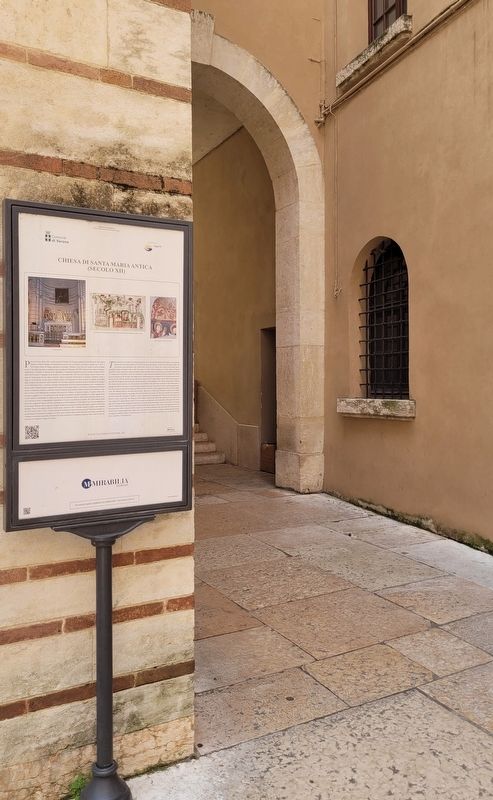
Photographed by James Hulse, June 11, 2025
2. Church of Santa Maria Antica (12th century) and Marker

Photographed by James Hulse, June 11, 2025
3. The view of the entrance to the Church of Santa Maria Antica (12th century)
The marker is located on the right side of the entrance to the church.

Photographed by James Hulse, June 11, 2025
4. The Scaliger Tombs in front of the church
Credits. This page was last revised on December 11, 2025. It was originally submitted on December 10, 2025, by James Hulse of Medina, Texas. This page has been viewed 44 times since then and 18 times this year. Photos: 1, 2, 3, 4. submitted on December 11, 2025, by James Hulse of Medina, Texas.
