Leadville in Lake County, Colorado — The American Mountains (Southwest)
Historic Mining Country

Photographed by Cosmos Mariner, July 27, 2025
1. Historic Mining Country Marker
The year was 1859. Prospectors returning from the California Rush found new gold fields in a gulch they named California, southeast of present-day Leadville.
Colorado became a state in 1876 because of her gold and silver. Those precious minerals were just the tip of the wealth. Leadville saw a dazzling parade of minerals create, each in turn, a new era — the gold, the silver, the zinc, and even the lead that grayed the towering peaks.
Mining remains the backbone of Leadville economy. Today, it's the miracle metal — molybdenum — that strengthens steel used around the world in kitchenware, transportation, industry and recreation.
Adelaide Park, Fryer, Jonny, and Carbonate hills — gulches called Evans, Stray Horse, Georgia and Iowa are colorful names that weave the multi-hued splendor of the past through the fabric of the Leadville Historic District. Their mystique surrounds you.
Please help to preserve Colorado's mining heritage by observing Mining Property Protocol:
Return home with only memories
Exercise good judgment
Safety is most important
Protect lives and property rights
Enjoy without destruction
Concern for private
this page online
Trespassing is unlawful
Topics. This historical marker is listed in these topic lists: Industry & Commerce • Settlements & Settlers. A significant historical year for this entry is 1859.
Location. 39° 15.04′ N, 106° 17.582′ W. Marker is in Leadville, Colorado, in Lake County. It is on Harrison Avenue (U.S. 24) just south of West 9th Street, on the right when traveling south. The marker is about 30 meters west of Harrison Avenue, in front of the retail shop at this address. Touch for map. Marker is at or near this postal address: 809 Harrison Avenue, Leadville CO 80461, United States of America. Touch for directions.

Regionally, this marker is in the Arkansas River Valley, in the Colorado High Rockies and on the Continental Divide. It is also in the American Mountain West. Globally, it is in North America, the Rocky Mountains, the Western Hemisphere, the Western World, and the Anglosphere.
Other nearby markers. At least 8 other markers are within walking distance of this marker: Welcome to Historic Leadville — Twin Lakes / Bienvenido a la histórico Leadville — Twin Lakes (a few steps from this marker); Sounding the Alarm
Photographed by Cosmos Mariner, July 27, 2025
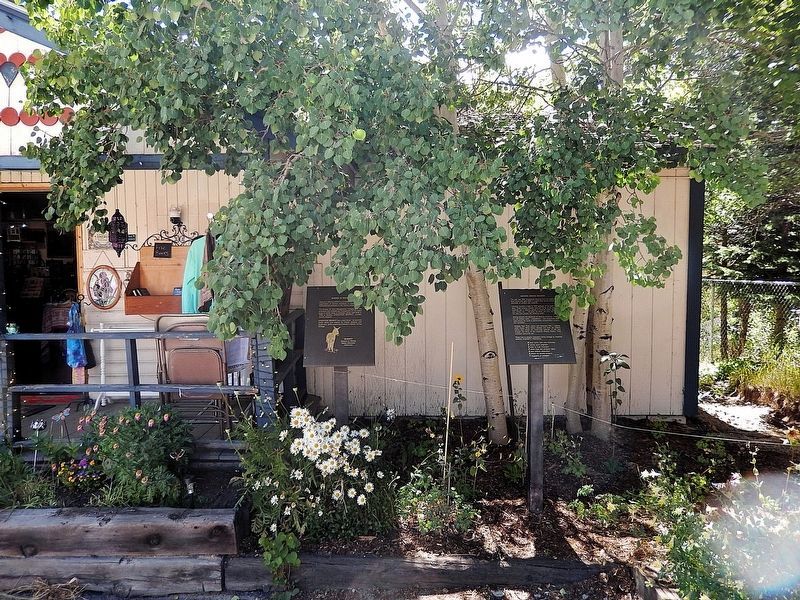
2. Historic Mining Country Marker
Looking west from Harrison Avenue; the marker is the rightmost of two markers in front of the retail shop at this location.
Also see . . . Leadville, Colorado (Western Mining History).
Excerpt: Abe Lee and others discovered gold at California Gulch in the upper Arkansas River Valley in 1860. A settlement called Oro City was established as thousands of miner's arrived to work the area. The placer deposits were rich, and millions of dollars in gold was mined in the first five years. However, by 1865 the gold was running out, and most of the miners moved on to new strikes.(Submitted on December 10, 2025, by Cosmos Mariner of Cape Canaveral, Florida.)
By 1877 the silver discoveries were finally catching the attention of miners and businessmen throughout the state, and an influx of people began. New businesses were built in the area formerly known as Slabtown. A meeting was held by residents of the growing community, and the name Leadville was chosen as the official name of the settlement that was forming in the center of the new silver district.
Leadville would become one of the world's largest (and most notorious) mining cities. The railroad reached Leadville in 1880, further accelerating growth of the town. At its peak in 1882, Leadville is estimated to have over 50,000 residents.
Leadville's boom years ended with the silver crash of 1893. The drop in silver prices resulted in most mines of the district being idled, and ninety percent of Leadville's workforce became unemployed. Despite the fact that the gold and silver mines were in decline, the diversity of mines in the district kept the town going for decades, even if its glory days were long gone.
By 1900 Leadville had a fledgling zinc industry. As demand for zinc increased, the Leadville zinc mines expanded and in 1915 a zinc smelter was built. Molybdenum deposits were discovered on Bartlett Mountain north of Leadville. These deposits became the Climax molybdenum mine which was developed just as World War I started and demand for molybdenum skyrocketed.
Credits. This page was last revised on December 10, 2025. It was originally submitted on December 10, 2025, by Cosmos Mariner of Cape Canaveral, Florida. This page has been viewed 77 times since then and 29 times this year. Photos: 1, 2. submitted on December 10, 2025, by Cosmos Mariner of Cape Canaveral, Florida.
