Leadville in Lake County, Colorado — The American Mountains (Southwest)
Shaker Concentrating Table
Photographed by Cosmos Mariner, July 27, 2025
1. Shaker Concentrating Table Marker
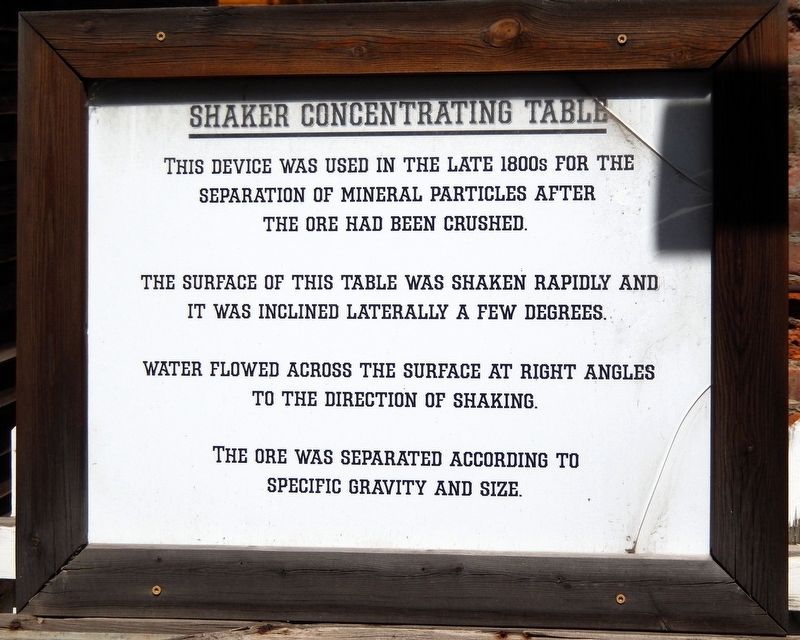
This device was used in the late 1800s for the separation of mineral particles after the ore had been crushed.
The surface of this table was shaken rapidly and it was inclined laterally a few degrees.
Water flowed across the surface at right angles to the direction of shaking.
The ore was separated according to specific gravity and size.
Topics. This historical marker is listed in this topic list: Industry & Commerce.
Location. 39° 15.085′ N, 106° 17.541′ W. Marker is in Leadville, Colorado, in Lake County. It is at the intersection of East 9th Street (U.S. 24) and Harrison Avenue, on the right when traveling west on East 9th Street. The marker and shaker table are on the Leadville Heritage Museum grounds. Touch for map. Marker is at or near this postal address: 102 East 9th Street, Leadville CO 80461, United States of America. Touch for directions.

Regionally, this marker is in the Arkansas River Valley, in the Colorado High Rockies and on the Continental Divide. It is also in the American Mountain West. Globally, it is in North America, the Rocky Mountains, the
this page online
Other nearby markers. At least 8 other markers are within walking distance of this marker: Gravity Stamp Mill (here, next to this marker); Crib (here, next to this marker); Headframe (a few steps from this marker); Side-Dumping Ore Car (a few steps from this marker); Carnegie Library (a few steps from this marker); Healy House (within shouting distance of this marker); Leadville City Hall (about 300 feet away, measured in a direct line); Welcome to Historic Leadville — Twin Lakes / Bienvenido a la histórico Leadville — Twin Lakes (about 300 feet away). Touch for a list and map of all markers in Leadville.
Also see . . . The Ultimate Guide to Gold Shaking Table (Miningpedia).
Excerpt: The concept of using shaking tables dates back to the mid-19th century, with the first patent issued to an American inventor, James R. Wilfley, in 1865. These tables were initially designed to separate coal from slate, but their potential for mineral separation was quickly recognized. Over the years, the design has evolved, and today's gold shaking tables are sophisticated(Submitted on December 13, 2025, by Cosmos Mariner of Cape Canaveral, Florida.)machines that play a crucial role in the recovery of gold and other precious metals.Photographed by Cosmos Mariner, July 27, 20252. Shaker Concentrating Table Marker
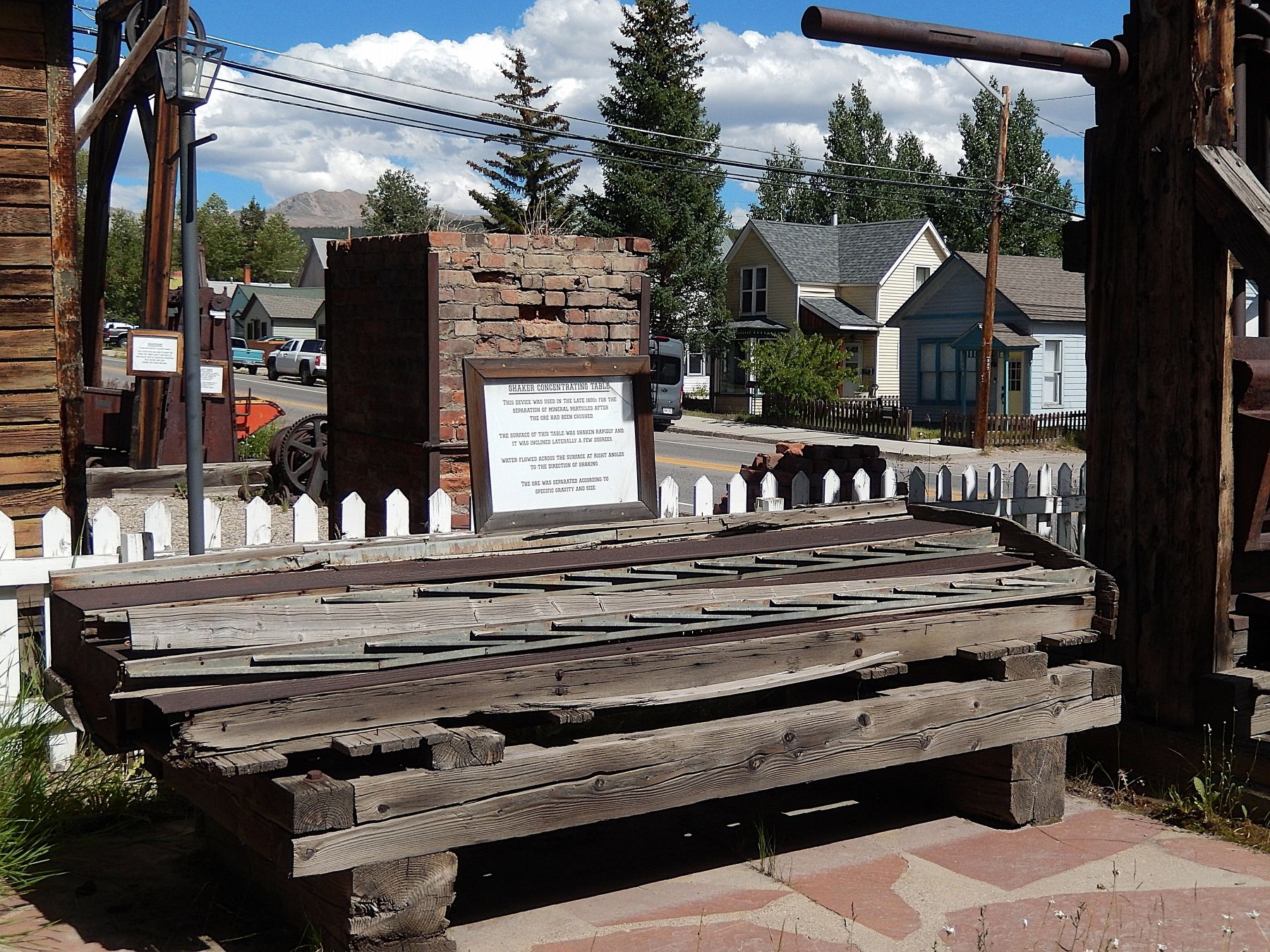
At the heart of a gold shaking table is the principle of gravity separation. The table consists of a flat, riffled surface that is set at an angle to the horizontal. When fed with a mixture of water and mineral particles, the table's oscillating motion creates a thin film of water over the surface. This motion, combined with the gravitational pull, causes the denser minerals, such as gold, to settle and move in a different direction than the lighter materials. The riffles, or corrugations, on the table's surface further enhance this separation by creating small channels that trap the heavier particles.
Credits. This page was last revised on December 14, 2025. It was originally submitted on December 12, 2025, by Cosmos Mariner of Cape Canaveral, Florida. This page has been viewed 57 times since then and 23 times this year. Photos: 1, 2. submitted on December 13, 2025, by Cosmos Mariner of Cape Canaveral, Florida.
