
North Dakota State University in Fargo in Cass County, North Dakota — The American Midwest (Upper Plains)
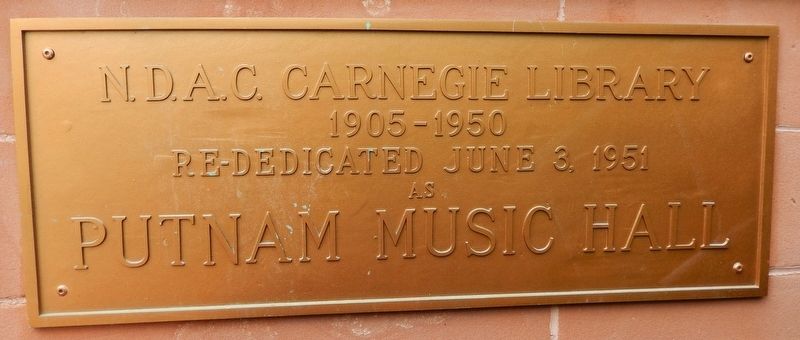
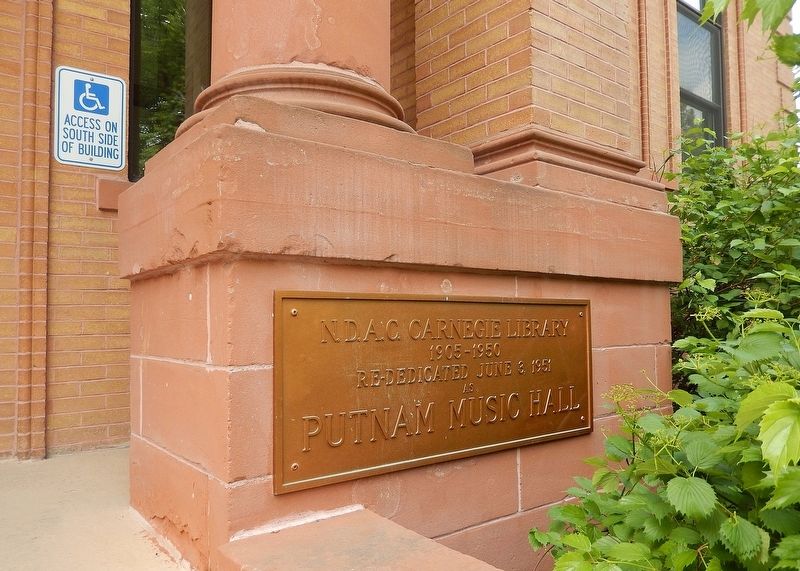
N.D.A.C. Carnegie Library
1905-1950
Photographed by Cosmos Mariner, June 27, 2024
1. N.D.A.C. Carnegie Library Marker
as
Putnam Music Hall
Topics and series. This historical marker is listed in these topic lists: Architecture • Charity & Public Work • Education • Notable Buildings. In addition, it is included in the Carnegie Libraries, and the National Register of Historic Places (NRHP) series lists. A significant historical year for this entry is 1905.
Location. 46° 53.462′ N, 96° 48.032′ W. Marker is in Fargo, North Dakota, in Cass County. It is in North Dakota State University. It can be reached from 12th Avenue North (State Highway 294) just west of College Street, on the right when traveling west. The marker is on the right side of the Putnam Hall north/front entrance. Touch for map. Marker is at or near this postal address: 1349 12th Avenue North, Fargo ND 58102, United States of America. Touch for directions.

Regionally, this marker is in North Dakota’s Red River Valley. It is also in the American Lewis & Clark Corridor, on the prairies, and on the Northern Plains. Globally, it is in North America, the Western Hemisphere, the Western World, and the Anglosphere. Historically, it
this page online
Other nearby markers. At least 8 other markers are within walking distance of this marker: Minard Hall (about 500 feet away, measured in a direct line); Churchill Residence Hall (approx. 0.2 miles away); First Lutheran Church & Cathedral of St. Mary (approx. 0.9 miles away); The Ford Building (approx. 0.9 miles away); Ford Building & BNSF Railroad (approx. 0.9 miles away); ROCO & Powers Hotel (approx. one mile away); Eddie and Hildegarde Kraus (approx. one mile away); Theaters of Fargo (approx. one mile away). Touch for a list and map of all markers in Fargo.
Regarding N.D.A.C. Carnegie Library. Contributing property, North Dakota State University District, National Register of Historic Places № 86003261.
From the National Register Nomination prepared by Norene A. Roberts, 11/5/1982:
The North Dakota State University Historic District comprises a large portion of the original 1891 campus. The district contains a concentration of examples of the work of Fargo's finest practicing architects between the years 1890 and 1949. The work of William C.Albrant, the Hancock Brothers, Milton Earl Beebe, Orff and Joralemon, and William F. Kurke can be found scattered from Montana to Minnesota but is nowhere concentrated altogether as at the North Dakota State University campus. In addition, these campus buildings are associated with the University's achievements in education, research, and agricultural science, the effects of which were felt far beyond the Red River Valley.Photographed by Cosmos Mariner, June 27, 20242. N.D.A.C. Carnegie Library MarkerThe marker is on the base of the column on the right side of the Putnam Hall north/front/main entrance.
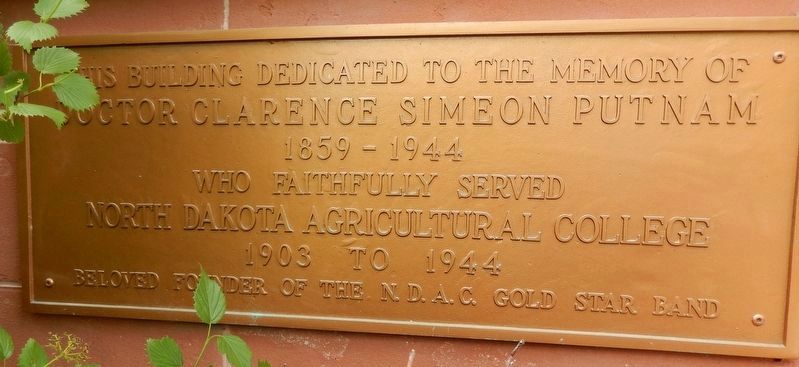
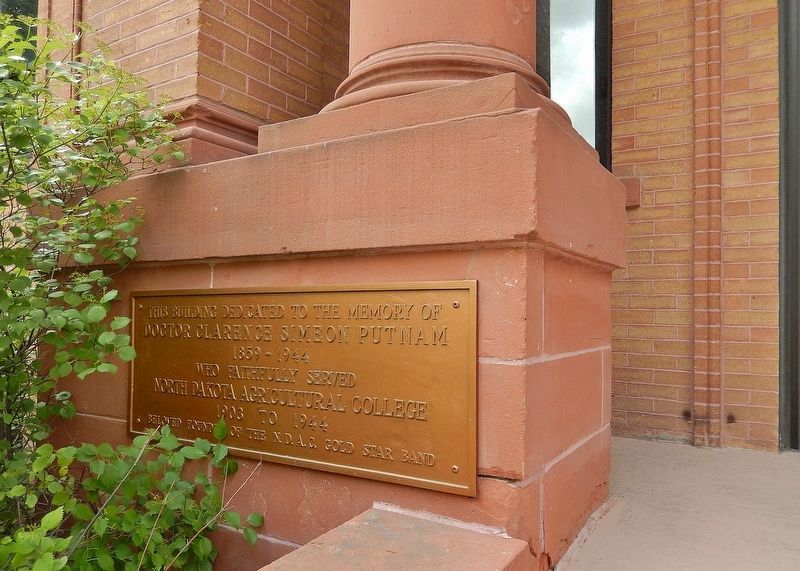
North Dakota achieved statehood in 1889. Anxious to take advantage of the 1862 Morrill Act, supplemented by the Hatch Act of 1887 and the second Morrill Act of 1890, the state legislature established a people’s college and experiment station for the sons and daughters of North Dakota farmers at Fargo in 1890. During the 1890 academic year, the new Agricultural College took up quarters in the basement of a building at Fargo College, a congregational institution, operated since 1882. Meanwhile, the Board of Trustees located the campus on Section 36, Fargo township. The land was poorly drained prairie a mile and a half northwest of the Fargo business district. Erection of College Hall, now “Old Main,” began on April18, 1891, with a state appropriation of $25,000.Photographed by Cosmos Mariner, June 27, 20243. Clarence Simeon Putnam MarkerThis building dedicated to the memory of
Doctor Clarence Simeon Putnam
1859-1944
who faithfully served
North Dakota Agricultural College
1903-1944
Beloved founder of the N.D.A.C. Gold Star Band
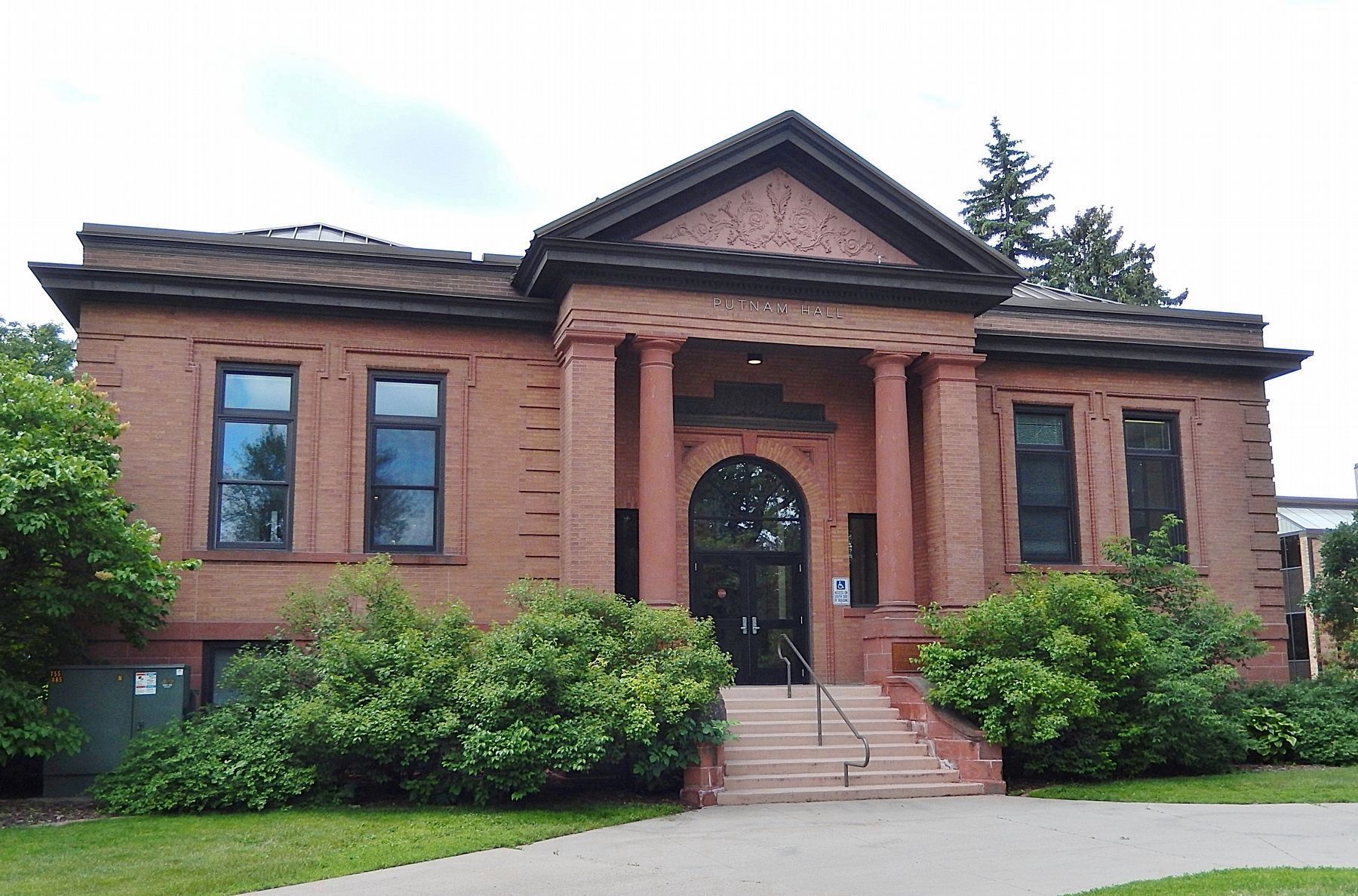
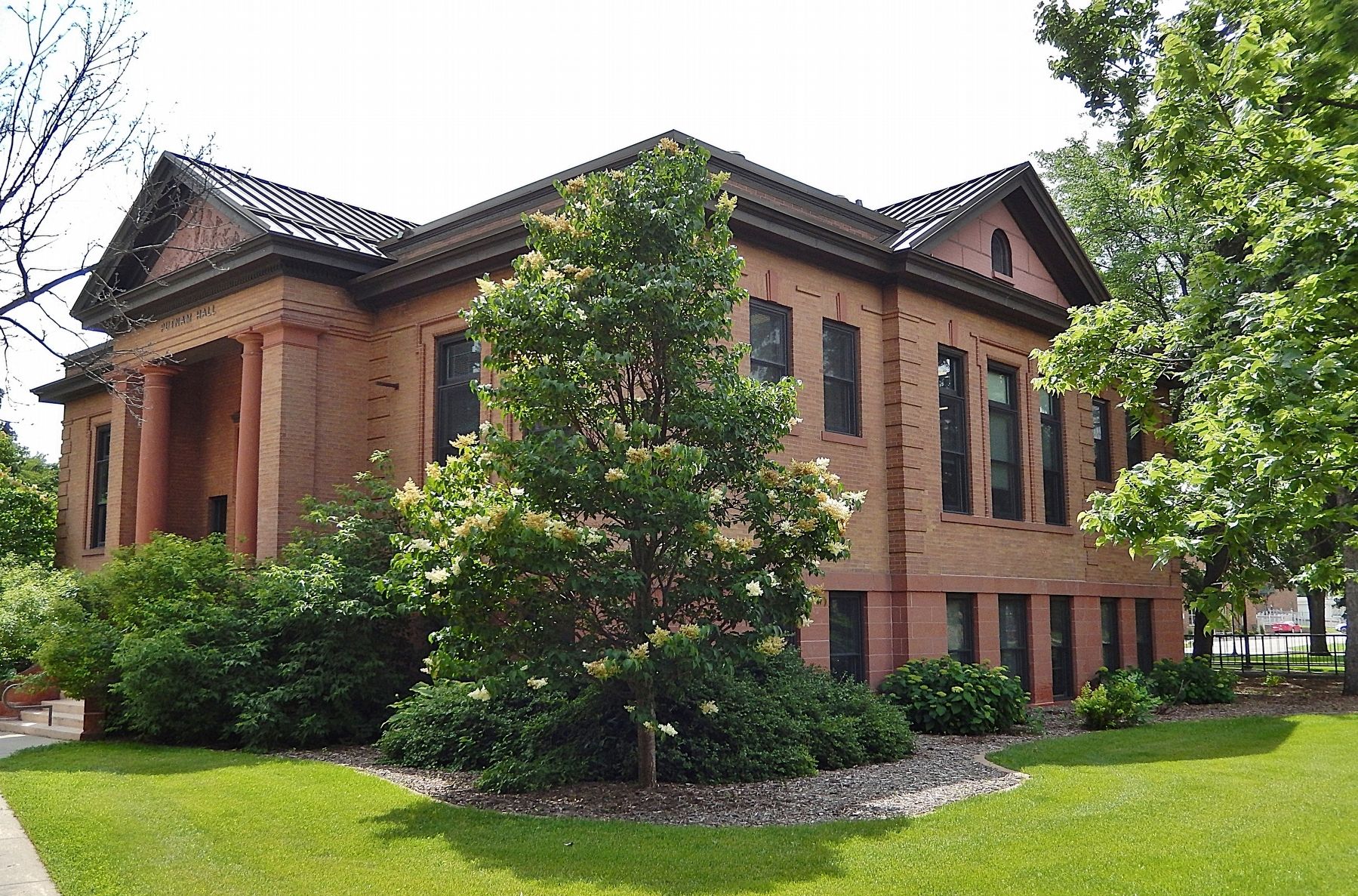
When the faculty and student body moved into College Hall on January 1, 1892, the new building housed all the instruction, faculty, and students under one roof. As mandated by state and federal laws, the courses of instruction were threefold: (1) a course in common school subjects and agriculture for working farm students; (2) a preparatory course for students desiring to eventually enter the regular four year course of study; and (3) a regular four year course of study in liberal arts with an emphasis on agriculture and mechanic arts. As with most of the land grant institutions in the new states of the west, the faculty, of necessity, concentrated on pre-college instruction in the early years. A wave of building construction on the campus followed the construction of Old Main.Carnegie Library — Putnam Hall (1904-05): Classical Revival, built on a Greek Cross plan, one story above raised basement of yellow brick, brick corner quoining, and sandstone trim. Windows on sides and rear have jack-arched lintels and keystones. Roof is surmounted by a small cupola; north facing entry uses sandstone
Tuscan column distyle in antis. Metal cornice is heavily dentilled around pedimented gables. William C. Albrant, architect.Photographed by Cosmos Mariner, June 27, 20244. Clarence Simeon Putnam MarkerThe marker is on the base of the column on the left side of the Putnam Hall north/front/main entrance.
Also see . . .
1. Putnam Hall (North Dakota State University).
Excerpt: Putnam Hall (Carnegie Library) had its beginnings in 1903 when B. F. Spalding, Representative at Large for North Dakota, wrote to Andrew Carnegie requesting $35,000 to $40,000 to build a library and chapel for the North Dakota Agricultural College (NDAC). James Bentram, Carnegie's private secretary, responded saying that Carnegie was not dealing with colleges at this time but the letter would be kept for later reference. President Worst, NDAC President, wrote to Carnegie on 2 February 1904 requesting $50,000 for a library and chapel that could seat 1,000 students on the second floor and have the first floor devoted to the library. Bentram responded positively about the library and inquired about other buildings on campus, the amount of money spent on upkeep of the current library, the number of students enrolled on the 14th of December for the last three years, and the needs of the students and faculty. The letter included(Submitted on December 14, 2025, by Cosmos Mariner of Cape Canaveral, Florida.)a postscript saying that a chapel would not be considered by Carnegie.Photographed by Cosmos Mariner, June 27, 20245. Putnam Hall — North Dakota Agricultural College Carnegie Library (north/front elevation)The historical marker is partially visible on the base of the column at the right side of the staircase.
2. Putnam Hall (Prairie Public Newsroom).
(by Lane Sunwall) Excerpt: School supporters hoped to secure funds for both a library and chapel at the North Dakota Agricultural College, but Carnegie repeatedly refused their requests. The school was undeterred, and Carnegie eventually relented; granting the North Dakota Agricultural College $15,000 for a new building. The College wasted little time getting the project moving, and on June 7, 1905, within a few months of receiving funds, laid the building's cornerstone.(Submitted on December 14, 2025, by Cosmos Mariner of Cape Canaveral, Florida.)
3. Putnam Hall (Carnegie Library) (Society of Architectural Historians).
(by Steve C. Martens and Ronald H. L. M. Ramsay) Excerpt: NDSU’s former Carnegie Library, known for many years as Putnam Hall after music director Clarence S. “Doc” Putnam, is another product of the brief architectural career of William C. Albrant. The Classical Revival, cross-plan brick building is(Submitted on December 14, 2025, by Cosmos Mariner of Cape Canaveral, Florida.)on a foundation of dressed sandstone. The entrance has sandstone Tuscan columns. The building concludes with a heavily dentiled cornice around pedimented gables and the roof is surmounted by a small cupola. Entrance from the north was originally emphasized by an ornamental pond and landscape plantings. The building is clearly too small to serve the needs of a modern university research library, but it continues to contribute in many significant ways to the character and perception of the historic campus.Photographed by Cosmos Mariner, June 27, 20246. Putnam Hall — North Dakota Agricultural College Carnegie Library (northwest elevation)
4. North Dakota State University District (Wikipedia).
Excerpt: North Dakota State University District is a 36-acre historic district on the campus of North Dakota State University, in Fargo, North Dakota, that was listed on the National Register of Historic Places in 1986. Also known as North Dakota Agricultural College, it was built in Late 19th and 20th Century Revivals, Moderne, and Late Victorian architectural styles.(Submitted on December 14, 2025, by Cosmos Mariner of Cape Canaveral, Florida.)
Credits. This page was last revised on December 14, 2025. It was originally submitted on December 12, 2025, by Cosmos Mariner of Cape Canaveral, Florida. This page has been viewed 76 times since then and 40 times this year. Photos: 1, 2, 3, 4, 5, 6. submitted on December 13, 2025, by Cosmos Mariner of Cape Canaveral, Florida.
