
Sainte-Mère-Église in Manche, Normandy, France — Western Europe
Symbole du Jour J/ Symbol of D-Day
Photographed by James Hulse, June 3, 2025
1. Symbole du Jour J/ Symbol of D-Day Marker

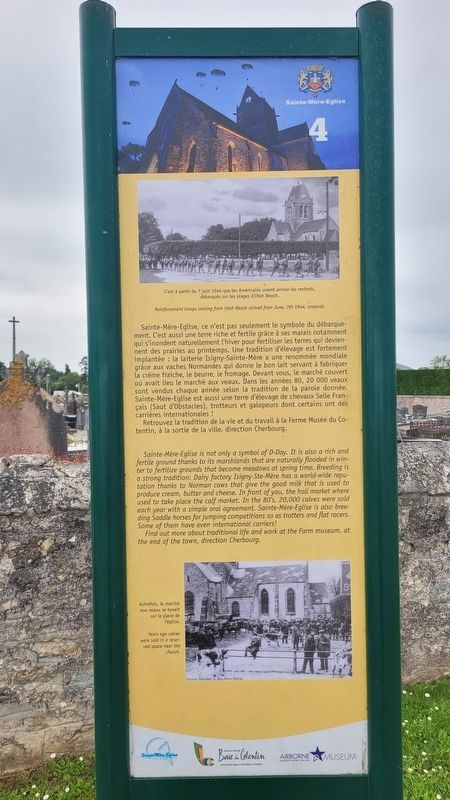
Sainte-Mère-Eglise, ce n'est pas seulement le symbole du débarquement. C'est aussi une terre riche et fertile grâce à ses marais notamment qui s'inondent naturellement l'hiver pour fertiliser les terres qui deviennent des prairies au printemps. Une tradition d'élevage est fortement implantée: la laiterie Isigny-Sainte-Mère a une renommée mondiale grâce aux vaches Normandes qui donne le bon lait servant à fabriquer la crème fraîche, le beurre, le fromage. Devant vous, le marché couvert où avait lieu le marché aux veaux. Dans les années 80, 20 000 veaux sont vendus chaque année selon la tradition de la parole donnée. Sainte-Mère-Eglise est aussi une terre d'élevage de chevaux Selle Français (Saut d'Obstacles), trotteurs et galopeurs dont certains ont des carrières internationales!
Retrouvez la tradition de la vie et du travail à la Ferme Musée du Cotentin, à la sortie de la ville, direction Cherbourg.
Légendes
(Photo #1) C'est à partir du 7 juin 1944 que les Américains voient arriver les renforts, débarqués sur les plages d'Utah Beach.
(Photo #2) Autrefois, le marché aux veaux se tenait sur la place de l'église.
Sainte-Mère-Eglise is not only a symbol of D-Day. It is also a rich and fertile ground thanks to its marshlands that are naturally flooded in winter to fertilize grounds that become meadows at spring time. Breeding is a strong tradition: Dairy factory Isigny-Ste-Mère has a world-wide reputation thanks to Norman cows that give the good milk that is used to produce cream, butter and cheese. In front of you, the hall market where used to take place the calf market. In the 80's, 20,000 calves were sold each year with a simple oral agreement. Sainte-Mère-Eglise is also breeding Saddle horses for jumping competitions so as trotters and flat racers.
Some of them have
this page online
Captions
(Photo #1) Reinforcement troops coming from Utah Beach arrived from June, 7th 1944, onwards.
(Photo #2) Years ago calves were sold in a reserved space near the church.
Erected by Sainte Mère Eglise, Baie du Cotentin and Airborne Museum Sainte-Mère-Eglise. (Marker Number 4.)
Topics. This historical marker is listed in this topic list: War, World II. A significant historical date for this entry is June 7, 1944.
Location. 49° 24.544′ N, 1° 18.824′ W. Marker is in Sainte-Mère-Église, Normandie (Normandy), in Manche. It is on Rue de la Liberté just east of Rue Eisenhower, on the left when traveling west. The marker is located along the street and cemetery on the sidewalk. Touch for map. Marker is in this post office area: Sainte-Mère-Église, Normandie 50480, France. Touch for directions.

Regionally, it is in the North Atlantic Region, Europe, the European Union, Atlantic Europe, the Schengen Area, Western Europe, a coastal Mediterranean country, and the Western World. Historically,
Photographed by James Hulse, June 3, 2025
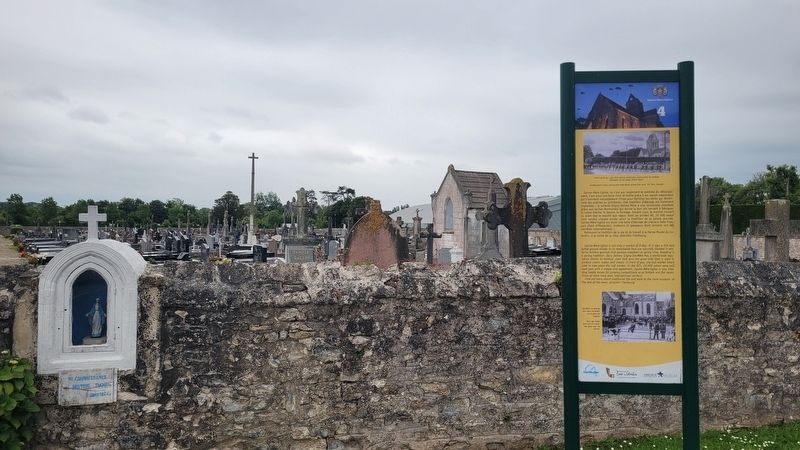
2. Symbole du Jour J/ Symbol of D-Day Marker
Other nearby markers. At least 8 other markers are within walking distance of this marker: Aux morts pour la Patrie / To the fallen for the Fatherland (a few steps from this marker); Les Cimetières Provisoires / Temporary Cemeteries (within shouting distance of this marker); Un bourg aux matériaux de construction contrastés (within shouting distance of this marker); Truck Cargo 6×6 CCKW 353 (about 90 meters away, measured in a direct line); House on Fire at Sainte-Mère-Église (about 120 meters away); M4A4 Sherman (about 120 meters away); A Tous Les Français / To all French People (about 120 meters away); 88 mm FLAK 18-36-37-41 (about 150 meters away). Touch for a list and map of all markers in Sainte-Mère-Église.
Photographed by James Hulse, June 3, 2025
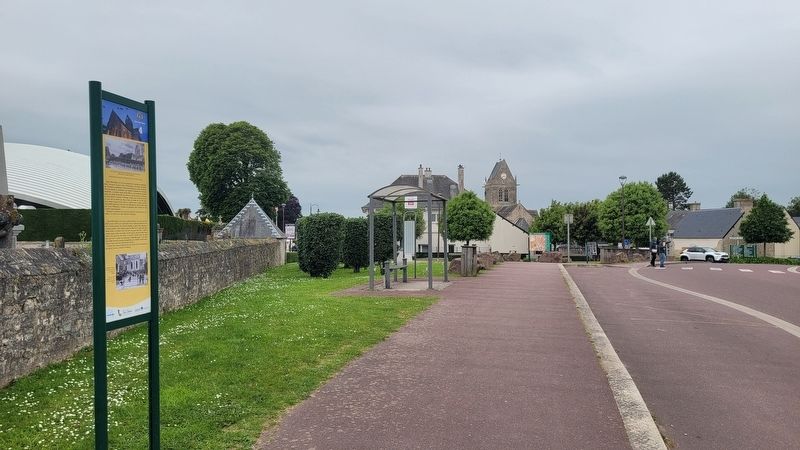
3. The view of the marker along the street
Credits. This page was last revised on December 13, 2025. It was originally submitted on December 12, 2025, by James Hulse of Medina, Texas. This page has been viewed 45 times since then and 14 times this year. Photos: 1, 2, 3. submitted on December 13, 2025, by James Hulse of Medina, Texas.
