
Sainte-Mère-Église in Manche, Normandy, France — Western Europe
88 mm FLAK 18-36-37-41
Photographed by James Hulse, June 3, 2025
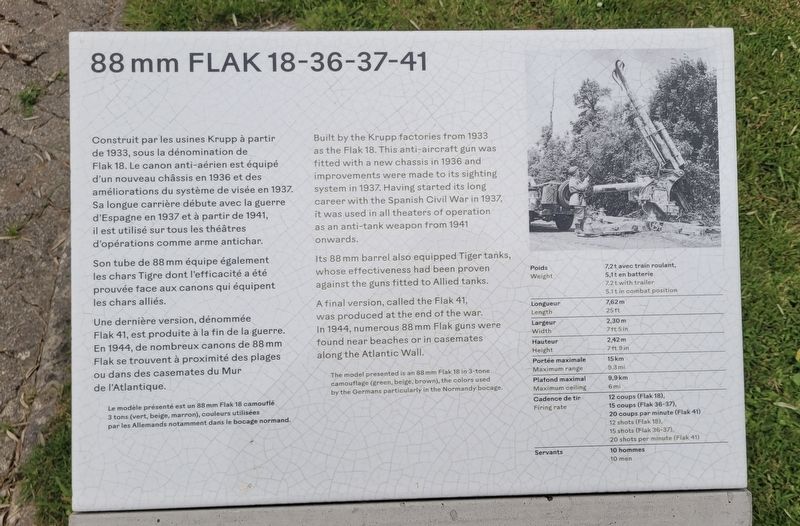
1. 88 mm FLAK 18-36-37-41 Marker

Construit par les usines Krupp à partir de 1933, sous la dénomination de Flak 18. Le canon anti-aérien est équipé d'un nouveau châssis en 1936 et des améliorations du système de visée en 1937. Sa longue carrière débute avec la guerre d'Espagne en 1937 et à partir de 1941, il est utilisé sur tous les théâtres d'opérations comme arme antichar.
Son tube de 88 mm équipe également les chars Tigre dont l'efficacité a été prouvée face aux canons qui équipent les chars alliés.
Une dernière version, dénommée Flak 41, est produite à la fin de la guerre. En 1944, de nombreux canons de 88 mm Flak se trouvent à proximité des plages ou dans des casemates du Mur de l'Atlantique.
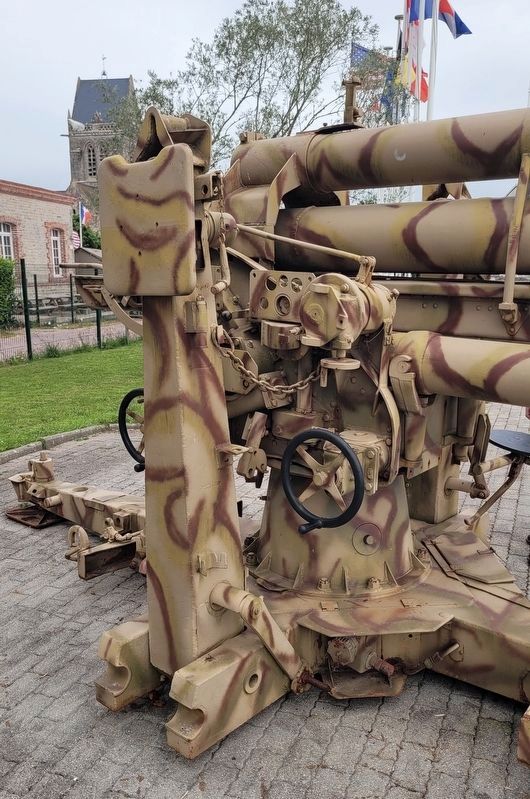
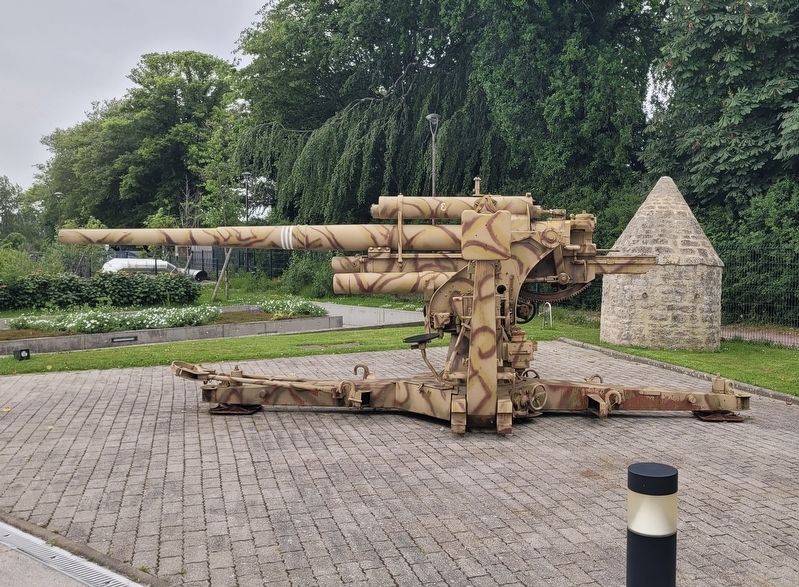
Le modèle présenté est un 88 mm Flak 18 camouflé 3 tons (vert, beige, marron), couleurs utilisées par les Allemands notamment dans le bocage normand.
Poids - 7,2 t avec train roulant, 5,1 t en batterie
Longueur - 7,62 m
Largeur - 2,30 m
Hauteur - 2,42 m
Portée maximale - 15 km
Plafond maximal - 9,9 km
Cadence de tir - 12 coups (Flak 18), 15 coups (Flak 36-37), 20 coups par minute (Flak 41)
Servants - 10 hommes
Built
this page online
Its 88 mm barrel also equipped Tiger tanks, whose effectiveness had been proven against the guns fitted to Allied tanks.
A final version, called the Flak 41, was produced at the end of the war. In 1944, numerous 88 mm Flak guns were found near beaches or in casemates along the Atlantic Wall.
The model presented is an 88 mm Flak 18 in 3-tone. camouflage (green, beige, brown), the colors used by the Germans particularly in the Normandy bocage.
Weight - 7.2 t with trailer, 5.1 t in combat position
Length - 25 ft
Width - 7ft 5 in
Height - 7 ft 9 in
Maximum range - 9.3 mi
Maximum ceiling - 6 mi
Firing rate - 12 shots (Flak 18), 15 shots (Flak 36-37), 20 shots per minute (Flak 41)
Servants - 10 hommes
Erected by Airborne Museum.
Topics. This historical marker is listed in this topic list: War, World II. A significant historical year for this entry is 1933.
Location. 49° 24.493′ N,
Photographed by James Hulse, June 3, 2025
2. Closeup view of 88 mm FLAK 18-36-37-41

Regionally, it is in the North Atlantic Region, Europe, the European Union, Atlantic Europe, the Schengen Area, Western Europe, a coastal Mediterranean country, and the Western World. Historically, it finds itself in what was once a French colony and also the Roman Empire.
Other nearby markers. At least 8 other markers are within walking distance of this marker: M4A4 Sherman (here, next to this marker); A Tous Les Français / To all French People (a few steps from this marker); House on Fire at Sainte-Mère-Église (within shouting distance of this marker); Truck Cargo 6×6 CCKW 353 (within shouting distance of this marker); 90 mm Anti Aircraft Gun M1 (within shouting distance of this marker); General Dwight D. Eisenhower (within shouting
Photographed by James Hulse, June 3, 2025
3. 88 mm FLAK 18-36-37-41
More about this marker. The markers and static displays are located on the grounds of the Airborne Museum and a small entrance fee is required to enter.
Also see . . . 8.8 cm Flak 18/36/37/41. Wikipedia
The 8.8 cm Flak 18/36/37/41 is a German 88 mm anti-aircraft and anti-tank artillery gun, developed in the 1930s. It was widely used by Nazi Germany throughout World War II and is one of the most recognized German weapons of the conflict. The gun was universally known as the Acht-acht ("eight-eight") by the Germans and the "eighty-eight" by the Allies. Due to its lethality, especially as a tank killer, the eighty-eight was greatly feared by Allied soldiers.(Submitted on December 13, 2025, by James Hulse of Medina, Texas.)
Credits. This page was last revised on December 13, 2025. It was originally submitted on December 12, 2025, by James Hulse of Medina, Texas. This page has been viewed 107 times since then and 63 times this year. Photos: 1, 2, 3. submitted on December 13, 2025, by James Hulse of Medina, Texas.
