
Sainte-Mère-Église in Manche, Normandy, France — Western Europe
Truck Cargo 6×6 CCKW 353

Photographed by James Hulse, June 3, 2025
1. Truck Cargo 6×6 CCKW 353 Marker

Au début de la guerre, la General Motors Corporation Yellow Truck & Manufacturing Co. de Pontiac dans le Michigan lance la production du camion GMC cargo 6x6 2½ ton. Deux versions sont produites: le CCKW 352 à châssis court et le CCKW 353 à châssis standard. Certains modèles sont équipés d'un treuil et d'une mitrailleuse et servent aux transports de troupes, camion-citerne, camion atelier...
En 1943, afin d'économiser l'acier, la cabine fermée est remplacée par une cabine ouverte bâchée.
Robuste et fiable, d'une conduite agréable, le GMC a notamment équipé l'armée française et de nombreuses entreprises civiles à l'issue de la Seconde Guerre mondiale.
Le modèle présenté est un GMC CCKW 353 de 1942 aux couleurs du 66th Armored Field Artillery Battalion de la 4th Armored Division.
Production - 572 500 exemplaires
Longueur - 6,86 m
Largeur - 2,24 m
Hauteur - 2,77 m
Poids à vide - 4,5 t
Motorisation - 6 cylindres en ligne, 4,4 L essence, 102 CV à 2750 tr/min, boite manuelle 5 rapports
Vitesse - 75 km/h sur route
Consommation - 40 L/100 km
At the beginning of the war, General
this page online
In 1943, to save steel, the closed cab was replaced by a tarpaulin-covered open cab.
Robust, reliable and easy to drive, the GMC equipped the French army as well as many civilian companies after World War II.
The model presented here is a 1942 GMC CCKW 353 with the colors of the 66th Armored Field Artillery Battalion of the 4th Armored Division.
Production - 572,500 units
Length - 22 ft 5 in
Width - 7 ft 3 in
Height - 9 ft
Weight - 4.5 t
Motorization - 6-cylinder, 4.4 L gasoline engine, 102 hp at 2750 rpm, 5-speed manual gearbox
Speed - 45 mph on road
Consumption - 5.8 mi/gal
Erected by Airborne Museum.
Topics. This historical marker is listed in this topic list: War, World II. A significant historical year for this entry is 1943.
Location. 49° 24.509′ N, 1° 18.884′ W. Marker

Photographed by James Hulse, June 3, 2025
2. Truck Cargo 6×6 CCKW 353 and Marker

Regionally, it is in the North Atlantic Region, Europe, the European Union, Atlantic Europe, the Schengen Area, Western Europe, a coastal Mediterranean country, and the Western World. Historically, it finds itself in what was once a French colony and also the Roman Empire.
Other nearby markers. At least 8 other markers are within walking distance of this marker: House on Fire at Sainte-Mère-Église (a few steps from this marker); M4A4 Sherman (within shouting distance of this marker); A Tous Les Français / To all French People (within shouting distance of this marker); 88 mm FLAK 18-36-37-41 (within shouting distance of this marker); Un bourg aux matériaux de construction contrastés (within shouting distance of this marker); Les Cimetières Provisoires / Temporary Cemeteries (within shouting distance
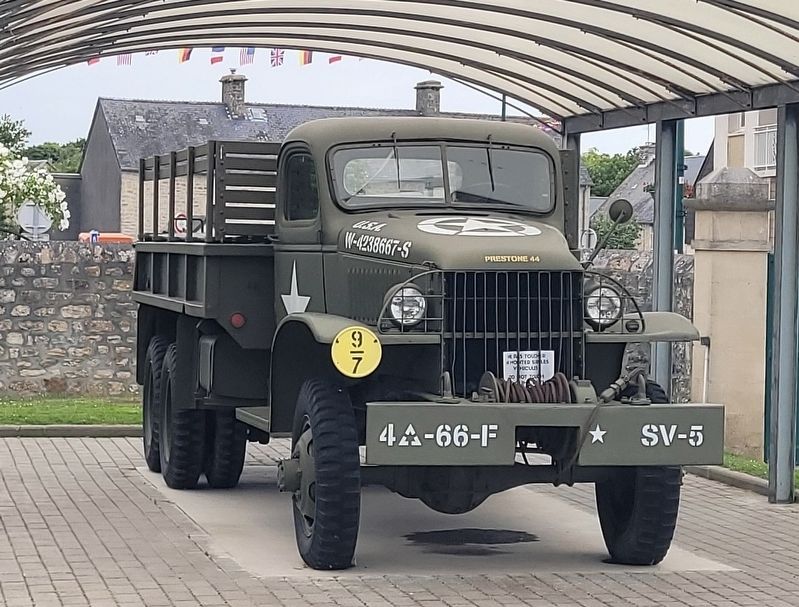
Photographed by James Hulse, June 3, 2025
3. Truck Cargo 6×6 CCKW 353
More about this marker. The markers and static displays are located on the grounds of the Airborne Museum and a small entrance fee is required to enter.
Also see . . . GMC CCKW 2½-ton 6×6 truck. Wikipedia
The GMC CCKW, also known as "Jimmy", or the G-508 by its Ordnance Supply Catalog number, was a highly successful series of off-road capable, 2 1⁄2-ton, 6×6 trucks, built in large numbers to a standardized design (from 1941 to 1945) for the U.S. Army, that saw heavy service, predominantly as cargo trucks, in both World War II and the Korean War. The original "Deuce and a Half", it formed the backbone of the Red Ball Express that kept Allied armies supplied as they pushed eastward after the Normandy invasion.(Submitted on December 13, 2025, by James Hulse of Medina, Texas.)
Credits. This page was last revised on December 13, 2025. It was originally submitted on December 12, 2025, by James Hulse of Medina, Texas. This page has been viewed 62 times since then and 29 times this year. Photos: 1, 2, 3. submitted on December 13, 2025, by James Hulse of Medina, Texas.
