
Sainte-Mère-Église in Manche, Normandy, France — Western Europe
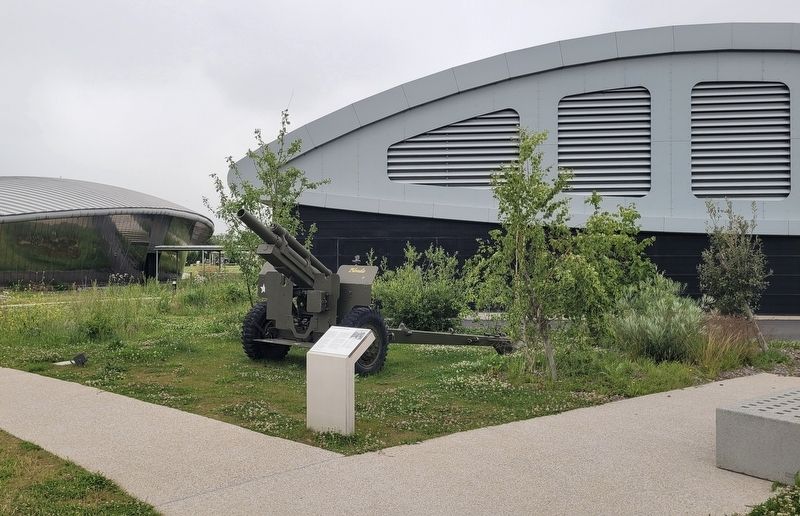
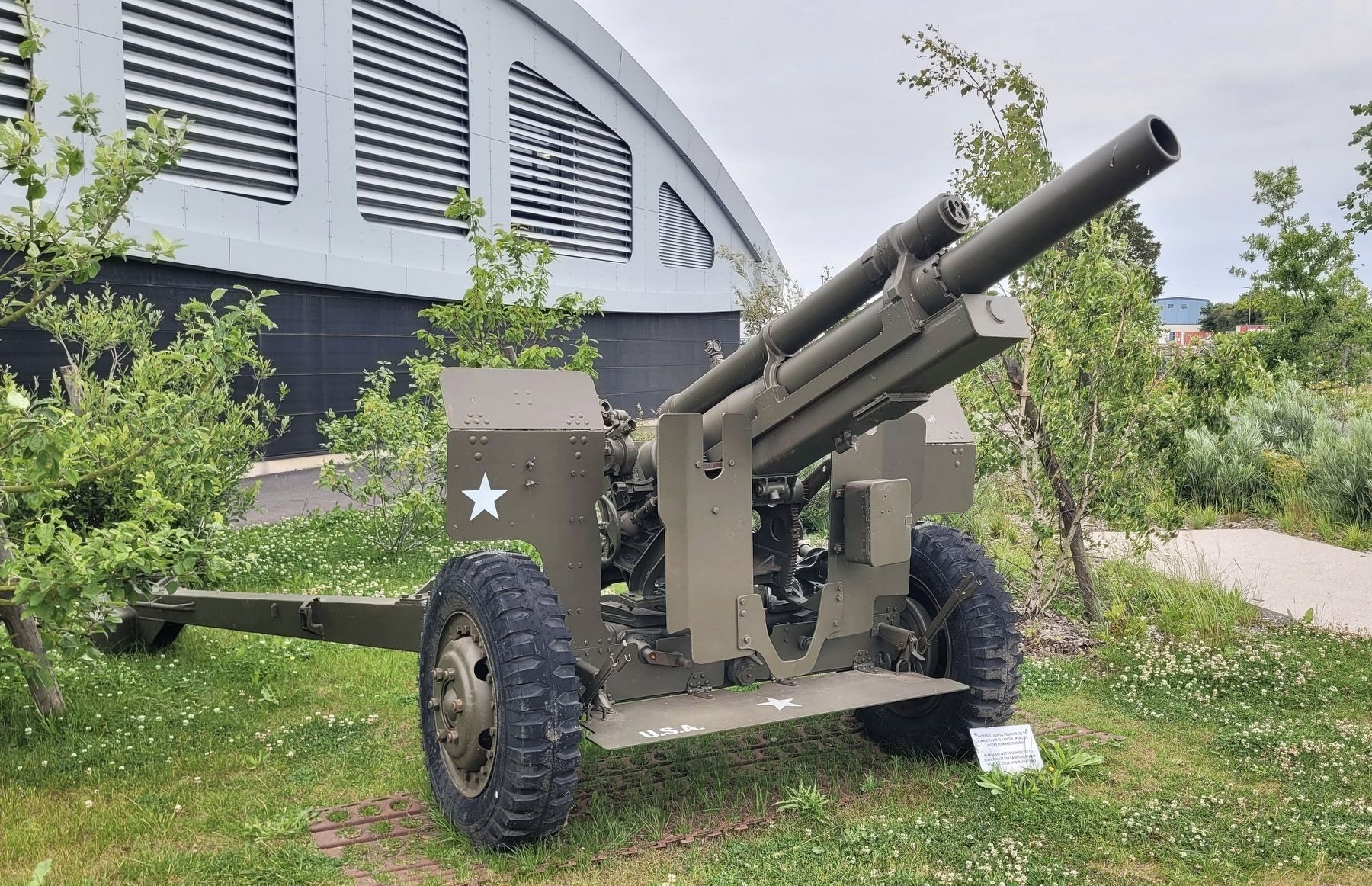
105 mm Howitzer M2

Photographed by James Hulse, June 3, 2025
1. 105 mm Howitzer M2 Marker

En 1917, faute de pièces d'artillerie performantes, les Américains utilisent des canons français et anglais. À l'issue de la Première Guerre mondiale, les USA créent une instance qui permet le développement et l'amélioration des futurs matériels de l'artillerie qui préconise la mise en service de nouveaux obusiers, dont un 105 mm destiné au soutien de l'infanterie et à la destruction d'ouvrages légers de campagne.
Si les plans sont prêts en 1928, il faut attendre 1939 pour que les premiers exemplaires sortent des ateliers de Rock Island Arsenal dans l'Illinois. Mis en service en 1940, l'obusier de 105 mm est généralement tracté par un camion GMC puis mis en batterie avec 4 à 6 autres canons.
Le 105 mm Howitzer M2 est utilisé en masse sur tous les fronts pendant la Seconde Guerre mondiale. Produit jusqu'en 1953, il est utilisé par plus de 50 pays, dont la France jusqu'à la fin des années 1990.
Le modèle présenté est un 105 mm M2A1 de 1944 aux couleurs du 915th Field Artillery Battalion.
Production - 10 202 exemplaires
Poids - 2,36 t
Longueur - 5,94 m
Largeur - 2,31 m
Hauteur - 1,73 m
Portée maximum - 11,3 km
Cadence de tir - supérieur à 10 coups/mn
Servants - 8 hommes
In
this page online
Although plans were ready in 1928, it wasn't until 1939 that the first models rolled off the production line at the Rock Island Arsenal in Illinois. Commissioned in 1940, the 105 mm howitzer was usually towed by a GMC truck, then placed in battery with 4 to 6 other guns.
The 105 mm Howitzer M2 was used on all fronts during World War II. Produced until 1953, it was used by over 50 countries, including France until the late 1990s.
The model presented here is a 1944 105 mm M2A1 with the colors of the 915th Field Artillery Battalion.
Production - 10,202 units
Weight - 2.36 t
Length - 19 ft 4 in
Width - 7ft 6 in
Height - 5 ft 6 in
Maximum range - 7 mi
Firing rate - more than 10 shots/min
Crew - 8 men
Erected by Airborne Museum.
Topics. This historical marker is listed in this topic list:

Photographed by James Hulse, June 3, 2025
2. 105 mm Howitzer M2 and Marker
Location. 49° 24.468′ N, 1° 18.812′ W. Marker is in Sainte-Mère-Église, Normandie (Normandy), in Manche. It is on Rue Eisenhower just east of Rue Général de Gaulle. The marker is on the grounds of the museum. Touch for map. Marker is at or near this postal address: 14 Rue Eisenhower, Sainte-Mère-Église, Normandie 50480, France. Touch for directions.

Regionally, it is in the North Atlantic Region, Europe, the European Union, Atlantic Europe, the Schengen Area, Western Europe, a coastal Mediterranean country, and the Western World. Historically, it finds itself in what was once a French colony and also the Roman Empire.
Other nearby markers. At least 8 other markers are within walking distance of this marker: M16 Multiple Gun Motor Carriage (a few steps from this marker); M8 Light Armored Car (a few steps from this marker); Brigadier General Theodore Roosevelt Jr. (within shouting distance of this marker); 90 mm Anti Aircraft Gun M1 (within shouting distance of this marker); Truck Cargo 6×6 CCKW 353 (about 120 meters away, measured in a direct line); House on Fire at Sainte-Mère-Église
Photographed by James Hulse, June 3, 2025
3. 105 mm Howitzer M2 and Marker
More about this marker. The markers and static displays are located on the grounds of the Airborne Museum and a small entrance fee is required to enter.
Also see . . . M101 howitzer. Wikipedia
The M101A1 (previously designated Howitzer M2A2 on Carriage M2A2) howitzer is an artillery piece developed and used by the United States. It was the standard U.S. light field howitzer in World War II and saw action in both the European and Pacific theaters and during the Korean War. Entering production in 1941, it quickly gained a reputation for accuracy and a powerful punch. The M101A1 fires 105 mm high explosive (HE) semi-fixed ammunition and has a range of 12,330 yards (11,270 m) or 7 miles, making it suitable for supporting infantry.(Submitted on December 13, 2025, by James Hulse of Medina, Texas.)
Photographed by James Hulse, June 3, 2025
4. 105 mm Howitzer M2
Credits. This page was last revised on December 13, 2025. It was originally submitted on December 12, 2025, by James Hulse of Medina, Texas. This page has been viewed 48 times since then and 16 times this year. Photos: 1, 2, 3, 4. submitted on December 13, 2025, by James Hulse of Medina, Texas.
