Ocean Springs in Jackson County, Mississippi — The American South (East South Central)
Marble Springs
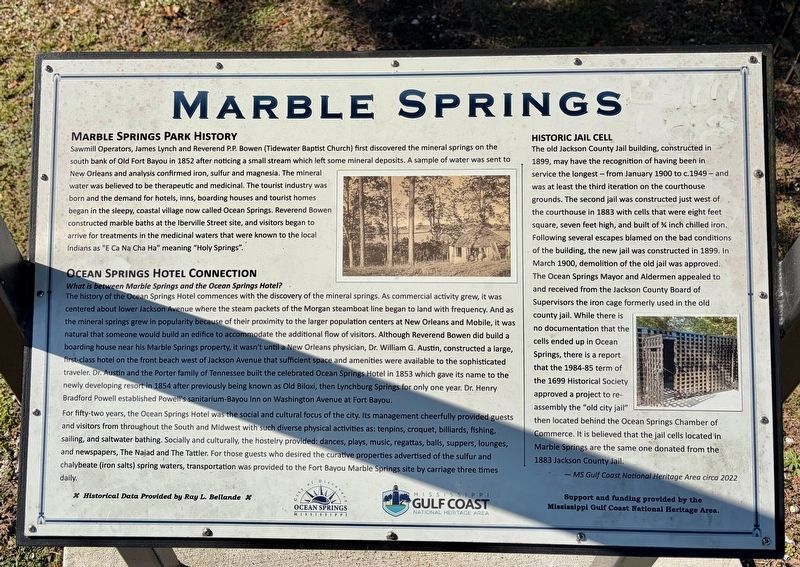
Photographed by Mark Hilton, December 10, 2025
1. Marble Springs Marker
Marble Springs Park History
Sawmill Operators, James Lynch and Reverend P.P. Bowen (Tidewater Baptist Church) first discovered the mineral springs on the south bank of Old Fort Bayou in 1852 after noticing a small stream which left some mineral deposits. A sample of water was sent to New Orleans and analysis confirmed iron, sulfur and magnesia. The mineral water was believed to be therapeutic and medicinal. The tourist industry was born and the demand for hotels, inns, boarding houses and tourist homes began in the sleepy, coastal village now called Ocean Springs. Reverend Bowen constructed marble baths at the Iberville Street site, and visitors began to arrive for treatments in the medicinal waters that were known to the local Indians as "E Ca Na Cha Ha" meaning "Holy Springs".
Ocean Springs Hotel Connection
What is between Marble Springs and the Ocean Springs Hotel?
The history of the Ocean Springs Hotel commences with the discovery of the mineral springs. As commercial activity grew, it was centered about lower Jackson Avenue where the steam packets of the Morgan steamboat line began to land with frequency.
this page online
For fifty-two years, the Ocean Springs Hotel was the social and cultural focus of the city. Its management cheerfully provided guests and visitors from throughout the South and Midwest with such diverse physical activities as: tenpins, croquet, billiards, fishing,
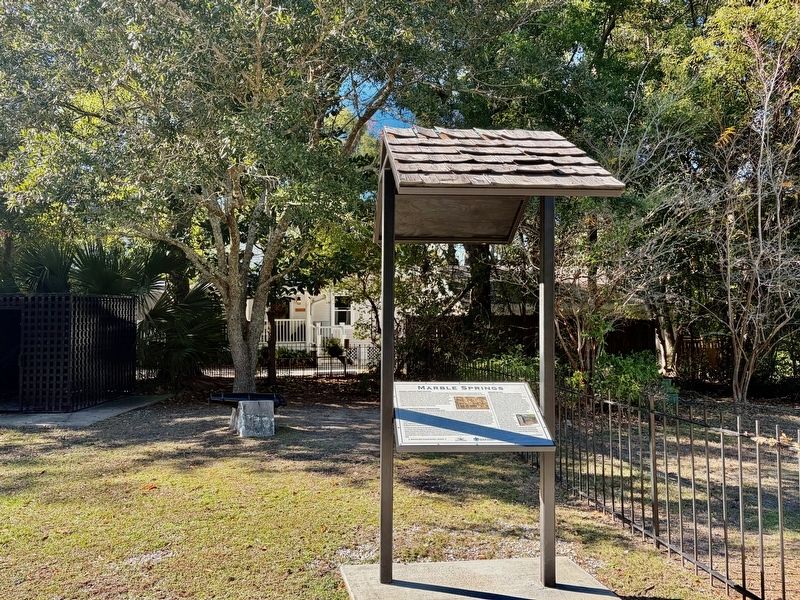
Photographed by Mark Hilton, December 10, 2025
2. Marble Springs Marker
Historic Jail Cell
The old Jackson County Jail building, constructed in 1899, may have the recognition of having been in service the longest - from January 1900 to c.1949 - and was at least the third iteration on the courthouse grounds. The second jail was constructed just west of the courthouse in 1883 with cells that were eight feet square, seven feet high, and built of 4 inch chilled iron. Following several escapes blamed on the bad conditions of the building, the new jail was constructed in 1899. In March 1900, demolition of the old jail was approved. The Ocean Springs Mayor and Aldermen appealed to and received from the Jackson County Board of Supervisors the iron cage formerly used in the old county jail. While there

Photographed by Mark Hilton, December 10, 2025
3. Jail cell mentioned on marker.
* Historical Data Provided by Ray L. Bellande *
-MS Gulf Coast National Heritage Area circa 2022
Support and funding provided by the Mississippi Gulf Coast National Heritage Area.
Erected 2023 by City of Ocean Springs, Mississippi Gulf Coast National Heritage Area.
Topics. This historical marker is listed in this topic list: Notable Places. A significant historical month for this entry is January 1900.
Location. 30° 25.065′ N, 88° 49.566′ W. Marker is in Ocean Springs, Mississippi, in Jackson County. It is on Iberville Drive east of Ames Avenue, on the left when traveling east. Touch for map. Marker is at or near this postal address: 1109 Iberville Dr, Ocean Springs MS 39564, United States of America. Touch for directions.

Regionally, this marker is in the American South, specifically in the Deep South, and on the Gulf Coast. Globally, it is in North America, a Gulf of Mexico state, the Western Hemisphere, the Western World, and the Anglosphere. Historically, it finds itself in what was once New Spain, the Viceroyalty of New France, the territory of the Mississippian Culture, one of the Confederate States of America, and the Antebellum South.
Other nearby markers. At least 8 other markers are within walking distance of this marker: A different marker also named Marble Springs (within shouting distance of this marker); Marble Springs Historic District (within shouting distance of this marker); The Indian Springs Historic District (approx. 0.2 miles away); The L & N Railroad Depot (approx. 0.2 miles away); L&N Depot (approx. 0.2 miles away); The Railroad Historic District (approx. 0.2 miles away); Marshall Park (approx. 0.2 miles away); Ocean Springs Blues (approx. 0.2 miles away). Touch for a list and map of all markers in Ocean Springs.
Related marker. Click here for another marker that is related to this marker. Another Marble Springs marker neaarby.
Credits. This page was last revised on December 15, 2025. It was originally submitted on December 15, 2025, by Mark Hilton of Montgomery, Alabama. This page has been viewed 120 times since then and 79 times this year. Photos: 1, 2, 3. submitted on December 15, 2025, by Mark Hilton of Montgomery, Alabama.
