
Sainte-Mère-Église in Manche, Normandy, France — Western Europe
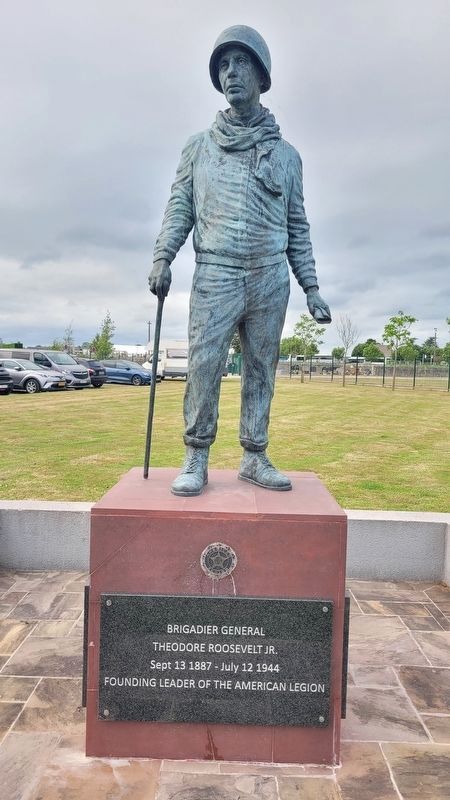
Brigadier General Theodore Roosevelt Jr.
Sept 13 1887 - July 12 1944
| — | Founding Leader of the American Legion | — |

Photographed by James Hulse, June 3, 2025
1. Brigadier General Theodore Roosevelt Jr. Marker
 At age 56, armed only with a pistol, the cane-waving general led terrified young soldiers across the sand, through heavy enemy fire. Eldest son of the 26th U.S. President, he could easily have avoided combat duty. He had to fight higher command for the opportunity to help liberate France and to "steady the men" on June 6, 1944.
His heart was always that of a soldier.
Shot and gassed in major World War I battles, Roosevelt Jr. earned the respect of officers and privates alike for his combat leadership in France.
At age 56, armed only with a pistol, the cane-waving general led terrified young soldiers across the sand, through heavy enemy fire. Eldest son of the 26th U.S. President, he could easily have avoided combat duty. He had to fight higher command for the opportunity to help liberate France and to "steady the men" on June 6, 1944.
His heart was always that of a soldier.
Shot and gassed in major World War I battles, Roosevelt Jr. earned the respect of officers and privates alike for his combat leadership in France."We'll start the war from here!"
Brig. Gen. Theodore Roosevelt Jr., the only general to come ashore in the first wave of D-Day, led a platoon from a Higgins Boat that was delivered nearly a mile from their targeted position on Utah Beach. That did not matter. He shouted to the men their change of plan.
Shortly after World War I, he inspired the March 1919 founding of The American Legion, on principles of freedom, justice and democracy for all. It grew to become the largest organization of wartime veterans in the United States. Roosevelt Jr. died of a heart attack in Normandy on July 12, 1944,
this page online
Consequently, Locust Valley, N.Y., near the boyhood home of Roosevelt Jr., later formed Operation Democracy, a grassroots effort to supplement the Marshall Plan, which founded the concept of sister cities with Sainte-Mère-Église. On Sept. 21, 1944, Roosevelt Jr. posthumously received the Medal of Honor for his bravery at Utah Beach on D-Day. His grave was later moved to the Normandy American Cemetery at Colleville sur Mer, where he rests today, among his beloved fellow soldiers.
Agé de 56 ans, le Général armé d'un seul pistolet et de sa canne conduisit les jeunes soldats terrifiés à travers la plage sous un feu ennemi nourri. Fils le plus agé du 26ème président Americain il aurait pu facilement être dispensé de se joindre aux combats. Il dut se démener auprès du commandement
Photographed by James Hulse, June 3, 2025
2. Closeup of Brigadier General Theodore Roosevelt Jr. statue
"Nous commencerons la guerre ici!"
Le Général Théodore Roosevelt Jr., le seul général à débarquer avec la première vague le Jour J, commandait une section qui aborda le rivage sur une barge Higgins à Utah Beach, à presque 2 kilomètres de l'endroit prévu. Il ne s'en soucia pas et annonça à ses hommes le changement de plans.
En mars 1919 il fut à l'origine de la création de l'Américan Légion sur des principes de liberté, justice et démocratie pour tous. L'American Légion devint la plus grande organisation de Vétérans aux États Unis. Le Général Roosevelt décéde d'une crise cardiaque le 12 juillet 1944. Il fut provisoirement enterré à Sainte-Mère-Église. Les Généraux George Patton et Omar Bradley firent partie des porteurs de son cercueil. Un mois plus tard, une photo parut dans LIFE magazine, celle de

Photographed by James Hulse, June 3, 2025
3. Brigadier General Theodore Roosevelt Jr. Marker - Front Right Side
Ensuite, Locust Valley, N.Y. 'proche de la maison d'enfance du Général, fonda Opération Democracy, groupement de volontaires pour épauler le Plan Marshall. Locust Valley est à l'origine de l'idée des villes jumelées avec Sainte-Mére-Église. Le 21 septembre 1944 le Général Roosevelt reçut à titre posthume, la Medal of Honor pour sa bravoure à Utah Beach le Jour J. Plus tard sa tombe fut transférée au cimetière Américain de Colleville sur Mer où il repose désormais parmi ses frères d'armes.
Erected 2023 by Statues of Liberation, Susan Eisenhower, Mayor Jean Quetier, Mayor Alain Holley, National Commander Vincent J. Troiola, Operation Democracy , City of Sainte Mere Eglise, Fedex, Stephen Lee, Sculptor Pablo Eduardo.
Topics. This memorial is listed in this topic list: War, World II. A significant historical month for this entry is March 1919.
Location. 49° 24.444′ N, 1° 18.764′ W. Memorial is in Sainte-Mère-Église, Normandie (Normandy),

Photographed by James Hulse, June 3, 2025
4. Brigadier General Theodore Roosevelt Jr. Marker - Front Left Side

Regionally, it is in the North Atlantic Region, Europe, the European Union, Atlantic Europe, the Schengen Area, Western Europe, a coastal Mediterranean country, and the Western World. Historically, it finds itself in what was once a French colony and also the Roman Empire.
Other nearby markers. At least 8 other markers are within walking distance of this marker: M8 Light Armored Car (within shouting distance of this marker); M16 Multiple Gun Motor Carriage (within shouting distance of this marker); 105 mm Howitzer M2 (within shouting distance of this marker); 90 mm Anti Aircraft Gun M1 (about 150 meters away, measured in a direct line); Truck Cargo 6×6 CCKW 353 (about 180 meters away); Aux morts pour la Patrie / To the fallen for the Fatherland (about 180 meters away); House on Fire at Sainte-Mère-Église (about 180 meters away);

Photographed by James Hulse, June 3, 2025
5. Brigadier General Theodore Roosevelt Jr. Marker - French Text

Photographed by James Hulse, June 3, 2025
6. Brigadier General Theodore Roosevelt Jr. Marker - French Text

Photographed by James Hulse, June 3, 2025
7. Brigadier General Theodore Roosevelt Jr. Marker - French Text

Photographed by James Hulse, June 3, 2025
8. Brigadier General Theodore Roosevelt Jr. Marker - French Text

Photographed by James Hulse, June 3, 2025
9. The view of the reverse side of the Brigadier General Theodore Roosevelt Jr. Memorial
Credits. This page was last revised on December 17, 2025. It was originally submitted on December 15, 2025, by James Hulse of Medina, Texas. This page has been viewed 78 times since then and 38 times this year. Photos: 1, 2, 3, 4, 5, 6, 7, 8, 9. submitted on December 17, 2025, by James Hulse of Medina, Texas.
