
Longues-sur-Mer in Calvados, Normandy, France — Western Europe
Sainte-Marie Abbey
Photographed by James Hulse, June 4, 2025
1. Sainte-Marie Abbey Marker
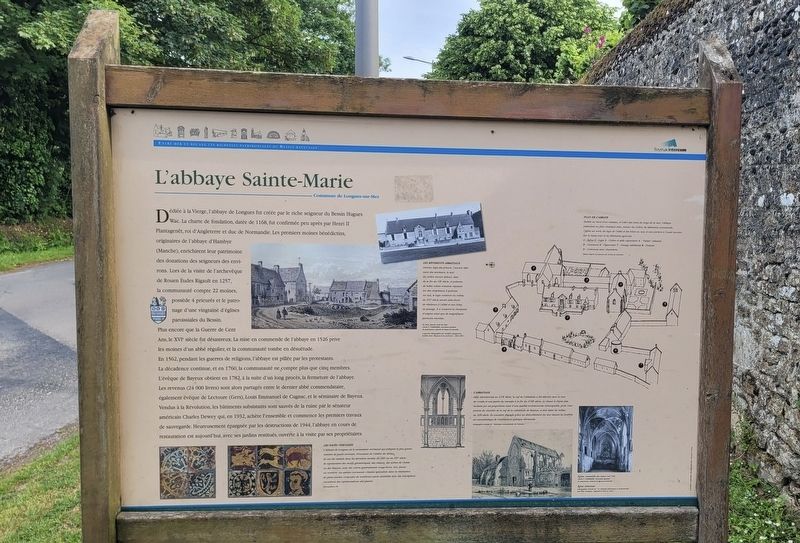
 Dédiée à la Vierge, l'abbaye de Longues fut créée par le riche seigneur du Bessin Hugues Wac. La charte de fondation, datée de 1168, fut confirmée peu après par Henri II Plantagenêt, roi d'Angleterre et duc de Normandie. Les premiers moines bénédictins, originaires de l'abbaye d'Hambye (Manche), enrichirent leur patrimoine des donations des seigneurs des environs. Lors de la visite de l'archevêque de Rouen Eudes Rigault en 1257, la communauté compte 22 moines, possède 4 prieurés et le patronage d'une vingtaine d'églises paroissiales du Bessin. Plus encore que la Guerre de Cent Ans, le XVIᵉ siècle fut désastreux. La mise en commende de l'abbaye en 1526 prive les moines d'un abbé régulier, et la communauté tombe en désuétude. En 1562, pendant les guerres de religions, l'abbaye est pillée par les protestants. La décadence continue, et en 1760, la communauté ne compte plus que cinq membres. L'évêque de Bayeux obtient en 1782, à la suite d'un long procès, la fermeture de l'abbaye. Les revenus (24 000 livres) sont alors partagés entre le dernier abbé commendataire, également évêque de Lectoure (Gers), Louis Emmanuel de Cugnac, et le séminaire
this page online
Légendes
(Photo #1) LES PAVÉS VERNISSÉS. L'abbaye de Longues est le monument normand qui présente le plus grand nombre de pavés vernissés. Provenant de l'atelier du Molay, ils ont été réalisés dans les dernières années du XIIIᵉ ou au XIVᵉ siècle. Ils représentent des motifs géométriques, des rosaces, des scènes de chasse ou des blasons, avec des coloris généralement rouge-brun, vert, jaune ou noirâtre. Les ateliers normands s'étaient spécialisés dans la réalisation de plates-tombes composées de nombreux pavés assemblés avec des inscriptions encadrant des représentations des gisants. Photographies DR
(Photo #2) LES BÂTIMENTS ABBATIAUX. Devenu logis des prieurs, l'ancien bâtiment des serviteurs, le seul du cloître encore debout, date de la fin du XIIᵉ siècle, et présente de belles voûtes romanes reposant sur des chapiteaux à godrons. Au sud, le logis construit au milieu du XIVᵉ siècle servait sans doute de résidence à l'abbé et aux hôtes
Photographed by James Hulse, June 4, 2025
2. Sainte-Marie Abbey Marker - Reverse Side
(Photo #3) L'ABBATIALE. Déjà abandonnée au XVIIᵉ siècle, la nef de l'abbatiale a été détruite avec la tour de croisée et une partie du transept à la fin du XVIIIᵉ siècle. Le chœur à chevet plat, modeste par ses proportions mais d'une qualité architecturale remarquable, porte l'empreinte du chantier de la nef de la cathédrale de Bayeux, et doit dater du milieu du XIIIe siècle. La coursière dégagée grâce au dédoublement du mur devant les fenêtres est caractéristique de l'architecture gothique normande. Lithographie extraite de "Statistique monumentale du Calvados".
(Photo #4) PLAN DE L'ABBAYE. Etablie au bord d'un ruisseau, à l'abri des vents du large de la mer, l'abbaye présentait un plan classique avec, autour du cloître, les bâtiments conventuels, l'église au nord, les logis de l'abbé et des hôtes au sud, et une porterie à l'ouest ouvrant sur la basse-cour et les bâtiments agricoles. 1- Eglise 2 - Logis 3 - Cloître et salle capitulaire 4 - "Palais" abbatial 5- Communs 6 - Pigeonnier 7 - Grange médiévale 8 - Porterie 9- Communs avec charetterie. Dessin
Photographed by James Hulse, June 4, 2025
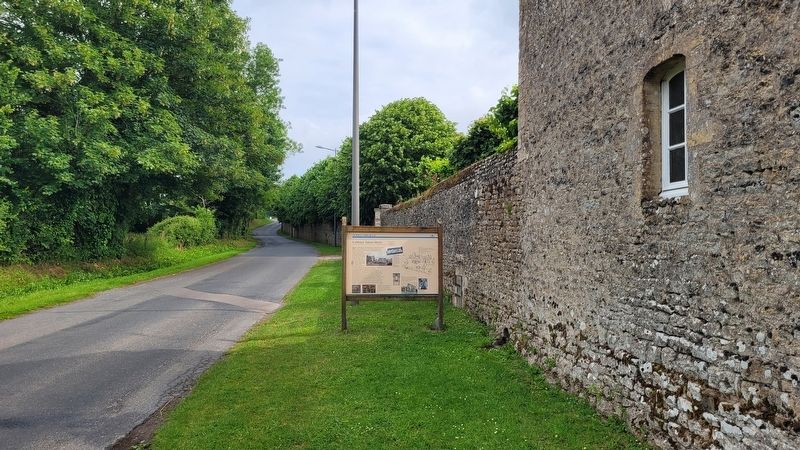
3. The view of the Sainte-Marie Abbey Marker along the street
(Photo #5) Église, ensemble du cœur ver l'est. Cliché P. CORBIERRE, Inventaire général du patrimoine culturel de Basse-normandie.
(Photo #6) Église abbatiale. Lithographie extraite de "Le Calvados pittoresque et monumental par Félix Thorigny., imprimé à Caen en 1847
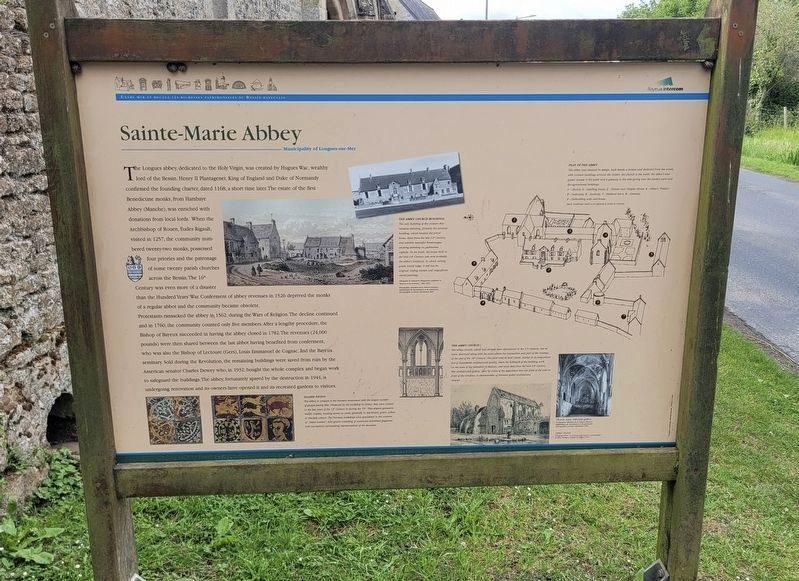
The Longues abbey, dedicated to the Holy Virgin, was created by Hugues Wac, wealthy lord of the Bessin. Henry II Plantagenet, King of England and Duke of Normandy confirmed the founding charter, dated 1168, a short time later. The estate of the first Benedictine monks, from Hambaye Abbey (Manche), was enriched with donations from local lords. When the Archbishop of Rouen, Eudes Rigault, visited in 1257, the community numbered twenty-two monks, possessed four priories and the patronage of some twenty parish churches across the Bessin. The 16th Century was even more of a disaster than the Hundred Years' War. Conferment of abbey revenues in 1526 deprived the monks of a regular abbot and the community became obsolete. Protestants ransacked the abbey in 1562, during the Wars of Religion. The decline continued and in 1760, the community counted only five members. After a lengthy procedure, the Bishop of Bayeux succeeded in having the abbey closed in 1782. The revenues (24,000 pounds) were then shared
Photographed by James Hulse, June 4, 2025
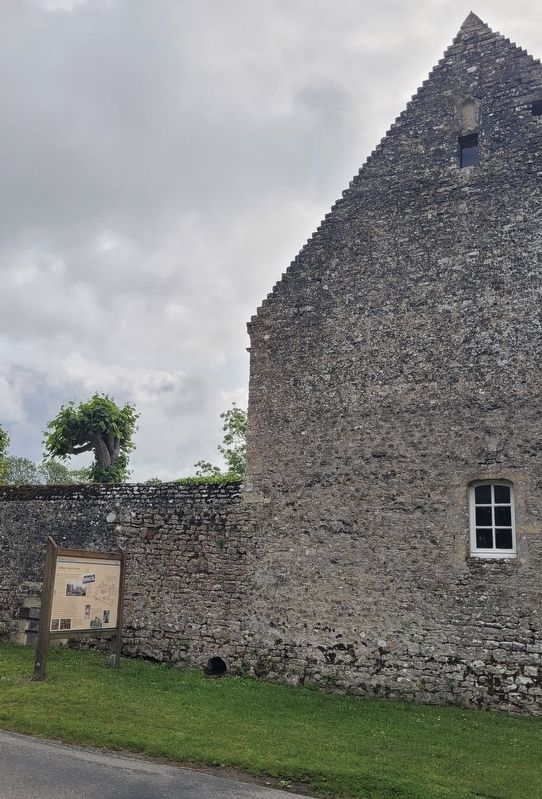
4. The view of the Sainte-Marie Abbey and Marker from across the street
Captions
(Photo #1) GLAZED PAVING. The abbey in Longues is the Norman monument with the largest number of glazed paving tiles. Produced by the workshop in Molay, they were created in the last years of the 13th Century or during the 14th. They display geometric motifs, rosettes, hunting scenes or crests, generally in red-brown, green, yellow or blackish colours. The Norman workshops were specialised in the creation of "plates-tombes", level graves consisting of numerous assembled flagstones with inscriptions surrounding representations of the deceased.
(Photo #2) THE ABBEY CHURCH BUILDINGS. The only building of the cloisters that remains standing, formerly the servants' building, which became the priors' home, dates from the late 12th Century, and exhibits beautiful Romanesque vaulting standing on gadrooned capitals. To the south, the house built in the mid-14th Century was most probably the abbot's residence, in which visiting guests would lodge. It still has its original roofing timbers and magnificent mural paintings. Lithograph by Alexandre Maugendre, published in "Bayeux et ses environs", 1862-1865. Photography, Ministère de la Culture (France), Médiathèque de l'architecture et du patrimoine (photographic archives) distribution RMN
(Photo #3) THE ABBEY CHURCH. The abbey church, which had already been abandoned in the 17th Century, lost its nave, destroyed along with the tower above the intersection and part of the transept, at the end of the 18th Century. The choir with its level chevet, modest in its proportions but of remarkable architectural quality, bears the hallmark of the building work on the nave of the cathedral in Bayeux, and must date from the mid-13th Century. The unobstructed gallery, open by virtue of the separation into two parts of the wall in front of the windows, is characteristic of Norman gothic architecture. Lithograph
(Photo #4) PLAN OF THE ABBEY. The abbey was classical in design, built beside a stream and sheltered from sea winds, with convent buildings around the cloister, the church to the north, the abbot's and guests' houses to the south and a gateway to the west giving onto the poultry yard and the agricultural buildings. 1- Church, 2 - Dwelling house, 3 - Cloister and Chapter House, 4 - Abbot's "Palace", 5- Outhouses, 6 - Dovecote, 7- Medieval barn, 8 - Gateway, 9- Outbuilding with cart-house. Sketch: Com&Graph, based on an engraving by Arcisse de Caumont. (Photo #5) Church, nave, triforium gallery Photography, Ministère de la Culture (France), Médiathèque de l'architecture et du patrimoine (photographic archives) distribution RMN
(Photo #6) Abbey church. Lithograph from "Le Calvados pittoresque et monumental by Félix Thorigny, printed in Carn in 1847
Erected by Municipality of Longues-sur-Mer.
Topics. This historical marker is listed in this topic list: Religion & Religious Structures. A significant historical year for this entry is 1168.
Location. 49° 19.975′ N, 0° 41.921′ W. Marker is in Longues-sur-Mer, Normandie (Normandy), in Calvados. It is on Rte de Bayeux (Route D104) just south of Rue de l'Église, on the right when traveling north. The marker is located in front of the abbey by the road. Touch for map. Marker is at or near this postal address: 15 Rue de l'Abbaye, Longues-sur-Mer, Normandie 14400, France. Touch for directions.

Regionally, it is in the North Atlantic Region, Europe, the European Union, Atlantic Europe, the Schengen Area, Western Europe, a coastal Mediterranean country, and the Western World. Historically, it finds itself in what was once a French colony and also the Roman Empire.
Other nearby markers. At least 8 other markers are within walking distance of this marker: Les casemates / The casemates (approx. 1.2 kilometers away); Aérodrome B-11 de Longues-sur-Mer / B-11 airfield at Longues-sur-Mer (approx. 1.2 kilometers away); La prise de la batterie / Capturing the battery (approx. 1.2 kilometers away); Canon russe Putilov / Putilov Russian cannon (approx. 1.2 kilometers away); Un site d'exception / An exceptional site (approx. 1.2 kilometers away); Une batterie allemande de défense côtière / A German coastal defence battery (approx. 1.2 kilometers away); La piste d'aviation B-11 / The B-11 airfield (approx. 1.3 kilometers away); Un rédoutable système défensif / A formidable defensive system (approx. 1.5 kilometers away). Touch for a list and map of all markers in Longues-sur-Mer.
Credits. This page was last revised on December 18, 2025. It was originally submitted on December 15, 2025, by James Hulse of Medina, Texas. This page has been viewed 67 times since then and 17 times this year. Photos: 1, 2, 3, 4. submitted on December 18, 2025, by James Hulse of Medina, Texas.
