Longues-sur-Mer in Calvados, Normandy, France — Western Europe
Un site d'exception
⎯⎯⎯
An exceptional site
Photographed by James Hulse, June 4, 2025
1. Un site d'exception / An exceptional site Marker

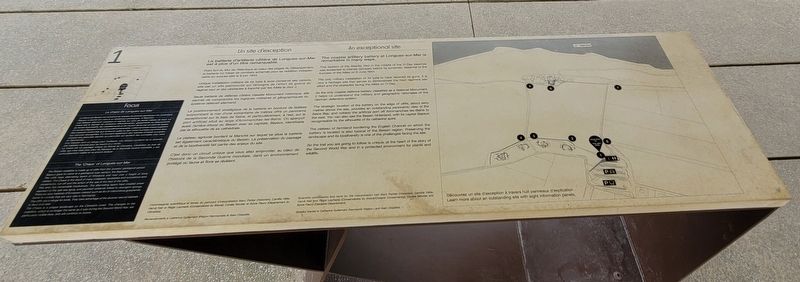
La batterie d'artillerie côtière de Longues-sur-Mer est à plus d'un titre remarquable.
Point fort du Mur de l'Atlantique au cœur des plages du Débarquement, la batterie fut l'objet de combats acharnés pour sa reddition indispensable au succès allié le 6 juin 1944.
Unique installation militaire de ce type à avoir conservé ses canons, elle est un site patrimonial qui témoigne de l'effort de guerre du régime nazi et des obstacles à franchir par les Alliés le Jour J.
Seule batterie de défense côtière classée Monument historique, elle permet de comprendre les logiques militaires et géographiques du système défensif allemand.
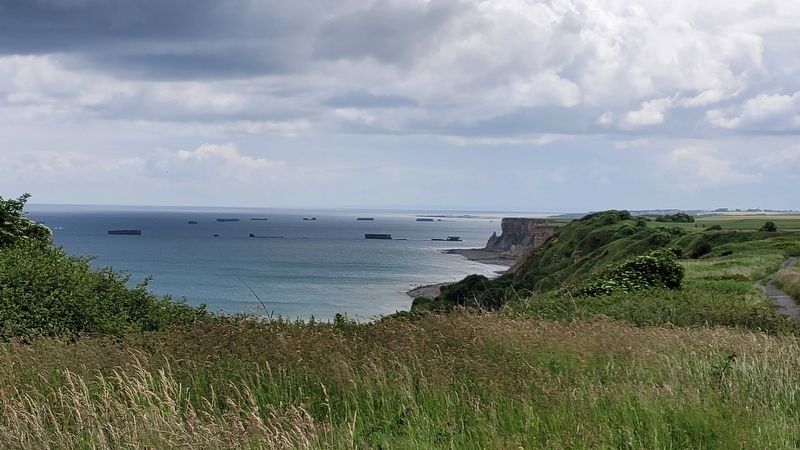
Le positionnement stratégique de la batterie en bordure de falaises surplombant la mer d'une soixantaine de mètres offre un panorama exceptionnel sur la baie de Seine, et particulièrement, à l'est, sur le port artificiel situé au large d'Arromanches-les-Bains. On aperçoit aussi l'arrière-littoral du Bessin avec sa capitale, Bayeux, identifiable par la silhouette de sa cathédrale.
Le plateau agricole bordant la Manche sur lequel se situe la batterie est également caractéristique du Bessin. La préservation du paysage et de la biodiversité fait partie des enjeux du site.
C'est donc un circuit unique que vous allez emprunter, au cœur de l'histoire de la Seconde Guerre mondiale, dans un environnement protégé où faune et flore se révèlent.
Commissariat scientifique et textes du parcours d'interprétation Marc Pottier (Historien), Camille Hélie, Hervé Niel et Régis Leymarie (Conservatoire du littoral), Coralie Moutier et Sylvie Fleury (Département du Calvados).
Remerciements à Catherine Guillemant (Région Normandie) et Alain Chazette.
Le chaos de Longues-sur-Mer
Le littoral du Bessin est constitué de falaises de période géologique du Jurassique. Bayeux a donné son nom à un stratotype géologique, le Bajocien. Les falaises alternent calcaires et marnes sur plus de trente mètres de haut. Le chaos est le résultat de nombreux effondrements, glissements ou mouvements de terrain successifs, de ruissellements et de l'action de la mer en pied de falaise. Ce secteur dispose d'une biodiversité remarquable. L'alternance de niveaux a généré des espaces confrontés aux embruns salés ou des zones humides perchées liées aux sources résurgentes. S'y trouvent également des habitats d'intérêt européen, comme des pelouses sèches ou calcicoles qui abritent des orchidées très rares en Normandie. Ces falaises sont un refuge pour l'avifaune. Les oiseaux profitent de la diversité des habitats naturels pour se nourrir et y nicher. Le chaos est un paysage unique du littoral du Calvados. L'évolution du trait de côte, qui n'est déjà plus celui de l'époque de la Seconde Guerre mondiale, y est particulièrement visible et va encore évoluer.
The coastal artillery battery at Longues-sur-Mer is remarkable in many ways.
This
this page online
The only military installation of its type to have retained its guns, it is now a heritage site that serves to demonstrate the Nazi regime's war effort and the obstacles facing the Allies on D-Day.
As the only coastal defence battery classified as a National Monument, it helps us understand the military and geographic rationales of the German defensive system.
The strategic location of the battery on the edge of cliffs, about sixty metres above the sea, provides an outstanding panoramic view of the Seine Bay, and notably the artificial port off Arromanches-les-Bains to the east. You can also see the Bessin hinterland, with its capital Bayeux recognisable by the silhouette of its cathedral spire.
The plateau of farmland bordering the English Channel on which the battery is located is also typical of the Bessin region. Preserving the landscape and its biodiversity is one of the challenges facing the site.
So the trail you are going to follow is unique, at the heart of the story of the Second World War and in a protected environment for plants and wildlife.
Scientific commission and texts for the interpretation trail Marc Pottier (Historian), Camille Hélie, Hervé Niel and Régis Leymarie (Conservatoire du littoral/Coastal Conservancy), Coralie Moutier and Sylvie Fleury (Calvados Département).
Grateful thanks to Catherine Guillemant (Normandy Region) and Alain Chazette.
The 'Chaos' of Longues-sur-Mer
The Bessin coastline is made up of cliffs from the Jurassic geological period. Bayeux gave its name to a geological type section, the Bajocian. The cliffs have alternating layers of limestone and marl over a height of thirty metres. The Chaos is the result of many collapses, landslides and successive land movements, run-off and the action of the sea at the foot of the cliffs. This area has remarkable biodiversity. The alternating layers have created areas exposed to the salt sea spray and perched wetlands linked to resurgent springs. There are also habitats of European interest such as dry or calcicolous grasslands, home to orchids that are very rare in Normandy. The cliffs are a refuge for birds. They take advantage of the diverse natural habitats to feed and nest. The Chaos is a unique landscape on the Calvados coast. The changes to the coastline, which is no longer the same as it was during the Second World War, are particularly visible here, and will continue to evolve.
Erected by Longues-sur-Mer
Photographed by James Hulse, June 4, 2025
2. An exceptional site Marker
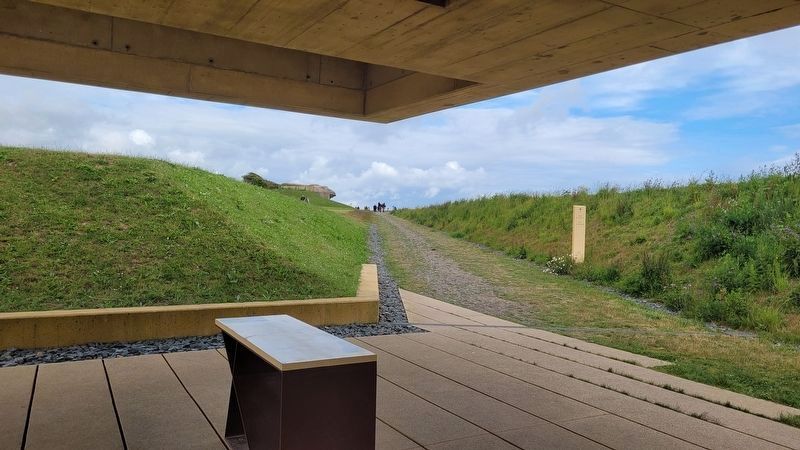
View from the visitor center at the beginning of the walking trail.
Topics. This historical marker is listed in this topic list: War, World II. A significant historical date for this entry is June 6, 1944.
Location. 49° 20.581′ N, 0° 41.515′ W. Marker is in Longues-sur-Mer, Normandie (Normandy), in Calvados. It is on Rue de la Mer just north of Rue des Batteries. The marker is located on the grounds of the Longues-sur-Mer Battery Historical Monument Site. Touch for map. Marker is at or near this postal address: 39 Rue de la Mer, Longues-sur-Mer, Normandie 14400, France. Touch for directions.

Regionally, it is in the North Atlantic Region, Europe, the European Union, Atlantic Europe, the Schengen Area, Western Europe, a coastal Mediterranean country, and the Western World. Historically, it finds itself in what was once a French colony and also the Roman Empire.
Other nearby markers. At least 8 other markers are within walking distance of this marker: Aérodrome B-11 de Longues-sur-Mer / B-11 airfield at Longues-sur-Mer (a few steps from this marker); Canon russe Putilov / Putilov Russian cannon (within shouting distance of this marker); Une batterie allemande de défense côtière / A German coastal defence battery (about 90 meters away, measured in a direct line); La piste d'aviation B-11 / The B-11 airfield (about 120 meters away); La prise de la batterie / Capturing the battery (about 240 meters away); Les casemates / The casemates (approx. 0.2 kilometers away); Un site naturel remarquable / A remarkable natural environment (approx. 0.3 kilometers away); Le poste de commandement de tir / The fire command post (approx. 0.4 kilometers away). Touch for a list and map of all markers in Longues-sur-Mer.
Also see . . . Longues-sur-Mer battery. Wikipedia
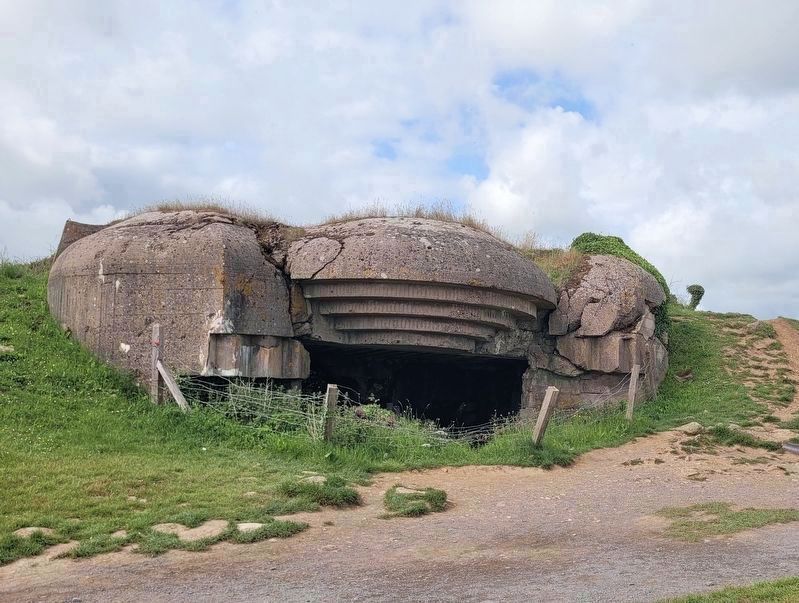
The Longues-sur-Mer battery (German: Marineküstenbatterie (MKB) Longues-sur-Mer; also designated Widerstandsnest (Wn) 48) is a World War II German coastal artillery battery approximately 1 km (0.62 mi) north of the village of Longues-sur-Mer in Normandy, France. The battery is sited on a 60 m (200 ft) cliff overlooking the Baie de Seine and formed a part of Germany's Atlantic Wall coastal fortifications,(Submitted on December 21, 2025, by James Hulse of Medina, Texas.)between the Allied landing sectors of Gold Beach and Omaha Beach.Photographed by James Hulse, June 4, 20253. An exceptional site MarkerAs you walk from the visitor center, Casemate No. 4 is the first of four 120 mm gun casemates on the trail.

Photographed by James Hulse, June 4, 2025
4. An exceptional site Marker
At the end of the trail are Casemate No. 2 and Casemate No. 1.
Photographed by James Hulse, June 4, 2025
5. An exceptional site Marker
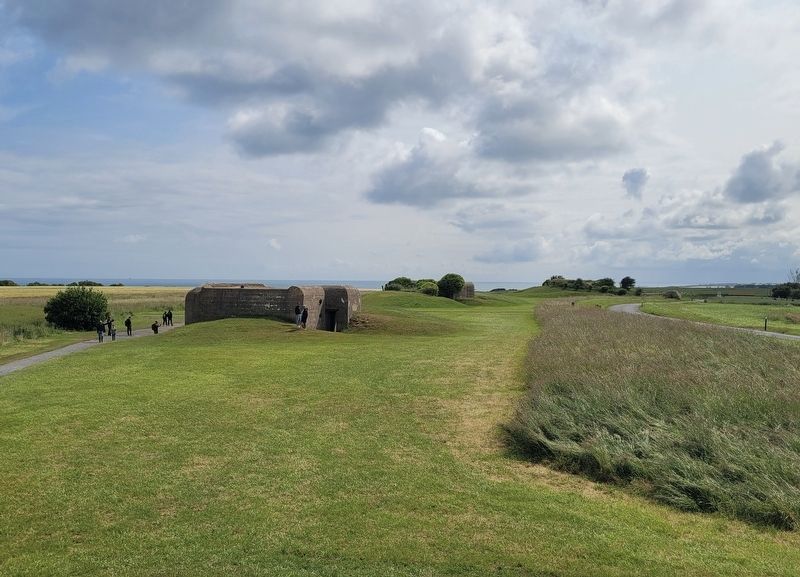
View of the line of casemate bunkers looking back toward the visitor center.
Photographed by James Hulse, June 4, 2025
6. An exceptional site Marker
The view of the cliffs looking towards Seine Bay.
Credits. This page was last revised on December 21, 2025. It was originally submitted on December 15, 2025, by James Hulse of Medina, Texas. This page has been viewed 114 times since then and 83 times this year. Photos: 1, 2, 3, 4, 5, 6. submitted on December 21, 2025, by James Hulse of Medina, Texas.
