Bremen-Mitte in Mitte, Germany — Central Europe
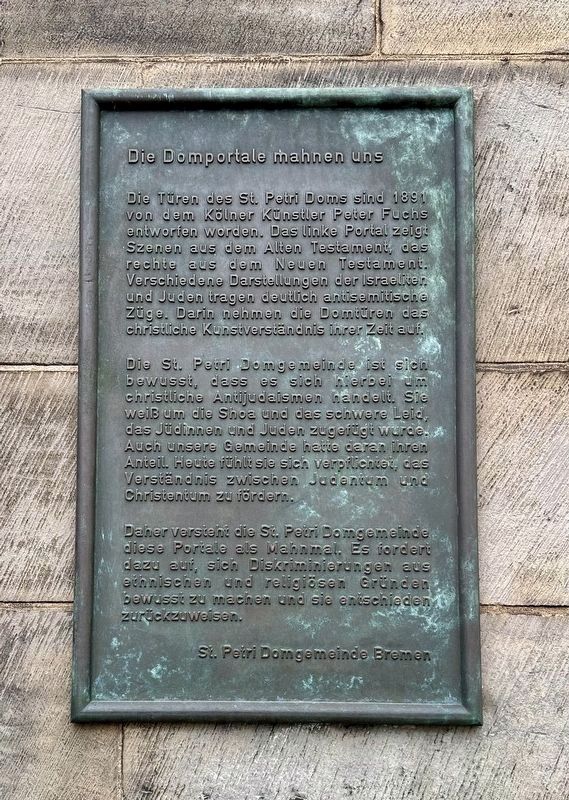
Die Domportale mahnen uns
⎯⎯⎯
The Cathedral Doors Serve as a Reminder
Photographed by Andrew Ruppenstein, May 18, 2025
1. The Cathedral Doors Serve as a Reminder Marker

Die Türen des St. Petri Doms sind 1891 von dem Kölner Künstler Peter Fuchs entworfen worden. Das linke Portal zeigt Szenen aus dem Alten Testament, das rechte aus dem Neuen Testament. Verschiedene Darstellungen der Israeliter und Juden tragen deutlich antisemitische Züge. Darin nehmen die Domtüren das christliche Kunstverständnis inrer Zeit auf.
Die St. Petri Domgemeinde ist sich bewusst, dass es sich hierbei um christliche Antijudaismen handelt. Sie weiß um die Shoa und das schwere Leid, das Jüdinnen und Juden zugefügt wurde. Auch unsere Gemeinde hatte daran ihren Anteil. Heute fühlt sie sich verpflichtet, das Verständnis zwischen Judentum und Christentum zu fördern.
Daher versteht die St. Petri Domgemeinde diese Portale als Mahnmal. Es fordert dazu auf, sich Diskriminierungen aus ethnischen und religiösen Gründen bewusst zu machen und sie entschieden zurückzuweisen.
The Cathedral Doors Serve as a Reminder
The doors of St. Petri (“Peter's”) Cathedral were designed in 1891 by the Cologne artist Peter Fuchs. The left doorway depicts scenes
this page online
The St. Peter's Cathedral parish is aware that these are examples of Christian anti-Judaism. It knows about the Shoah and the immense suffering inflicted upon Jewish people. Our parish also played a part in this. Today, it feels obligated to promote understanding between Judaism and Christianity.
Therefore, the St. Petri Cathedral parish understands these portals as a memorial. It calls for awareness of discrimination based on ethnicity and religion and for its decisive rejection.
Erected 2009 by St. Petri Domgemeinde Bremen.
Topics. This historical marker is listed in these topic lists: Arts, Letters, Music • Religion & Religious Structures. A significant historical year for this entry is 1891.
Location. 53° 4.522′ N, 8° 48.503′ E. Marker is in Bremen, in Mitte. It is in Bremen-Mitte. It is on Am Dom, on the right when traveling north. Touch for map. Marker is at or near this postal address:
Photographed by Andrew Ruppenstein, May 18, 2025
2. The Cathedral Doors Serve as a Reminder Marker - wide view
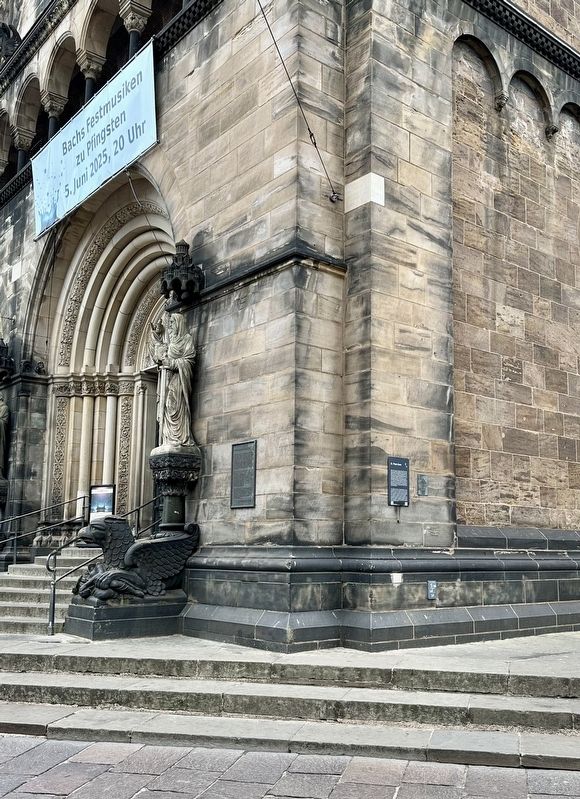
The marker is visible here on the front of the church at the south corner, with the two portals, as named on the marker, forming the front entrance, immediately to the north.

Regionally, it is in Europe, the European Union, Atlantic Europe, Central Europe, the Schengen Area, Western Europe, and the Western World. Historically, it finds itself in what was once the Holy Roman Empire.
Other nearby markers. At least 8 other markers are within walking distance of this marker: Börsenhof / Stock Exchange (within shouting distance of this marker); Bismarck-Denkmal / Bismarck Monument (within shouting distance of this marker); Neues Rathaus / New Town Hall (within shouting distance of this marker); Haus der Bürgerschaft / Parliament Building (within shouting distance of this marker); Glocke / “Bell” (within shouting distance of this marker); Der Schütting (about 120 meters away, measured in a direct line); St. Petrus / Saint Peter (about 120 meters away); Ehemaliges Hauptpostamt / Former Main Post Office (about 120 meters away). Touch for a list and map of all markers in Bremen.
Also see . . . Ein Mea Culpa an der Wand (taz, May 8, 2009, in German). Excerpt (in translation):
The relationship between Christians and Jews is traditionally an(Submitted on December 17, 2025.)important theme at church assemblies—an occasion, therefore, for the parish to address the antisemitic depictions that were placed above the cathedral portals as early as 1891. Yesterday, they unveiled a memorial plaque, rededicating the depictions as a "memorial against discrimination."Photographed by Andrew Ruppenstein, May 18, 20253. The Cathedral Portals - Old Testament (north) portal
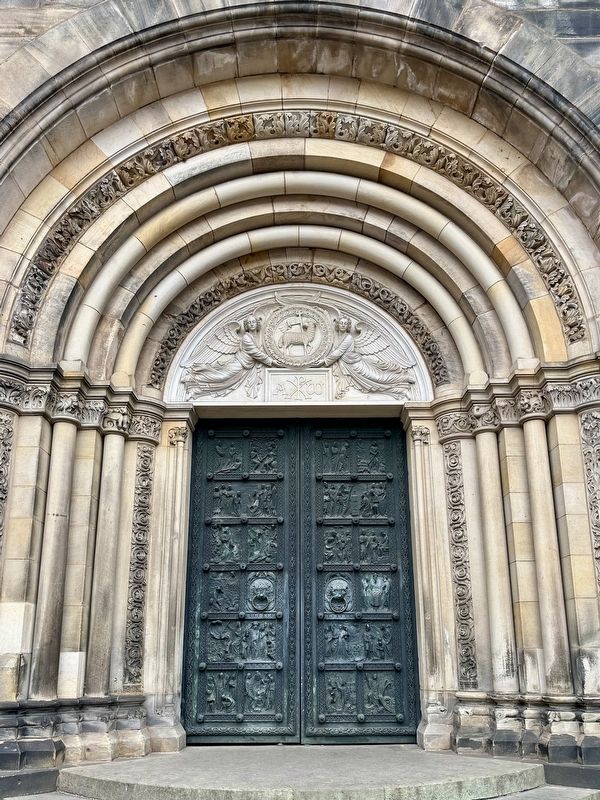
The portals depict scenes from biblical history, including malicious caricatures of Jews with puffy eyes and hooked noses. In one image, Jews wearing "Jewish hats" smile as they watch from a window as Jesus is tortured by Roman soldiers. The antisemitic sentiment that ultimately led to the Holocaust was already "present in minds and hearts" at the time these depictions were created, said Gotzen during the service, which was also attended by Mayor Jens Böhrnsen.
The memorial plaque, now installed next to the right entrance, bears the inscription "The Cathedral Portals Remind Us." It states that their "clearly antisemitic features reflect the Christian understanding of art of their time." The inscription continues, "The parish is aware of the immense suffering inflicted upon Jewish people. Our parish also played a part in this." The portals areto be understood as a memorial and a call to "become aware of discrimination and resolutely reject it."Photographed by Andrew Ruppenstein, May 18, 20254. Cathedral Door - New TestamentAlthough not readily apparent here, closer inspection reveals the Jews depicted as having almost cartoonishly large hooked noses.
At the unveiling of the plaque, Hans-Georg Friedrichs of the cathedral parish said that while the Shoah cannot be fully explained, there are "building blocks" that contributed to its development. One of these is "socially acceptable antisemitism," which is also reflected in the bronze door panels. The point, therefore, is not to attack the artist Peter Fuchs, who created the portals "in the spirit of his time." "Back then, the toxicity of this germ may not have been recognized," said Friedrichs. But the cathedral parish, too, had allowed itself to be "infected by the brown bacillus." This is demonstrated, for example, by the fact that swastika flags were displayed on the cathedral, or by the role of the Nazi theologian Heinrich Weidemann. Weidemann, the cathedral preacher, regional bishop, and Gauleiter of the "German Christians," had campaigned vigorously for a "de-Judaized" church "committed to the German people."

Additional keywords. Gedenktafel
Photographed by Andrew Ruppenstein, May 18, 2025
5. St. Petri Dom / St. Peter’s Cathedral
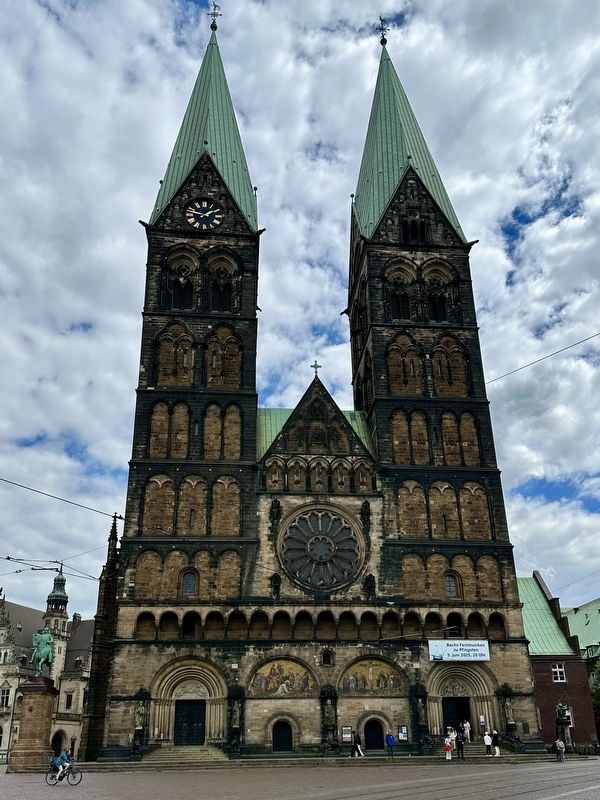
The marker is visible here on the right corner of the church, while the Old Testament portal (previous two pictures) is visible on the left.
Credits. This page was last revised on December 17, 2025. It was originally submitted on December 17, 2025, by Andrew Ruppenstein of Lamorinda, California. This page has been viewed 55 times since then and 26 times this year. Photos: 1, 2, 3, 4, 5. submitted on December 17, 2025, by Andrew Ruppenstein of Lamorinda, California.
