Père-Lachaise in Paris in Département de Paris, Île-de-France, France — Western Europe
Bergen-Belsen Concentration Camp Memorial
Monument aux victimes de Bergen-Belsen

Photographed by Andrew Ruppenstein, April 19, 2024
1. Bergen-Belsen Concentration Camp Memorial

Ils ont souffert et espéré
Toi combats pour ta liberté
On brisa leur corps
jamais leur esprit.
Erected 1994.
Topics and series. This memorial is listed in this topic list: War, World II. In addition, it is included in the The Holocaust series list.
Location. 48° 51.609′ N, 2° 24.009′ E. Memorial is in Paris, Île-de-France, in Département de Paris. It is in Père-Lachaise. It is on Avenue Circulaire. The memorial is located in Division 77. Touch for map. Memorial is in this post office area: Paris, Île-de-France 75020, France. Touch for directions.

Regionally, it is in the North Atlantic Region, Europe, the European Union, Atlantic Europe, the Schengen Area, Western Europe, a coastal Mediterranean country, and the Western World. Historically, it finds itself in what was once a French colony and also the Roman Empire.
Other nearby markers. At least 8 other markers are within walking distance of this marker: Nous sommes 900 Français / We are 900 Frenchmen (Convoy 73) Memorial
this page online
Also see . . .
1. Monument aux victimes de BERGEN BELSEN (APPL, in French). Excerpt (in translation):
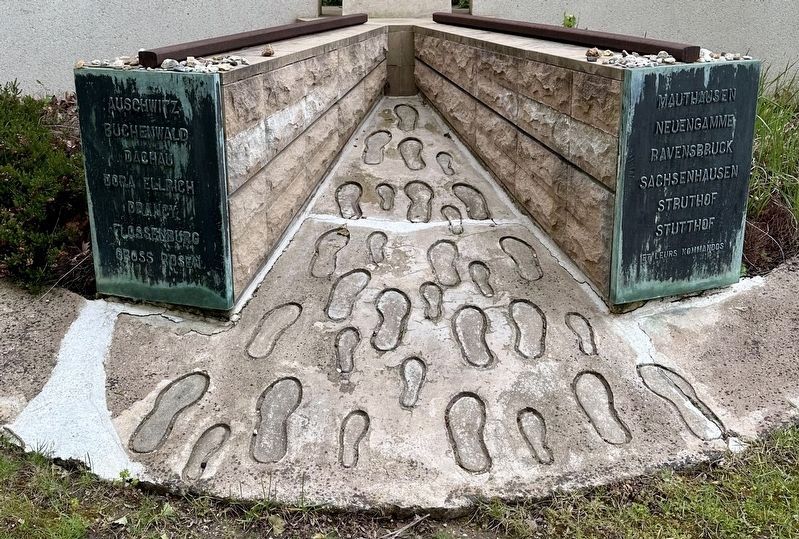
The monument was inaugurated on March 23, 1994. It is the work of architect Guillaume d’Astorg. It is a monument made of dressed stone and concrete, reminiscent of the one that stands on the site of the camp amidst a heath of heather. The visitor's gaze is drawn to the central fissure, opening onto darkness and nothingness. The appearance of the obelisk, reaching towards the sky, opens(Submitted on December 19, 2025.)the door to hope. Period rails laid on low walls and footprints on the ground represent the transports arriving at the camp. While the majority of the camp's victims were Jewish, the monument avoids any specific reference to them, instead paying general tribute to all the victims.Photographed by Andrew Ruppenstein, April 19, 20242. Bergen-Belsen Concentration Camp Memorial - detailAuschwitz, Buchenwald, Dachau, Dora-Ellrich, Drancy, Flossenburg, Gross-Rosen, Mauthausen, Neuengamme, Ravensbruck, Sachsenhausen, Struthof, Stutthof et leurs commandos (and their sub-camps).
2. Bergen-Belsen concentration camp (Wikipedia). Overview:
Bergen-Belsen, or Belsen, was a Nazi concentration camp in what is today Lower Saxony in northern Germany, southwest of the town of Bergen near Celle. Originally established as a prisoner of war camp, in 1943, parts of it became a concentration camp. Initially this was an "exchange camp", where Jewish hostages were held with the intention of exchanging them for German prisoners of war held overseas. The camp was later expanded to hold Jews from other concentration camps.(Submitted on December 19, 2025.)
…From 1941 to 1945, almost 20,000 Soviet prisoners of war and a further 50,000 inmates died there. Overcrowding, lack of food, and poor sanitary conditions caused outbreaks of typhus, tuberculosis, typhoid fever, and dysentery, leading to the deaths of more than 35,000 people in the first few months of 1945, shortly before and after the liberation.
The camp was liberated on April 15, 1945, by the British 11th Armoured Division. The soldiers discovered approximately 60,000 prisoners inside, most of them half-starved and seriously ill, and another 13,000 corpses lying around the camp unburied. A memorial with an exhibition hall currently stands at the site.
Additional keywords. Holocaust
Credits. This page was last revised on December 19, 2025. It was originally submitted on December 19, 2025, by Andrew Ruppenstein of Lamorinda, California. This page has been viewed 52 times since then and 23 times this year. Photos: 1, 2. submitted on December 19, 2025, by Andrew Ruppenstein of Lamorinda, California.
