Near Milam in Sabine County, Texas — The American South (West South Central)
The Gaines-Oliphint House
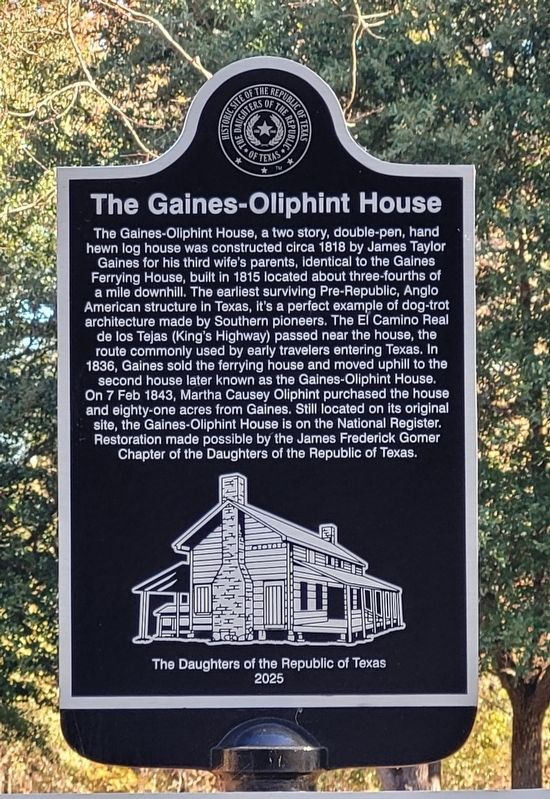
Photographed by James Hulse, December 19, 2025
1. The Gaines-Oliphint House Marker
Erected 2025 by The Daughters of the Republic of Texas.
Topics. This historical marker is listed in this topic list: Notable Buildings. A significant historical date for this entry is February 7, 1843.
Location. 31° 28.028′ N,
this page online

Regionally, this marker is in the American South, specifically in the Deep South, and in the Piney Woods. Globally, it is in North America, a Gulf of Mexico state, the Western Hemisphere, the Western World, and the Anglosphere. Historically, it finds itself in what was once New Spain, the Republic of Texas, one of the Confederate States of America, and the Antebellum South.
Other nearby markers. At least 8 other markers are within 2 miles of this marker, measured as the crow flies: Alfred D. and Martha (Causey) Oliphint (here, next to this marker); James Taylor Gaines (here, next to this marker); Gaines Memorial Bridge (approx. 0.4 miles away); Site of Historic Crossing on the Sabine River (approx. 0.4 miles away); Site of Sabine River Crossing (approx. 0.4 miles
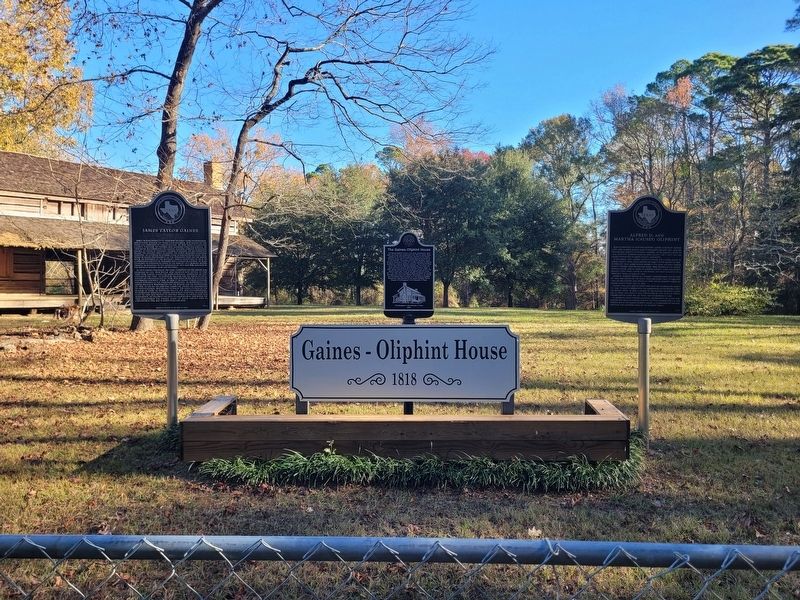
Photographed by James Hulse, December 19, 2025
2. The Gaines-Oliphint House Marker (center marker)
Also see . . . Gaines-Oliphint House: A Historic Log Home in Texas. Texas State Historical Association (TSHA)
The Gaines-Oliphint House is on State Highway 21 seven miles east of Milam in Sabine County. The structure, built by James Gaines on property that he acquired in 1830, is one of the oldest extant log residential buildings in Texas. The house, which measures fifty-two by twenty feet and has 2,000 square feet of living space, is a 1½-story double-pen log structure featuring dogtrots (see DOG-RUN HOUSES) upstairs and down. Longleaf pine was used for the planking, and cypress was used for the foundation beams and roofing. A staircase attached to the wall of the west pen in the downstairs dogtrot area provided access to the second floor. The upstairs dogtrot was enclosed, and porches ran the length of the house both front and back. All of the flooring was hand-planed and had a tongue-and-groove construction; the ceiling joists(Submitted on December 20, 2025, by James Hulse of Medina, Texas.)and base moldings were also hand-planed and beaded. In the interior of the house, the spaces between the logs were covered with hand-beveled batts. The two chimneys, one at each end of the house, were constructed of local stone and handmade brick, and the chimneys' original limestone mortar contained shell from the nearby Sabine River.Photographed by James Hulse, December 19, 20253. The Gaines-Oliphint House
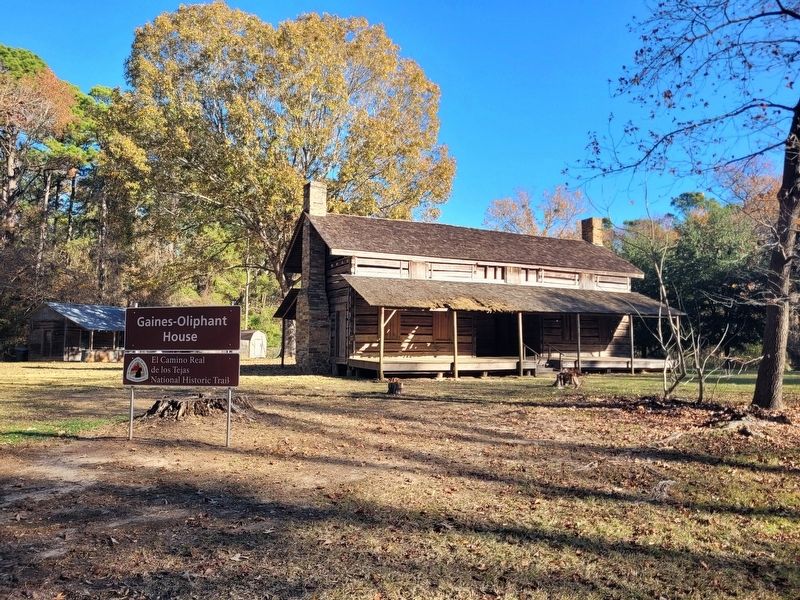
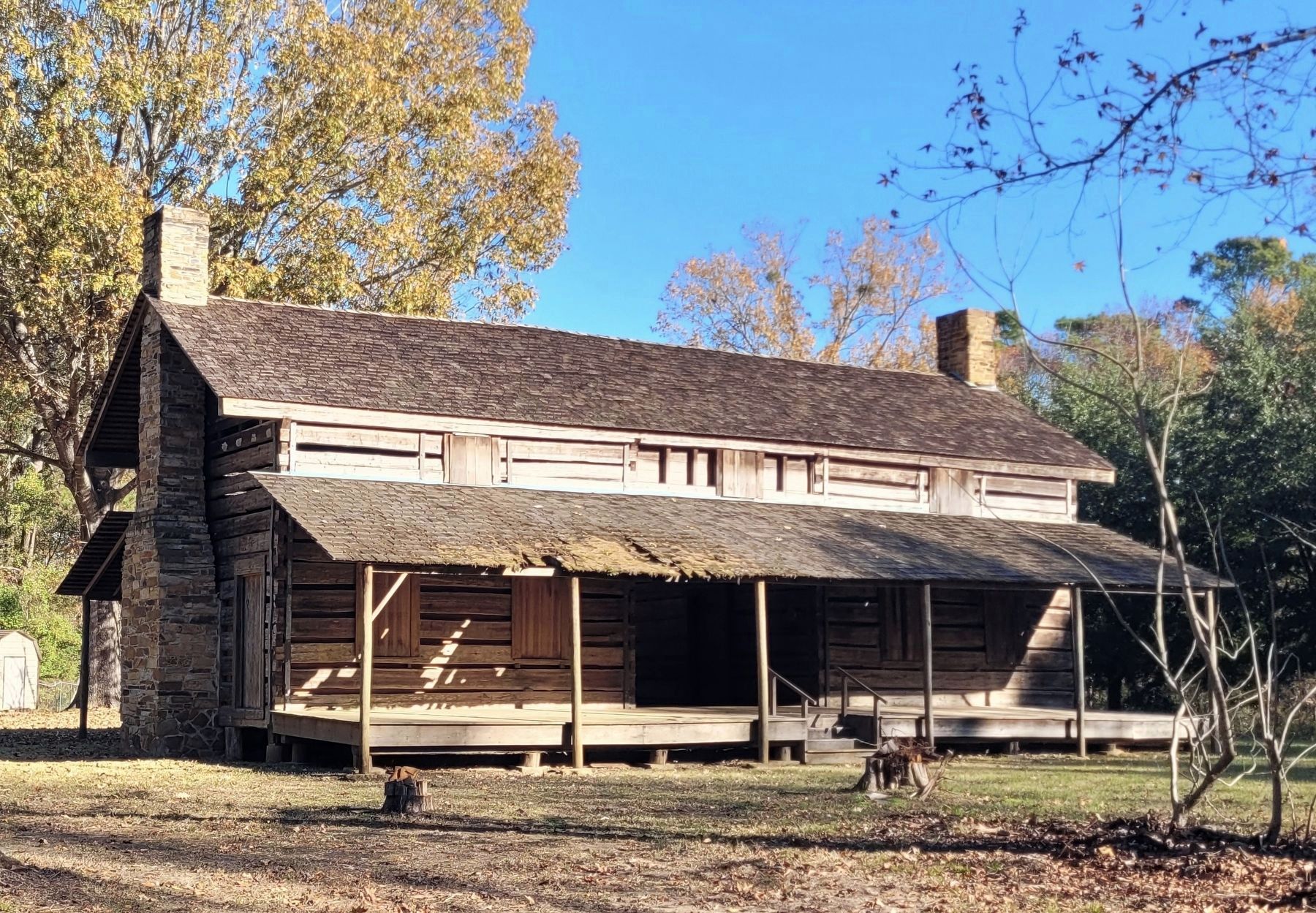
Photographed by James Hulse, December 19, 2025
4. The Gaines-Oliphint House
Credits. This page was last revised on December 20, 2025. It was originally submitted on December 19, 2025, by James Hulse of Medina, Texas. This page has been viewed 89 times since then and 62 times this year. Photos: 1, 2, 3, 4. submitted on December 20, 2025, by James Hulse of Medina, Texas.
