Riviera/Westchester in Bakersfield in Kern County, California — The American West (Pacific Coastal)
Kern County World War II Veterans Memorial
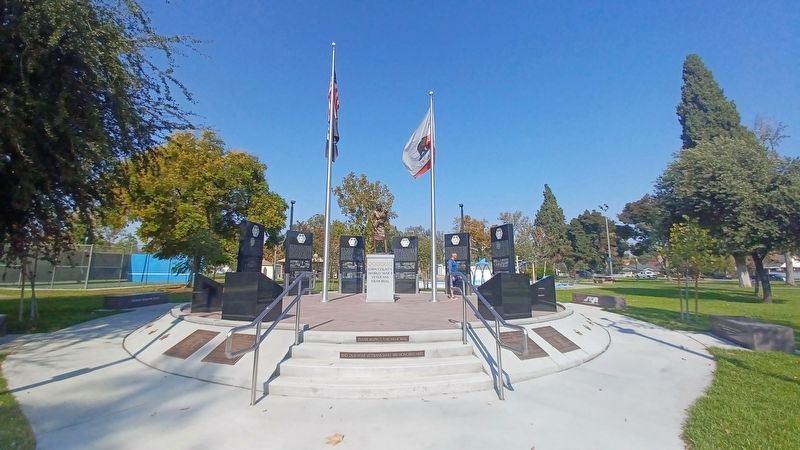
Photographed by Denise Boose, October 31, 2025
1. Kern County World War II Veterans Memorial Marker
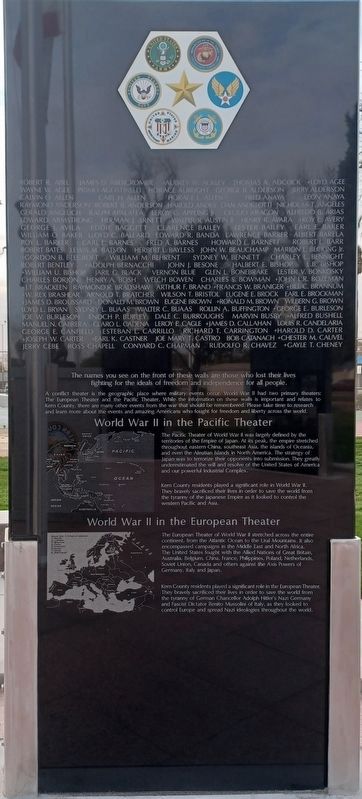
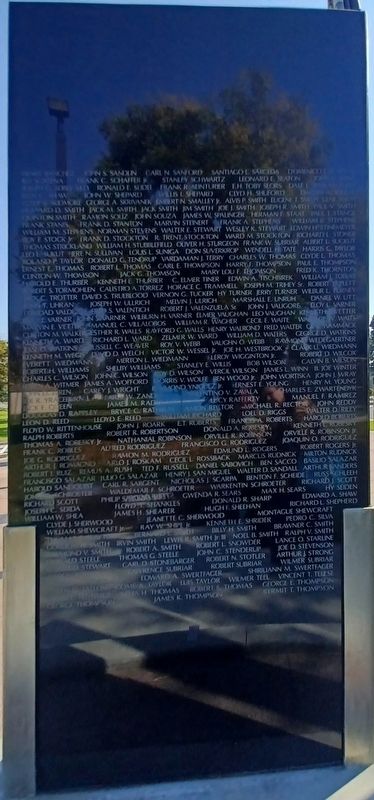
The names you see on the front of these walls are those who lost their lives fighting for the ideals of freedom and independence for all people.
A conflict theater is the geographic place where military events occur. World War II had two primary theaters: The European Theater and the Pacific Theater. While the information on these walls is important and relates to Kern County, there are many other events from the war that should be remembered. Please take time to research and learn more about the events and amazing Americans who fought for freedom and liberty across the world.
World War II in the Pacific Theater
The Pacific Theater of Word War II was largely defined by the territories of the Empire of Japan. At its peak, the empire stretched throughout eastern China, Southeast Asia, the islands of Oceania, and even the Aleutian Islands in North America. The strategy of Japan was to terrorize their opponents into submission. They gently underestimated the will and resolve of the United States of America and our powerful Industrial Complex.
Kern County residents played a significant role in World War II. They
this page online
World War II in the European Theater
The European Theater of World War II stretched across the entire continent, from the Atlantic Ocean to the Ural Mountains. It also encompassed campaign in the Middle East and North Africa. The United States fought with the Allied Nations of Great Britain, Australia, Belgium, China, France, Philippines, Poland, Netherlands, Soviet Union, Canada and others against the Axis Powers of Germany, Italy, and Japan.
Kern County residents played a significant role in the European Theater. They bravely sacrificed their lives in order to save the world from the tyranny of German Chancellor Adolph Hitler’s Nazi Germany and Fascist Dictator Benito Mussolini of Italy, as they looked to control Europe and spread Nazi ideologies throughout the world.
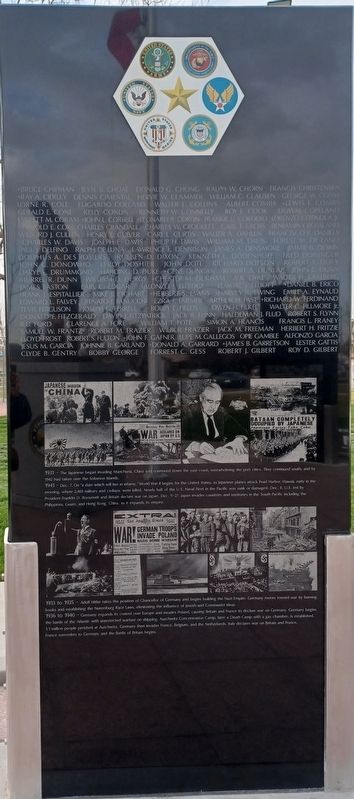
1931 - The Japanese began invading Manchuria, China and continued down the east coast, overwhelming the port cities. The continued south, and by 1942 had taken over the Solomon Islands.
1941 - Dec. 7, On
Photographed by Denise Boose, February 14, 2023
2. Kern County World War II Veterans Memorial
Panel 1
1933 to 1935 - Adolf Hitler takes the position of Chancellor of Germany and gains building the Nazi Empire. Germany moves toward war by burning books and establishing the Nuremberg Race Laws, eliminating the influence of Jewish and Communist ideas.
1936 to 1940 - Germany expands its control over Europe and invades Poland, causing Britain and France to declare war on Germany. Germany begins the battle of the Atlantic with unrestricted warfare on shipping. Auschwitz Concentration Camp, later a Death Camp with a gas chamber, is established. 1.1 million people perished at Auschwitz, Germany then invades France, Belgium, and the Netherlands, Italy declares war on Britain and France. France surrenders to Germany and the Battle of Britain begins.
1942 - Jan. 7: Japanese attack Bataan, Philippines.
Jan. 18: Japan, Germany and Italy sign military agreement in Berlin.
Jan. 27: First Japanese warship is sunk by a U.S. Submarine.
Feb. 22: President Roosevelt orders General Douglas MacArthur out of the Philippines. MacArthur states “I shall return.”
Feb. 23: First Japanese attach on U.S. Mainland as a submarine shells an oil refinery near Santa Barbara, Ca.
Mar. 18: War Relocation Authority is established in the U.S. which will eventually round up 120,000 Japanese Americans from the west coast and transport them to barbed-wired
Photographed by Denise Boose, October 31, 2025
3. Kern County World War II Veterans Memorial
Panel 1 Back
Mar. 24: Admiral Chester Nimitz is appointed as Commander in Chief of the U.S. Pacific Theater.
1940 - June 25: U.S. General Dwight D. Eisenhower arrives in London to meet with British Prime Minister Winston Churchill.
Sep. 16: U.S. Military Conscription Bill passed. Sept. 27: Tripartite (Axis) Pact signed by Germany, Italy, and Japan. Nov. 5: Franklin D. Roosevelt Re-elected as U.S. president.
1941 - Mar. 11: President Roosevelt signs the Lend-Lease Act. Aug. 14: Roosevelt and Churchill announce Atlantic Charter.
Dec. 11: Adolf Hitler declares war on the United States and the United States simultaneously declares war on Germany.
1942 - Jan. 13: Germany begins a U-Boat offensive along the east coast of the U.S.
Jan. 26: First American forces arrive in Great Britain.
Apr. 23: German air raids begin against cathedral cities in Britain.
May 30: First Thousand-bomber British air raid occurs against Cologne, France.
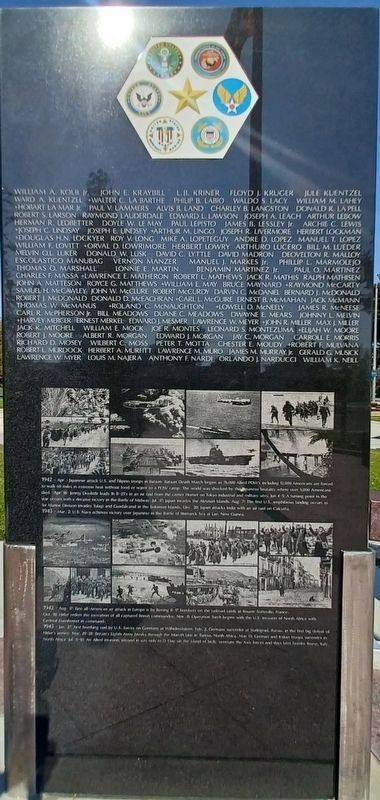
1942 - Apr.: Japanese attack U.S. and Filipino troops in Bataan Bataan Death March begins as 76,000 Allied POW’s including 12,000 Americans are forced to walk 60 miles in extreme heat without food or water to a POW camp. The world was shocked by the Japanese brutality where over 5,000 Americans died.
Apr. 18: Jimmy Doolittle leads 16 B-25’s in an air raid from the carrier Hornet on Tokyo Industrial and military sites.
Jun 4-5: A turning point in the war occurs with a decisive victory in the Battle of Midway
July 17: Japan invades the Aleutian Islands.
Aug. 7: The first U.S. amphibious landing occurs as 1st Marine Division invades Tulagi and Guadalcanal in the Solomon Islands. Dec. 20: Japan attacks
Photographed by Denise Boose, February 14, 2023
4. Kern County World War II Veterans Memorial
Panel 2
1942 - August 17: First all American air attack in Europe is by Boeing B-17 bombers on the railroad yard at Rouen-Sotteville, France. Oct. 18: Hitler orders the execution of all captured British commandos. Nov. 8: Operation Torch begins with the U.S. invasion of North Africa with General Eisenhower in command.
1943 - Jan. 27: First bombing raid by U.S. forces on Germany at Wilhelmshaven.
Feb. 2: Germans surrender at Stalingrad, Russia, in the first big defeat of Hitler’s armies. Mar. 20-28: Britains Eighth Army breaks through the Mareth Line in Tunisia, North Africa.
May 13: German and Italian troops surrender in North Africa. Jul. 9-10: An Allied invasion, second in size only to D-Day, on the island of Sicily, overruns the Axis forces and days later bombs Rome, Italy.
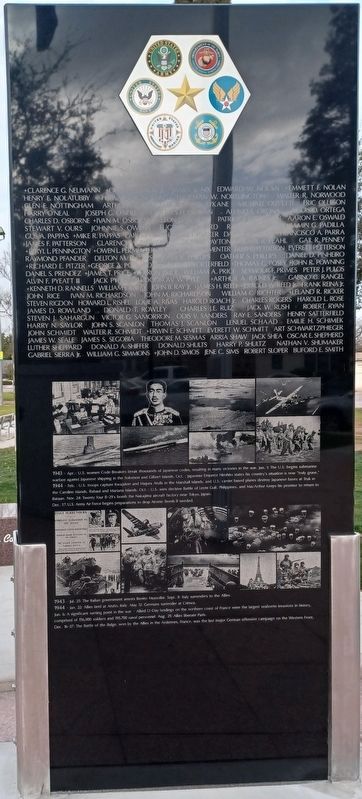
1943 - Apr.: U.S. women Code Breakers break thousands of Japanese codes, resulting in many victories in the war.
Jun. 1: The U.S. begins submarine warfare against Japanese shipping in the Solomon and Gilbert Islands. Oct.: Japanese Emperor Hirohito states his country’s situation is now “truly grave.”
1944 - Feb.: U.S. troops capture Kwajalein and Majura Atolls in the Marshall Islands, and U.S. carrier based planes destroy Japanese bases at Truk in the Caroline Islands, Rabaul and Mariana Islands.
Oct.: U.S. wins decisive Battle of Leyte Gulf, Philippines, and MacArthur keeps his prose to return to Bataan.
Nov. 24: Twenty four B-29’s bomb the Nakajma aircraft factory near Tokyo, Japan.
Dec. 17: U.S. Army Air Force begins preparations to drop Atomic Bomb if needed.
1943 - Jul. 25: The Italian government arrests Benito Mussolini.
Sept. 8: Italy surrenders to the Allies.
1944 - Jan. 22: Allies land
Photographed by Denise Boose, October 31, 2025
5. Kern County World War II Veterans Memorial
Panel 2 Back
Jun. 6: A significant turning point in the war - Allied D-Day landings on the northern coast of France were the largest seaborne invasions in history, comprised of 156,000 soldiers and 195, 700 naval personnel. Aug. 25: Allies liberate Paris.
Dec. 16-27: The Battle of the Bulge, won by the Allies in the Ardennes, France, was the last major German offensive campaign on the Western Front.
1945 - Feb. 19-23: Battle of Iwo Jima occurs, and U.S. Marines raise the U.S. flag on Mt. Suribachi. Navajo Code Talkers are praised as invaluable in the capture of Iwo Jima.
Mar. 10: Fifteen square miles of industrial and military targets in Tokyo are bombed by 279 B-29’s.
Apr. 1: Finial and largest amphibious landing of the war occurs on Okinawa.
Apr. 12: U.S. President Franklin D. Roosevelt dies and is succeeded by Vice President Harry S. Truman.
Jul. 5: The liberation of the Philippines occurs.
Aug. 6 & 9: First and second Atomic Bombs are dropped on Hiroshima and Nagasaki causing Japan to accept unconditional surrender.
Sept. 2: Formal Japanese surrender on board the Battleship USS Missouri in Tokyo Bay. President Truman declares VI Day.
1945 - Apr.: Allies discover stolen German/Jewish art and wealth hidden by the Nazis in German salt miners.
Apr./May: There is a race between Russian and Allied troops to take control of Berlin, resulting in Berlin being divided into two parts - West by Allies and East by Russia. The separation was later completed when the Russians built the Berlin Wall in August 1961. Apr 12: Vice President Harry S. Truman is sworn in as President of the United States.
Apr. 28: Benito Mussolini is captured and hanged by Italian partisans. Apr. 30: Adolf Hitler commits suicide in a bunker in Berlin.
May 7: German forces unconditionally surrender

Photographed by Denise Boose, February 14, 2023
6. Kern County World War II Veterans Memorial
Panel 3
May 8: V-E (Victory in Europe) Day.
Diversity in the War Effort - Homefront and Overseas
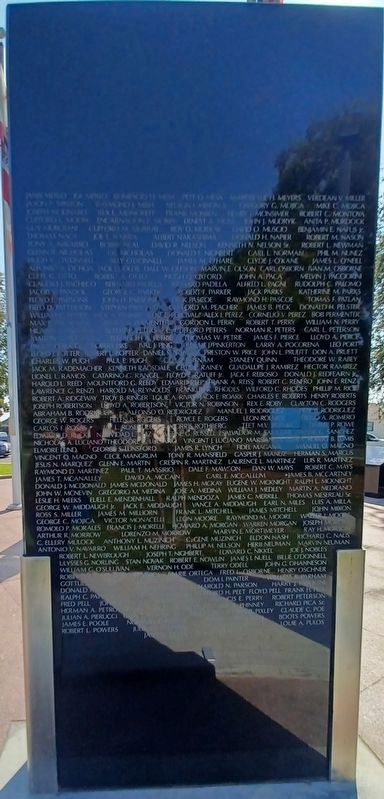
Kern County was home to a very diverse population during WWII. The success of the war effort would not have been possible without the collective efforts of our diverse force of Kern County residents, who came from every demographic, cultural, ethnic, religious and racial background. During the war, several Kern County resident served within, alongside or trained as members of the following groups:
1st & 3nd Filipino Infantry Regiments • 14th Air Service Group • 100th & 442nd Infantry Regiments • 158th Regimental Combat Team • 761st & 784th Tank Battalions • Code Talkers • Philippine Scouts • U.S Marine Corps Women’s Reserve (USMCWR) • Women Accepted for Volunteers Military Series (WAVES) • Women’s Army Auxiliary Corps (WAC) • Women’s AirForce Service Pilots (WASP) • Women’s Coast Guard Reserve (SPARS) • Women’s Navy Nurse Corps
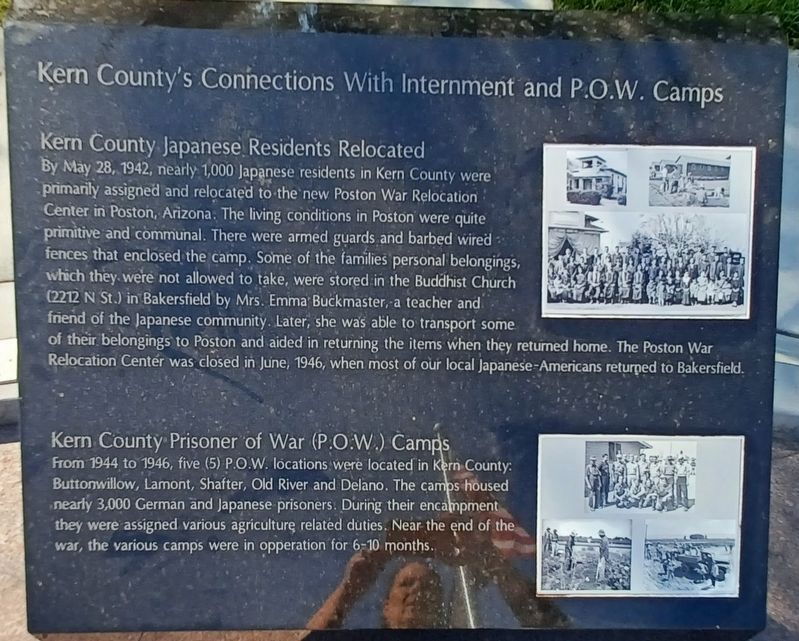
Kern County’s Connections With Internment and P.O.W Camps
Kern County Japanese Residents Relocated
By May 28, 1942, nearly 1,000 Japanese residents in Kern County were primarily assigned and relocated to the new Boston War Relocation Center in Poston, Arizona. The living conditions in Poston were quite primitive and communal. There were armed guards and barbed wired fences that enclosed the camp. Some of the families personal belongings, which they were not allowed to take, were stored in the Buddhist Church (2212 N St.) in Bakersfield by Mr.s Emma Buckmaster, a teacher and friend of the Japanese community. Later, she was able to transport some of their belongings to Poston and aided inn returning the items when they returned home. The Boston War Relocated Center was closed in June, 1946, when most of our local Japanese - Americans returned to
Photographed by Denise Boose, October 31, 2025
7. Kern County World War II Veterans Memorial
Panel 3 Back
Kern County Prisoner of War (P.O.W.) Camps From 1944 to 1946, five (5) P.O.W. locations were located in Kern County: Buttonwillow, Lamont, Shaftner, Old Rive and Delano. The camp housed nearly 3,000 German and Japanese prisoners. During their encampment they were assigned various agriculture related duties. Near the end of the war, the various camps were in operation for 6-10 months.
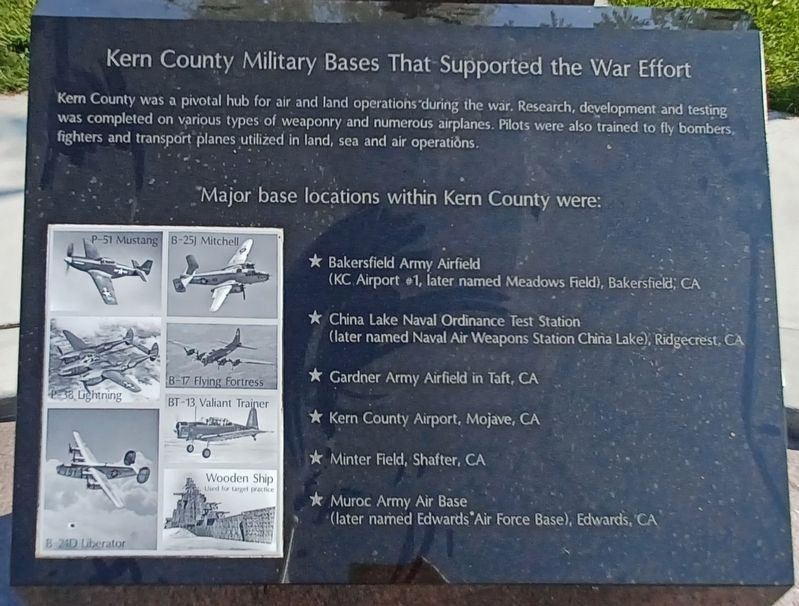
Kern County Military Bases that supported the war effort
Kern County was a pivotal hub for air and land operations during the war. Research, development and testing was completed on various types of weaponry and numbers airplanes. Pilots were also trained to fly bombers, fighters and transport planes utilized in land, sea and air operations.
Major base locations within Kern County were:
Bakersfield Army Airfield (KC Airport #1, later named Meadows Field), Bakersfield, CA • China Lake Naval Ordinance Test Station • (later named Naval Air Weapons Station China Lake), Ridgecrest, CA • Gardner Army Airfield in Taft, CA • Kern County Airports, Mojave, CA • Minter Field, Shafter, CA • Muroc Army Air Base (later named Edwards Air Force Base), Edwards, CA
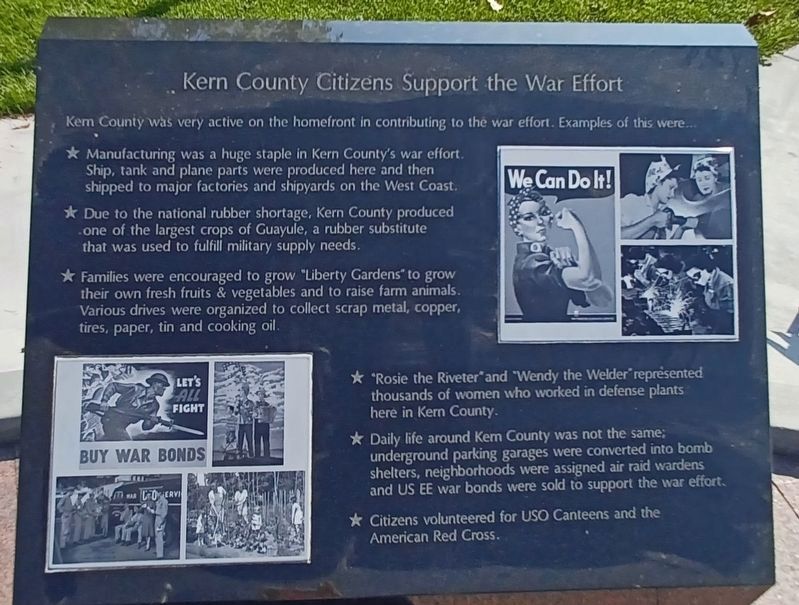
Kern County Citizens Support the War Effort Kern County was very active on the Homefront in contributing to the war effort. Examples of this were…
Manufacturing was huge staple in Kern County’s war effort. Ship, tank and plane parts were produced here and then shipped to major factories and shipyards on the West Coast.
Due to the national rubber shortage, Kern County produced one of the largest crops of Guayule, a rubber substituted that was used to fulfill military supply needs.
Families were encouraged to grow “Liberty Gardens” to grow their own fresh fruits & vegetables and to raise farm animals. Various drives were organized to collect scrap
Photographed by Denise Boose, October 31, 2025
8. Kern County World War II Veterans Memorial
Panel 4
“Rosie the Riveter” and “Wendy the Welder” represented thousands of women who worked in defense plants her in Kern County.
Daily life around Kern County was not the same; underground parking garages were converted into bomb shelters, neighborhoods were assigned air rail wardens and US EE war bonds were sold to support the war effort.
Citizens volunteered for USO Canteens and the American Red Cross.
Erected 2023 by The Kern County World War II Veterans Memorial Committee.
Topics. This memorial is listed in this topic list: War, World II. A significant historical date for this entry is May 30, 1931.
Location. 35° 22.417′ N, 119° 2.091′ W. Memorial is in Bakersfield, California, in Kern County. It is in Riviera/Westchester. It is on Truxtun Avenue west of Myrtle Street, on the right when traveling west. The memorial stands in Jastro Park. Touch for map. Memorial is in this post office area: Bakersfield CA 93301, United States of America. Touch for directions.

Regionally, this memorial is in the San Joaquin Valley, specifically in the Central Valley, and in the Sierra Nevada. It is also on the American Pacific Coast. Globally, it is in North America, on the Ring of Fire, on the Pacific Rim, in the Western Hemisphere, in the Western World, and in the Anglosphere. Historically, it finds itself in what was once New Spain and also Mexico’s Alta California.
Other nearby markers. At least 8 other markers are within walking distance of this marker: Kern County Korean War Memorial (within shouting distance of this marker); Standard Oil Company Building (approx. 0.7 miles away); Kern County Hospital (approx. ¾ mile away); First Presbyterian Church (approx. ¾ mile away); United States Post Office (approx. ¾ mile away); Padre Hotel (approx. ¾ mile away); Kern County Land Company Building

Photographed by Denise Boose, October 31, 2025
9. Kern County World War II Veterans Memorial
Panel 4 Back
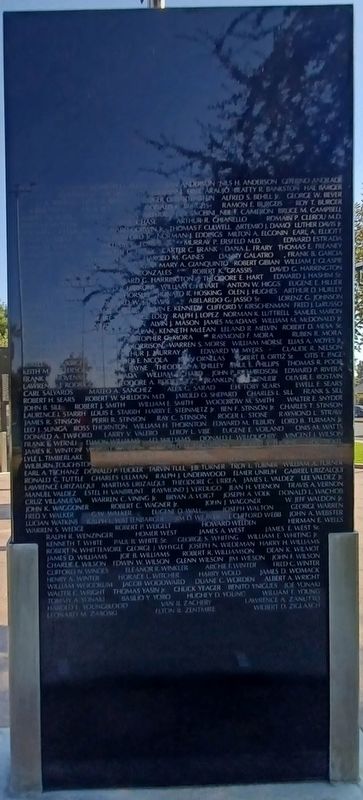
Also see . . . WWII Veteran Name List. This site has the complete list of all names etched on these memorial panels and names are still being added. (Submitted on November 8, 2025, by Denise Boose of Tehachapi, California.)
Photographed by Denise Boose, February 14, 2023
10. Kern County World War II Veterans Memorial
Panel 5
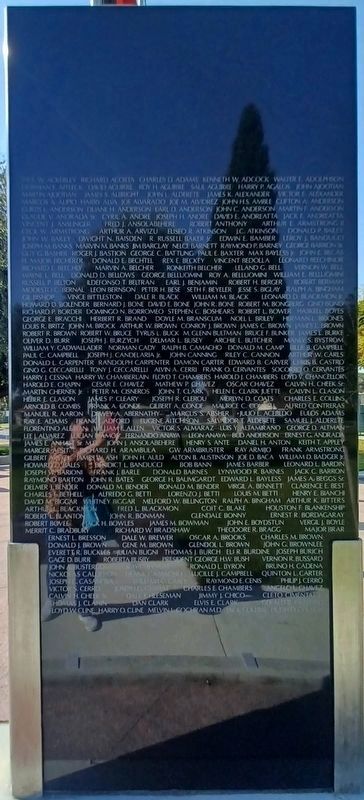
Photographed by Denise Boose, October 31, 2025
11. Kern County World War II Veterans Memorial
Panel 5 Back
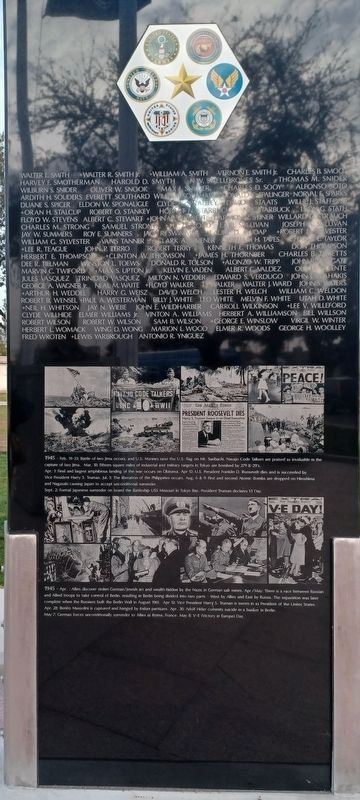
Photographed by Denise Boose, February 14, 2023
12. Kern County World War II Veterans Memorial
Panel 6
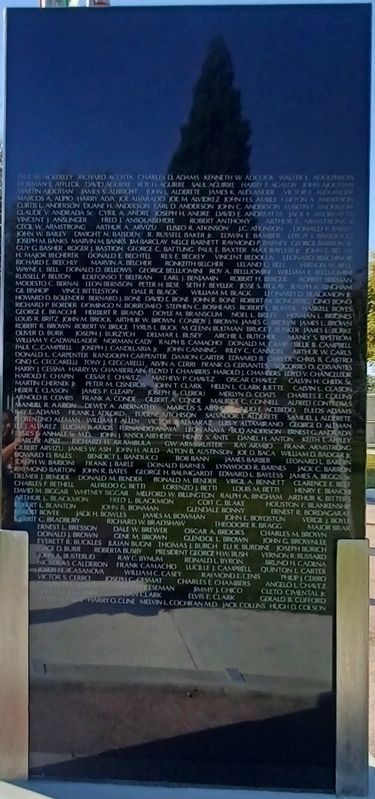
Photographed by Denise Boose, October 31, 2025
13. Kern County World War II Veterans Memorial
Panel 6 Back
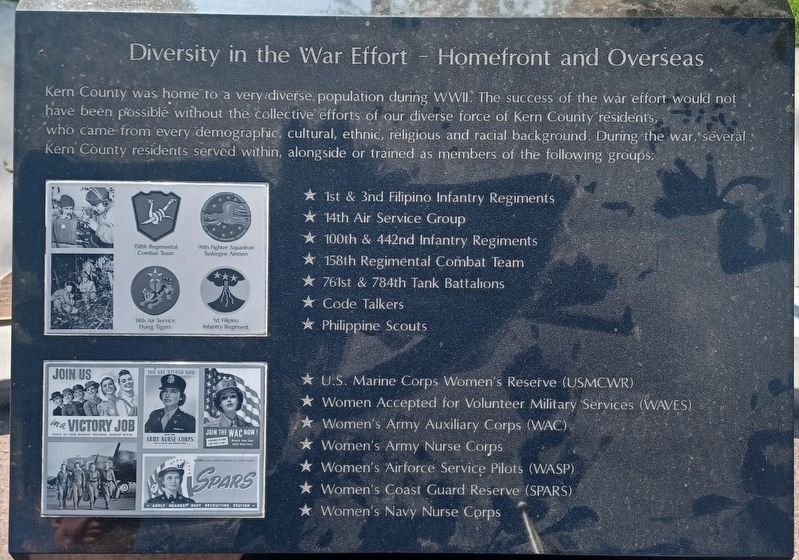
Photographed by Denise Boose, October 31, 2025
14. Kern County World War II Veterans Memorial
Photographed by Denise Boose, October 31, 2025
15. Kern County World War II Veterans Memorial
Photographed by Denise Boose, October 31, 2025
16. Kern County World War II Veterans Memorial
Photographed by Denise Boose, October 31, 2025
17. Kern County World War II Veterans Memorial
Photographed by Denise Boose, October 31, 2025
18. Kern County World War II Veterans Memorial
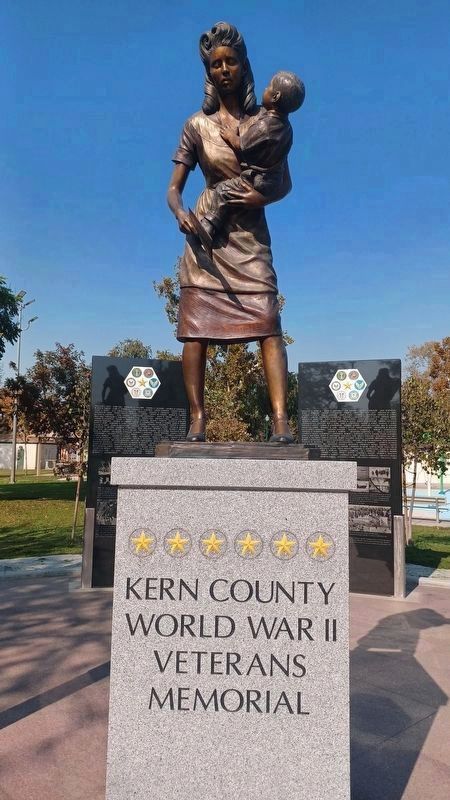
Sculptor Benjamin Victor. It depicts a grieving woman holding her child. In her hand is a Western Union Telegram from the War Department informing her that her loved one died in action fighting for freedom. Inside the statue, near her heart, is a capsule filled with sand from Omaha Beach and Utah Beach, two of the beaches where the Battle of Normandy was fought.
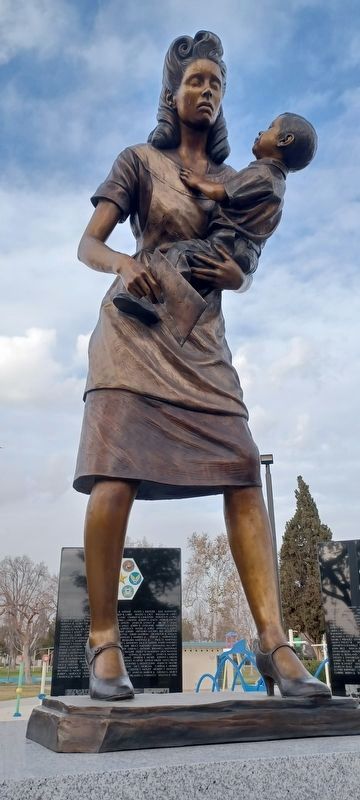
Photographed by Denise Boose, February 14, 2023
19. Kern County World War II Veterans Memorial
Credits. This page was last revised on February 19, 2026. It was originally submitted on November 7, 2025, by Denise Boose of Tehachapi, California. This page has been viewed 153 times since then and 117 times this year. Last updated on December 20, 2025, by Denise Boose of Tehachapi, California. Photos: 1, 2, 3, 4, 5, 6. submitted on November 7, 2025, by Denise Boose of Tehachapi, California. 7, 8, 9. submitted on December 19, 2025, by Denise Boose of Tehachapi, California. 10, 11, 12, 13, 14, 15, 16, 17, 18. submitted on December 20, 2025, by Denise Boose of Tehachapi, California. 19. submitted on February 11, 2026, by Denise Boose of Tehachapi, California. • Devry Becker Jones was the editor who published this page.
