Clinton in Hunterdon County, New Jersey — The American Northeast (Mid-Atlantic)
Hunterdon County's Forgotten
Bonnell's Tavern & the Minutemen/Militia
⎯⎯⎯ The Forgotten History Trail 1780
Photographed by William Honachefsky Jr
1. Abraham Bonnells Tavern Forgotten History Trail side of the marker
Inscription.
Hunterdon County's Forgotten, also, The Forgotten History Trail 1780. Bonnell's Tavern and the Minutemen/Militia /.
Abraham Bonnells Tavern Forgotten History Trail Bonnell's Tavern and the Minutemen/Militia. Bonnell's Tavern: A Crossroads of Rebellion This ground once echoed with the voices of rebel Minutemen, weary travelers, Sons of Liberty, and Washington's spies. Farmers and ironworkers from Union Furnace, where cannonballs were cast just up the hill, passed through this very route on their way to the fight for independence. Opened in 1766, Bonnell's Tavern quickly became more than a rest stop along the Old Stagecoach Road that linked East Jersey to the Delaware River. As stagecoach wheels ground to a halt and dust rose from the road, this tavern transformed into a command post in the Jersey wilderness. Here, intelligence was passed, militias mustered, and rebel supply lines coordinated. Abraham Bonnell, named a Son of Liberty at a 1766 gatering in Ringoes, converted his tavern into a center of resistance. His friend and fellow rebel, David Reynolds, paid the ultimate price, hanged in British-held Morristown in 1773 for his suspected role in a counterfeiting scheme aimed at destabilizing British finances. Bonnell carried Reynold's rebel spirit onward. As British forces surged through New York and into New Jersey, the Continental Congress authorized a revolutionary new defense: the Flying Camp, fast-moving, state-based Minutemen regiments, ready to reinforce Washington's army or defend vulnerable towns on a moment's notice. Returning from the Provincial Congress in 1775 with Charles Stewart (Washington's Commissary General) and Joseph Beavers, Abraham Bossell raised the 2nd Hunterdon County Militia. They mustered right here on August 19, 1775 and in a letter delivered to Stewart on September 28, 1775, before marching east to protect New Jersey's coast at Blazing Star Ferry (Woodbridge) and Elizabethtown. This same militia fought at Millstone (Bound Brook) 1777; Monmouth, 1778, one of the bloodiest battles of the war; and at Connecticut Farms and Springfield, 1780, in the final British retreat from northern New Jersey. Bonnell's Tavern was no ordinary inn. It was a headquarters, a safehouse, and a launch point in the struggle for liberty, its walls bearing witness to a revolution in motion., New Jersey's Militia: At a Moment's Notice Clinton, New Jersey , June 1780 , Urgent news raced west along the Swift-Sure Stagecoach route: British Redcoats had attacked the home of Rev. James Caldwell, the fiery "High Priest of Rebellion." His wife, Hannah Ogden Caldwell, was shot and killed in her bed. Her body defiled. Their home looted and set ablaze. This was no random act, it was a calculated assassination. Stripped of power, bitter Royal governors and loyalists plotted the murder as a warning. New York's Royal Chief Justice William Smith II called it an "experiment", to see how the people would respond. Their goal seemed clear, kill the love of the man, break his heart, silence his pulpit, and end the rebellion before it became too late. New Jersey answered with fury. Outnumbered but united, farmers, tradesmen, and townsmen took up arms. Here at Bonnell's Tavern, Colonel Abraham Bonnell and his militia had gathered, marched to Woodbridge and were called up as reinforcement militia in the Battle of Connecticut Farms (Union County) and two weeks later again at the Battle of Springfield. Four Hunterdon County regiments, including the 3rd Militia, with Jacob Francis, a free Balck soldier, and Col. Taylor's 4th Regt. who brougth one of the only cannon's, together faced down the British in what would become known as the Last STand of New Jersey. Francis, chose to defend the state. God inspired men to be as one. Many rebel reverends, like Caldwell's "New Lights", condemned the moral rot of Royal rule and called liberty a God-given right. These militiamen willingly signed up and supported a statewide network of beacon fires, supply routes, and coded intelligence, linking places like this tavern to the broader cause. The path became a road of resistance. Bonnell's Tavern stood not just as a rest stop, but as a rallying point for liberty., The Wartime Intelligence and Supply Network In 1776, Col. Stewart's Flying Camp included future leaders like Col. Abraham Bonnell, Col. Joseph Beavers, and Col. Frederick Frelinghuysen, who would fight at Springfield, and later join Caldwell in state governance. Even Lafayette trusted this network, in 1778, he recovered from illness under the care of 2nd Hunterdon Co. Regt. surgeon Dr. Gershom Craven in Ringoes before returning to France. New Jersey's Revolution wasn't just fought with muskets, it was won through secrets, signals, and supply lines. A hidden network of patriot leaders, including Col. Charles Stewart, Deputy Quartermaster General Moore Furman, and Rev. James Caldwell, coordinated logistics that kept Washington's army alive. Bonnell's Tavern and nearby Bethlehem Presbyterian Church, led by Scottish-born Stewart, served as hubs of activity. Strategically placed, the tavern linked Union Forge's ironworks with Jockey Hollow's winter encampment, moving essential arms and supplies during the brutal winter of 1779-80. Reverend James Caldwell, appointed by the New Jersey Safety Committee, organized beacon signals, flour routes, and militia supplies and Hunterdon County played a significant role. Moore Furman, NJ Deputy Q.M. set up a mill in 1778 specifically for military use and ran teams from Pittstown to feed Jockey Hollow in Morristown. Mill's like Col. John Taylor's in Readington became lifelines. Between the supply lines the tavern sat. At every turn, British spies lurked, so success depended on discretion, devotion, and faith. In 1783, Bonnell's Tavern hosted a military court, making key decisions as America's future still hung in the balance. It stood not just as an inn, but as a nerve center of resistance, a sanctuary of purpose and courage. It was never just a tavern. It was a house of rebellion., The Story of Bonnell's Tavern Before muskets fired, the Revolution began in the soul. Bonnell's Tavern in Clinton stood at the crossroads of a spiritual rebellion taht shook New Jersey long before 1776. The tavern's founders, families like the Bonnell's, Ogden's, Crane's, Meeker's, Day's, and Wade's, were part of the fiery "New Light" Protestant movement. As Presbyterians, Baptists, Quakers, and Lutherans, they rejected monarchy, slavery, the Church of England and the idea that kings ruled by divine right. For them, liberty was a sacred covenant, granted not by rulers, but by God. When King Charles II seized New Netherland in 1664 and handed it to his brother, the Duke of York, these communities resisted. They had already built self-governing, peaceful settlements, often with interracial ties to the Lenape, and they refused to bend to royal aristocrats tied to slavery and the Royal African Company, tied to the Duke of York, who branded enslaved Africans with 'D.Y.', a grim mark of ownership in one of history's cruelest trades. By the 1770's, this defiance burned hotter. Thomas Paine's first writing was about ending slavery. Those words resonated for many. At Bonnell's Tavern, faith and rebellion met by candlelight. Abraham Bonnell and his kin turned the tavern into a covert base for militia recruiting, supply routes, and coded intelligence. Their ally and neighbor, Rev. James Caldwell, called the "Rebel High Priest", preached revolution from both pulpits and supply depots- a guiding spirit for the free state of New Jersey. The wore tore families apart. Some Bonnell's were true Rebels and others remained Loyalists. The enemy was often not across the sea, but across the dinner table. Royal Governor William Franklin (Benjamin Franklin's Loyalist son) and the ruthless Gov. Tryon targeted this network of rebel Presbyterians. Their revenge was brutal: churches burned, towns destroyed, and Rev. Caldwell and his wife Hannah murdered. From Clinton to Elizabethtown, faith became resistance, and taverns like Bonnell's became outposts of the cause. Hunterdon's Spies like Samuel Holcombe and Col. David Schomp moved through forests and sermons alike, fighting not just for independence, but for a divine vision of freedom. For these rebels, the Revolution wasn't only declared. It was lived, risked, and believed. Here, in faith and defiance, ordinary families lit the fire that became a nation., [Map legend:]
1 - You are here , Bonnell Tavern, headquarters of Hunterdon Co. 2nd Militia 2 - Bethlehem Presbyterian Church, Grandin (Pittstown) founded 1730 3 - Pittstown Inn , Deputy Quartermaster General (1778-1780), Moore Furman's supply depot used by Rev. Caldwell for Jockey Hollow 4 - Col Charles Stewart , Commissary General of Issue (1777-1782) 5 - Reynold's Tavern / VanSyckles Tavern (Union Township) 6 - Gen. William "Scotch Willie" Maxwell gravesite, Old Greenwich 7 - Tinicum Boat Storage for the original Delaware crossing plan with Gen. Lee, before being captured, leaving Washington to cross the Delaware himself Dec. 1776. 8 - Union Forge , Iron Works est. 1742, pivotal industrial site 9 - Vought House, est. 1759, staunch German loyalist who was exiled and property confiscated in Annandale/Clinton 10 - Jones Tavern, est. 1760's Hunterdon militia recruitment hub 11 - Solitude House , In High Bridge, residence of Robert Taylor who oversaw the Union Iron Works (In 1777 John Penn, the last royal governor or Pennsylvania was jailed here, ordered by Congress) 12 - Col. John Taylor's Gristmill - In Readington Township
1776 , The Boats that Saved a Revolution In the bleak winter of December 1776, General George Washington's Continental Army was bruised and retreating after painful defeats in New York and New Jersey. With dwindling troops, expiring enlistments, and a freezing camp on the Delaware River, morale was near collapse. Behind the scenes, a bold strategy was forming , and it hinged on reinforcements from New Jersey. On December 8, Washington ordered Brigadier General William Maxwell to "secure 2,000-3,000 men to cross and reinforce him in Pennsylvania, but Lee dragged his feet. He disliked Washington, doubted the plan, and moved slowly, staying far behind his troops. On December 12, while lodging at Widow White's Tavern in Basking Ridge, he was captured by the British. On his desk, unopened, lay a chilling letter from Reverend James Caldwell, warning him to flee. Treated with unusual favor as a prisoner, Lee was later revealed , through documents uncovered in the 1800's in the papers of Sir Henry Clington1, to have drafted a blueprint urging a southern offensive, proving that his inaction and captivity were betrayals meant to break the Revolution. His men, now under General John Sullivan (guest of Bonnell's Tavern) joined Washington, only after the famous victory., Meanwhile, spies embedded in the Hessian camps , many of them German-speaking Lutherans loyal to the patriot cause , fed Washington intelligence. On the frigid night of December 25-26, Washington personally led 2,400 troops across the ice-choked Delaware, marching ten miles through snow and sleet to strike Trenton. The surprise was total: 1,500 Hessians were overwhelmed. Days later, the American "rebels" triumphed again at Princeton. These twin victories revived the Revolution, proving that faith, fire, and local resistance , from militiamen, ministers, and spies , could outwit a corrupt Royal Empire. The New Jersey boats were hidden and provided to the Army by the militia. The British were blind, and history was changed by New Jersey's forgotten defenders , who stood where you are today.,
1) Moore, George Henry, and New-York Historical Society, "Mr. Lee's Plan, March 29, 1777." The Treason of Charles Lee, Major General, Second in Command in the American Army of the Revolution, New-York, C. Scribener, 1860. PDF. Retrived from the Library of Congress, www.loc.gov/item/08004641
.
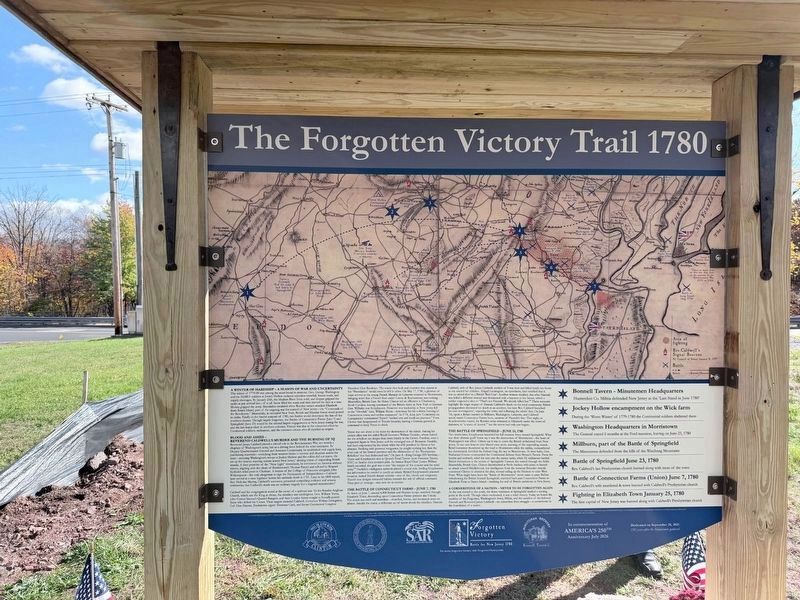
The Forgotten Victory 1780. A Winter of Hardship , A Season of War and Uncertainty,br> The winter of 1779-80 was among the most brutal in memory. Gen. George Washington and his 10,000+ soldiers at Jockey Hollow endured relentless snowfall, frozen roads, and supply shortages. By January 25th, the Hudson River froze solid, and despair gripped the ranks as pay arrived late, if at all. Snow filled the roads and men starved for days at a time. Mutiny gripped the army. Skirmishes escalated when Royalist raiders attacked Elizabeth from Staten Island, part of the ongoing war for control of New Jersey, the "Crossroads of the Revolution." Meanwhile, in occupied New York, British and Hessian forces stood poised to strike. Finally in the fateful summer of 1780, two battles would determine the fate of the northern theater. Though largely forgotten, the Battles of Connecticut Farms (June 7) and Springfield (June 23) would be the second largest engagements in New Jersey during the war, and the last major clash in northern colonies. Victory was due to the concerted effort by Continental soldiers, militiamen, and the common citizen who all repelled an empire., Blood and Ashes , Reverend Caldwell's Murder and the Burning of NJ Reverend James Caldwell played a critical role in the Revolutionary War, not merely a chaplain of Washington's army, but as a driving force behind the rebel resistance. As Deputy Quartermaster General and Assistant Commissary, he established vital supply lines, purchasing materials, stretching from western farms to taverns and churches across the state, ensuring Washington's troops at Jockey Hollow and the militia did not starve. He set up the beacon warning system across New Jersey1, alerting towns of impending British attacks. A fiery preacher of the "New Light" movement, he envisioned an America without slavery, aligning with the ideals of Bordontown's Thomas Paine's and echoed by Shepard Kollock's rebel press in Chatham. A trustee of the College of Princeton alongside John Witherspoon, the only clergyman to sign the Declaration of Independence, Caldwell later served as a state legislator before his untimely death in 1781. Later in his 1848 report, Rev. Nicholas Murray, Caldwell's successor, presented compelling evidence and testimonies that Caldwell's death was no ordinary tragedy but a targeted assassination.2, Caldwell and his congregation stood at the center of a spiritual war. To the Royalist Anglican Church, which saw the King as divine, the rebellion was sacrilegious. Gen. William Tryon, John Graves Simcoe's Queen's Rangers, and their Loyalist forces sought to brutally punish those who defied the Crown. Their targets included Caldwell, Governor William Livingston, Col. Elias Dayton, Declaration signer Abraham Clark, and future Continental Congress President Elias Boudinot. The towns they built and churches they prayed in for "Providence" would soon be left in ashes. On May 17, 1780, a glimmer of hope arrived as the young French Marquis de Lafayette returned to Morristown, bringing word that a French fleet under Comte de Rochambeau was coming. Meanwhile, British Gen. Sir Henry Clinton led an offensive in Charleston, South Carolina, leaving command of the British Army in New York to German Gen. Wilhelm von Knyphausen. However true leadership in New Jersey fell to the "Devilish" Gen. William Tryon, notorious for his ruthless burning of Connecticut towns and civilian massacres3. In 1776, John Jay's 'Committee on Conspiracies' condemned Tryon's wicked arts and insidious practices. Even Clinton had disapproved of Tryon's brutality, leaving a German general in command to keep Tryon in check., Tryon was not alone in his thirst for destruction of the rebels. Among his closest allies was the exiled Royal Governor William Franklin, whose hatred for the rebellion ran deeper than mere loyalty to the Crown. Franklin, once a respected figure in New Jersey and the estranged son of Benjamin Franklin, had been imprisoned by the rebels while his wife perished by illness in his absence. Seething with personal vengeance, he sought nothing less than the utter ruin of his former province and the obliteration of the 'Presbyterian Rebellion' that had dethroned him.4 On June 4, King George III's birthday, Tryon and Knyphausen met at Queen's Head Tavern (now Frances Tavern, NYC) to finalize their invasion plan. As former Royal Chief Justice William Smith recorded, the goal was to test "the temper of the country and the rebel army."5 Franklin's intelligence network played a crucial role, feeding Knyphausen the information he needed to justify an attack. Behind Knyphausen's planned invasion, lurked Tryon's deeper scheme, one of fire, blood, and vengeance. Tryon's true designs remained hidden beneath the veil of official command. Their plot of revenge, was now set in motion., The Battle of Connecticut Farms , June 7, 1780 At dawn on June 7, around 6,000 British and Hessian troops marched through Elizabeth Town, descending upon Connecticut Farms (present-day Union). The attack was swift and merciless, churches, homes, and farmlands were set aflame. Amidst the chaos, a deliberate act of terror shook the rebellion. Hannah Caldwell, wife of Rev. James Caldwell, mother of 9 was shot and killed inside her home as she tended her children. Abigail Lennington, an eyewitness, later testified that it was an aimed shot by a British 'Red Coat'. Another witness recalled, that after Hannah was killed a different woman was threatened with a bayonet to her breast, which as soldier akin to "That's not Hannah. We already killed her."6 These accounts highlight the tragic impact of Hannah Caldwell's death on the local community. British propagandists dismissed her death as an accident, but later Rev. Caldwell launched his own investigation6, exposing the crime and inflaming the rebels' fury. On June 7th, upon a distant summit in Millburn, Washington, lafeyette, and Caldwell would watch Connecticut Farms burn, unaware of Hannah's fate. That night, as thunderstorms roared, the Royalist army retreated to Elizabeth under the cover of darkness, in a "scene of horror,"7 but the storm had only just begun…, The Battle of Springfield , June 23, 1780 Two weeks later, Knyphausen launched his full invasion force toward Springfield. What was their ultimate goal? Some say it was the destruction of Morristown, the heart of Washington's war effort. Others say it was to cover the British withdrawal from New Jersey. In any case beacon fires blazed once more, warning of the impending assault. Rebel horsemen thundered up the road to Morristown while the militia, outnumbered but determined, fortified the Hobart Gap, the key to Morristown. At their helm, Gen. Nathanael Greene commanded the Continental defense from Bryant's Tavern. From the forests and orchards, rebel fire tore into the enemy ranks, while NJ militiamen battled British formations in the streets of Springfield. Cannon fire roared through the fields. Meanwhile, British Gen. Clinton disembarked at Perth Amboy, with plans to launch an attack toward Middlebrook, but intelligence from the turncoat Benedict Arnold convinced Clinton to abandon his plan, instead sailing up the Hudson to seize West Point. What might have been the "Battle of Morristown" never came to pass. Before withdrawing the British burned Springfield, marched back past Connecticut Farms to Elizabeth Point to Staten Island, marking the end of British ambitions in New Jersey., A Cornerstone of a Nation , Never to Be Forgotten Again As the war moved to the south, the fierce resistance at Springfield marked a turning point in the north. Though often overlooked, it was a rebel victory. Today we honor the sacrifice of the Forgotten, Washington's Army, Militia, and the sacrifice of the beloved Hannah and Reverend James Caldwell, we remember their struggle, a cornerstone in the foundation of a nation., [Map legend:]
❶ Bonnell Tavern - Minutemen Headquarters Hunterdon Co. Militia defended New Jersey at the 'Last Stand in June 1780' ❷ Jockey Hollow encampment on the Wick farm During the 'Worst Winter' of 1779-1780 the Continental soldiers sheltered there ❸ Washington Headquarters in Morristown The General stayed 6 months at the Ford mansion, leaving on June 23, 1780 ❹ Millburn, part of the Battle of Springfield The Minutemen defended from the hills of the Watchung Mountains ❺ Battle of Springfield June 23, 1780 Rev. Caldwell's last Presbyterian church burned along with most of the town ❻ Battle of Connecticut Farms (Union) June 7, 1780 Rev. Caldwell's wife murdered and town burned with Caldwell's Presbyterian church ❼ Fighting in Elizabeth Town January 25, 1780 The first capital of New Jersey was burned along with Caldwell's Presbyterian church
1. Council of Safety January 8, 1777, "__Orders already given to Mr. Caldwell, with respect to the erection of Beacons for the purpose of alarming the County in case of Invasion…"; 2. Notes of Rev. Nicholas Murray (MG 384) NJ Historical Society- "It was revealed in the materials he collected that Morgan's motive for shooting Caldwell was that he was bribed by the British." to kill Caldwell"; 3. "The Devilish William Tryon" - John Jay, 'Abolitionist'- Intelligence.gov, U.S. Government, 24 Oct. 2024, Archived at Web Archive, https://web.archive.org/web/2024102424749/https://intelligence.gov/evolution-of-espionage/revolutionary-war/british-espionage/william-tryon; The Battles of connecticut Farms and Springfield 1780 Edward G. Lengel; 5. NY Chief Justice William Smith memoirs on the plot to halt at Connecticut Farms, New Jersey in June 1780; 6. Certain Facts relating to the Tragic Death of Hannah Caldwell - Sept 4, 1780 - Investigation report by Rev. Caldwell; 7. Corbin, William H. Connecticut Farms. Journal Press, 1905. Library of Congress.
Abraham Bonnells Tavern Forgotten History Trail
Bonnell's Tavern & the Minutemen/Militia
Bonnell's Tavern: A Crossroads of Rebellion
This ground once echoed with the voices of rebel Minutemen, weary travelers, Sons of Liberty, and Washington's spies. Farmers and ironworkers from Union Furnace, where cannonballs were cast just up the hill, passed through this very route on their way to the fight for independence. Opened in 1766, Bonnell's Tavern quickly became more than a rest stop along the Old Stagecoach Road that linked East Jersey to the Delaware River. As stagecoach wheels ground to a halt and dust rose from the road, this tavern transformed into a command post in the Jersey wilderness. Here, intelligence was passed, militias mustered, and rebel supply lines coordinated. Abraham Bonnell, named a Son of Liberty at a 1766 gatering in Ringoes, converted his tavern into a center of resistance. His friend and fellow rebel, David Reynolds, paid the ultimate price—hanged in British-held Morristown in 1773 for his suspected role in a counterfeiting scheme aimed at destabilizing British finances. Bonnell carried Reynold's
Click or scan to see this page online
rebel spirit onward. As British forces surged through New York and into New Jersey, the Continental Congress authorized a revolutionary new defense: the Flying Camp—fast-moving, state-based Minutemen regiments, ready to reinforce Washington's army or defend vulnerable towns on a moment's notice. Returning from the Provincial Congress in 1775 with Charles Stewart (Washington's Commissary General) and Joseph Beavers, Abraham Bossell raised the 2nd Hunterdon County Militia. They mustered right here on August 19, 1775 and in a letter delivered to Stewart on September 28, 1775, before marching east to protect New Jersey's coast at Blazing Star Ferry (Woodbridge) and Elizabethtown. This same militia fought at Millstone (Bound Brook) 1777; Monmouth, 1778, one of the bloodiest battles of the war; and at Connecticut Farms and Springfield, 1780, in the final British retreat from northern New Jersey. Bonnell's Tavern was no ordinary inn. It was a headquarters, a safehouse, and a launch point in the struggle for liberty—its walls bearing witness to a revolution in motion.
New Jersey's Militia: At a Moment's Notice
Clinton, New Jersey — June
Photographed by William Honachefsky Jr
2. The Forgotten History Trail 1780 side of the marker
1780 — Urgent news raced west along the Swift-Sure Stagecoach route: British Redcoats had attacked the home of Rev. James Caldwell, the fiery "High Priest of Rebellion." His wife, Hannah Ogden Caldwell, was shot and killed in her bed. Her body defiled. Their home looted and set ablaze. This was no random act—it was a calculated assassination. Stripped of power, bitter Royal governors and loyalists plotted the murder as a warning. New York's Royal Chief Justice William Smith II called it an "experiment"—to see how the people would respond. Their goal seemed clear—kill the love of the man, break his heart, silence his pulpit, and end the rebellion before it became too late. New Jersey answered with fury. Outnumbered but united, farmers, tradesmen, and townsmen took up arms. Here at Bonnell's Tavern, Colonel Abraham Bonnell and his militia had gathered, marched to Woodbridge and were called up as reinforcement militia in the Battle of Connecticut Farms (Union County) and two weeks later again at the Battle of Springfield. Four Hunterdon County regiments—including the 3rd Militia, with Jacob Francis, a free Balck soldier, and Col. Taylor's 4th Regt. who brougth one of the only cannon's—together faced down the British in what would become known as the Last STand of New Jersey. Francis, chose to defend the state. God inspired men to be as one. Many rebel reverends, like Caldwell's "New Lights", condemned the moral rot of Royal rule and called liberty a God-given right. These militiamen willingly signed up and supported a statewide network of beacon fires, supply routes, and coded intelligence—linking places like this tavern to the broader cause. The path became a road of resistance. Bonnell's Tavern stood not just as a rest stop, but as a rallying point for liberty.
The Wartime Intelligence & Supply Network
In 1776, Col. Stewart's Flying Camp included future leaders like Col. Abraham Bonnell, Col. Joseph Beavers, and Col. Frederick Frelinghuysen, who would fight at Springfield, and later join Caldwell in state governance. Even Lafayette trusted this network—in 1778, he recovered from illness under the care of 2nd Hunterdon Co. Regt. surgeon Dr. Gershom Craven in Ringoes before returning to France. New Jersey's Revolution wasn't just fought with muskets—it was won through secrets, signals, and supply lines. A hidden network of patriot leaders, including Col. Charles Stewart, Deputy Quartermaster General Moore Furman, and Rev. James Caldwell, coordinated logistics that kept Washington's army alive. Bonnell's Tavern and nearby Bethlehem Presbyterian Church, led by Scottish-born Stewart, served as hubs of activity. Strategically placed, the tavern linked Union Forge's ironworks with Jockey Hollow's winter encampment, moving essential arms and supplies during the brutal winter of 1779-80. Reverend James Caldwell, appointed by the New Jersey Safety Committee, organized beacon signals, flour routes, and militia supplies and Hunterdon County played a significant role. Moore Furman, NJ Deputy Q.M. set up a mill in 1778 specifically for military use and ran teams from Pittstown to feed Jockey Hollow in Morristown. Mill's like Col. John Taylor's in Readington became lifelines. Between the supply lines the tavern sat. At every turn, British spies lurked—so success depended on discretion, devotion, and faith. In 1783, Bonnell's Tavern hosted a military court, making key decisions as America's future still hung in the balance. It stood not just as an inn, but as a nerve center of resistance—a sanctuary of purpose and courage. It was never just a tavern. It was a house of rebellion.
The Story of Bonnell's Tavern
Before muskets fired, the Revolution began in the soul. Bonnell's Tavern in Clinton stood at the crossroads of a spiritual rebellion taht shook New Jersey long before 1776. The tavern's founders—families like the Bonnell's, Ogden's, Crane's, Meeker's, Day's, and Wade's—were part of the fiery "New Light" Protestant movement. As Presbyterians, Baptists, Quakers, and Lutherans, they rejected monarchy, slavery, the Church of England and the idea that kings ruled by divine right. For them, liberty was a sacred covenant, granted not by rulers, but by God. When King Charles II seized New Netherland in 1664 and handed it to his brother—the Duke of York—these communities resisted. They had already built self-governing, peaceful settlements, often with interracial ties to the Lenape, and they refused to bend to royal aristocrats tied to slavery and the Royal African Company, tied to the Duke of York, who branded enslaved Africans with 'D.Y.'—a grim mark of ownership in one of history's cruelest trades. By the 1770's, this defiance burned hotter. Thomas Paine's first writing was about ending slavery. Those words resonated for many. At Bonnell's Tavern, faith and rebellion met by candlelight. Abraham Bonnell and his kin turned the tavern into a covert base for militia recruiting, supply routes, and coded intelligence. Their ally and neighbor, Rev. James Caldwell—called the "Rebel High Priest"—preached revolution from both pulpits and supply depots- a guiding spirit for the free state of New Jersey. The wore tore families apart. Some Bonnell's were true Rebels and others remained Loyalists. The enemy was often not across the sea—but across the dinner table. Royal Governor William Franklin (Benjamin Franklin's Loyalist son) and the ruthless Gov. Tryon targeted this network of rebel Presbyterians. Their revenge was brutal: churches burned, towns destroyed, and Rev. Caldwell and his wife Hannah murdered. From Clinton to Elizabethtown, faith became resistance, and taverns like Bonnell's became outposts of the cause. Hunterdon's Spies like Samuel Holcombe and Col. David Schomp moved through forests and sermons alike—fighting not just for independence, but for a divine vision of freedom. For these rebels, the Revolution wasn't only declared. It was lived, risked, and believed. Here, in faith and defiance, ordinary families lit the fire that became a nation.
[Map legend:]
1 - You are here — Bonnell Tavern, headquarters of Hunterdon Co. 2nd Militia
2 - Bethlehem Presbyterian Church, Grandin (Pittstown) founded 1730
3 - Pittstown Inn — Deputy Quartermaster General (1778-1780), Moore Furman's supply depot used by Rev. Caldwell for Jockey Hollow
4 - Col Charles Stewart — Commissary General of Issue (1777-1782)
5 - Reynold's Tavern / VanSyckles Tavern (Union Township)
6 - Gen. William "Scotch Willie" Maxwell gravesite, Old Greenwich
7 - Tinicum Boat Storage for the original Delaware crossing plan with Gen. Lee, before being captured, leaving Washington to cross the Delaware himself Dec. 1776.
8 - Union Forge — Iron Works est. 1742, pivotal industrial site
9 - Vought House, est. 1759, staunch German loyalist who was exiled and property confiscated in Annandale/Clinton
10 - Jones Tavern, est. 1760's Hunterdon militia recruitment hub
11 - Solitude House — In High Bridge, residence of Robert Taylor who oversaw the Union Iron Works (In 1777 John Penn, the last royal governor or Pennsylvania was jailed here, ordered by Congress)
12 - Col. John Taylor's Gristmill - In Readington Township
1776 — The Boats that Saved a Revolution
In the bleak winter of December 1776, General George Washington's Continental Army was bruised and retreating after painful defeats in New York and New Jersey. With dwindling troops, expiring enlistments, and a freezing camp on the Delaware River, morale was near collapse. Behind the scenes, a bold strategy was forming — and it hinged on reinforcements from New Jersey. On December 8, Washington ordered Brigadier General William Maxwell to "secure 2,000-3,000 men to cross and reinforce him in Pennsylvania, but Lee dragged his feet. He disliked Washington, doubted the plan, and moved slowly, staying far behind his troops. On December 12, while lodging at Widow White's Tavern in Basking Ridge, he was captured by the British. On his desk, unopened, lay a chilling letter from Reverend James Caldwell, warning him to flee. Treated with unusual favor as a prisoner, Lee was later revealed — through documents uncovered in the 1800's in the papers of Sir Henry Clington1— to have drafted a blueprint urging a southern offensive, proving that his inaction and captivity were betrayals meant to break the Revolution. His men, now under General John Sullivan (guest of Bonnell's Tavern) joined Washington, only after the famous victory.
Meanwhile, spies embedded in the Hessian camps — many of them German-speaking Lutherans loyal to the patriot cause — fed Washington intelligence. On the frigid night of December 25-26, Washington personally led 2,400 troops across the ice-choked Delaware, marching ten miles through snow and sleet to strike Trenton. The surprise was total: 1,500 Hessians were overwhelmed. Days later, the American "rebels" triumphed again at Princeton. These twin victories revived the Revolution, proving that faith, fire, and local resistance — from militiamen, ministers, and spies — could outwit a corrupt Royal Empire. The New Jersey boats were hidden and provided to the Army by the militia. The British were blind, and history was changed by New Jersey's forgotten defenders — who stood where you are today.
1) Moore, George Henry, and New-York Historical Society, "Mr. Lee's Plan—March 29, 1777." The Treason of Charles Lee, Major General, Second in Command in the American Army of the Revolution, New-York, C. Scribener, 1860. PDF. Retrived from the Library of Congress, www.loc.gov/item/08004641
The Forgotten Victory 1780
A Winter of Hardship — A Season of War and Uncertainty,br>
The winter of 1779-80 was among the most brutal in memory. Gen. George Washington and his 10,000+ soldiers at Jockey Hollow endured relentless snowfall, frozen roads, and supply shortages. By January 25th, the Hudson River froze solid, and despair gripped the ranks as pay arrived late—if at all. Snow filled the roads and men starved for days at a time. Mutiny gripped the army. Skirmishes escalated when Royalist raiders attacked Elizabeth from Staten Island, part of the ongoing war for control of New Jersey—the "Crossroads of the Revolution." Meanwhile, in occupied New York, British and Hessian forces stood poised to strike. Finally in the fateful summer of 1780, two battles would determine the fate of the northern theater. Though largely forgotten, the Battles of Connecticut Farms (June 7) and Springfield (June 23) would be the second largest engagements in New Jersey during the war, and the last major clash in northern colonies. Victory was due to the concerted effort by Continental soldiers, militiamen, and the common citizen who all repelled an empire.
Blood and Ashes — Reverend Caldwell's Murder and the Burning of NJ
Reverend James Caldwell played a critical role in the Revolutionary War, not merely a chaplain of Washington's army, but as a driving force behind the rebel resistance. As Deputy Quartermaster General and Assistant Commissary, he established vital supply lines, purchasing materials—stretching from western farms to taverns and churches across the state—ensuring Washington's troops at Jockey Hollow and the militia did not starve. He set up the beacon warning system across New Jersey1, alerting towns of impending British attacks. A fiery preacher of the "New Light" movement, he envisioned an America without slavery, aligning with the ideals of Bordontown's Thomas Paine's and echoed by Shepard Kollock's rebel press in Chatham. A trustee of the College of Princeton alongside John Witherspoon—the only clergyman to sign the Declaration of Independence—Caldwell later served as a state legislator before his untimely death in 1781. Later in his 1848 report, Rev. Nicholas Murray, Caldwell's successor, presented compelling evidence and testimonies that Caldwell's death was no ordinary tragedy but a targeted assassination.2
Caldwell and his congregation stood at the center of a spiritual war. To the Royalist Anglican Church, which saw the King as divine, the rebellion was sacrilegious. Gen. William Tryon, John Graves Simcoe's Queen's Rangers, and their Loyalist forces sought to brutally punish those who defied the Crown. Their targets included Caldwell, Governor William Livingston, Col. Elias Dayton, Declaration signer Abraham Clark, and future Continental Congress President Elias Boudinot. The towns they built and churches they prayed in for "Providence" would soon be left in ashes. On May 17, 1780, a glimmer of hope arrived as the young French Marquis de Lafayette returned to Morristown, bringing word that a French fleet under Comte de Rochambeau was coming. Meanwhile, British Gen. Sir Henry Clinton led an offensive in Charleston, South Carolina, leaving command of the British Army in New York to German Gen. Wilhelm von Knyphausen. However true leadership in New Jersey fell to the "Devilish" Gen. William Tryon—notorious for his ruthless burning of Connecticut towns and civilian massacres3. In 1776, John Jay's 'Committee on Conspiracies' condemned Tryon's wicked arts and insidious practices. Even Clinton had disapproved of Tryon's brutality, leaving a German general in command to keep Tryon in check.
Tryon was not alone in his thirst for destruction of the rebels. Among his closest allies was the exiled Royal Governor William Franklin, whose hatred for the rebellion ran deeper than mere loyalty to the Crown. Franklin, once a respected figure in New Jersey and the estranged son of Benjamin Franklin, had been imprisoned by the rebels while his wife perished by illness in his absence. Seething with personal vengeance, he sought nothing less than the utter ruin of his former province and the obliteration of the 'Presbyterian Rebellion' that had dethroned him.4 On June 4—King George III's birthday—Tryon and Knyphausen met at Queen's Head Tavern (now Frances Tavern, NYC) to finalize their invasion plan. As former Royal Chief Justice William Smith recorded, the goal was to test "the temper of the country and the rebel army."5 Franklin's intelligence network played a crucial role, feeding Knyphausen the information he needed to justify an attack. Behind Knyphausen's planned invasion, lurked Tryon's deeper scheme—one of fire, blood, and vengeance. Tryon's true designs remained hidden beneath the veil of official command. Their plot of revenge—was now set in motion.
The Battle of Connecticut Farms — June 7, 1780
At dawn on June 7, around 6,000 British and Hessian troops marched through Elizabeth Town, descending upon Connecticut Farms (present-day Union). The attack was swift and merciless—churches, homes, and farmlands were set aflame. Amidst the chaos, a deliberate act of terror shook the rebellion. Hannah Caldwell, wife of Rev. James Caldwell, mother of 9 was shot and killed inside her home as she tended her children. Abigail Lennington, an eyewitness, later testified that it was an aimed shot by a British 'Red Coat'. Another witness recalled, that after Hannah was killed a different woman was threatened with a bayonet to her breast, which as soldier akin to "That's not Hannah. We already killed her."6 These accounts highlight the tragic impact of Hannah Caldwell's death on the local community. British propagandists dismissed her death as an accident, but later Rev. Caldwell launched his own investigation6, exposing the crime and inflaming the rebels' fury. On June 7th, upon a distant summit in Millburn, Washington, lafeyette, and Caldwell would watch Connecticut Farms burn, unaware of Hannah's fate. That night, as thunderstorms roared, the Royalist army retreated to Elizabeth under the cover of darkness, in a "scene of horror,"7 but the storm had only just begun…
The Battle of Springfield — June 23, 1780
Two weeks later, Knyphausen launched his full invasion force toward Springfield. What was their ultimate goal? Some say it was the destruction of Morristown—the heart of Washington's war effort. Others say it was to cover the British withdrawal from New Jersey. In any case beacon fires blazed once more, warning of the impending assault. Rebel horsemen thundered up the road to Morristown while the militia, outnumbered but determined, fortified the Hobart Gap, the key to Morristown. At their helm, Gen. Nathanael Greene commanded the Continental defense from Bryant's Tavern. From the forests and orchards, rebel fire tore into the enemy ranks, while NJ militiamen battled British formations in the streets of Springfield. Cannon fire roared through the fields. Meanwhile, British Gen. Clinton disembarked at Perth Amboy, with plans to launch an attack toward Middlebrook, but intelligence from the turncoat Benedict Arnold convinced Clinton to abandon his plan, instead sailing up the Hudson to seize West Point. What might have been the "Battle of Morristown" never came to pass. Before withdrawing the British burned Springfield, marched back past Connecticut Farms to Elizabeth Point to Staten Island—marking the end of British ambitions in New Jersey.
A Cornerstone of a Nation — Never to Be Forgotten Again
As the war moved to the south, the fierce resistance at Springfield marked a turning point in the north. Though often overlooked, it was a rebel victory. Today we honor the sacrifice of the Forgotten, Washington's Army, Militia, and the sacrifice of the beloved Hannah and Reverend James Caldwell—we remember their struggle—a cornerstone in the foundation of a nation.
[Map legend:]
❶ Bonnell Tavern - Minutemen Headquarters
Hunterdon Co. Militia defended New Jersey at the 'Last Stand in June 1780'
❷ Jockey Hollow encampment on the Wick farm
During the 'Worst Winter' of 1779-1780 the Continental soldiers sheltered there
❸ Washington Headquarters in Morristown
The General stayed 6 months at the Ford mansion, leaving on June 23, 1780
❹ Millburn, part of the Battle of Springfield
The Minutemen defended from the hills of the Watchung Mountains
❺ Battle of Springfield June 23, 1780
Rev. Caldwell's last Presbyterian church burned along with most of the town
❻ Battle of Connecticut Farms (Union) June 7, 1780
Rev. Caldwell's wife murdered & town burned with Caldwell's Presbyterian church
❼ Fighting in Elizabeth Town January 25, 1780
The first capital of New Jersey was burned along with Caldwell's Presbyterian church
1. Council of Safety January 8, 1777, "__Orders already given to Mr. Caldwell, with respect to the erection of Beacons for the purpose of alarming the County in case of Invasion…"; 2. Notes of Rev. Nicholas Murray (MG 384) NJ Historical Society- "It was revealed in the materials he collected that Morgan's motive for shooting Caldwell was that he was bribed by the British." to kill Caldwell"; 3. "The Devilish William Tryon" - John Jay, 'Abolitionist'- Intelligence.gov, U.S. Government, 24 Oct. 2024, Archived at Web Archive, https://web.archive.org/web/2024102424749/https://intelligence.gov/evolution-of-espionage/revolutionary-war/british-espionage/william-tryon; The Battles of connecticut Farms and Springfield 1780 Edward G. Lengel; 5. NY Chief Justice William Smith memoirs on the plot to halt at Connecticut Farms, New Jersey in June 1780; 6. Certain Facts relating to the Tragic Death of Hannah Caldwell - Sept 4, 1780 - Investigation report by Rev. Caldwell; 7. Corbin, William H. Connecticut Farms. Journal Press, 1905. Library of Congress
Erected 2025 by Sons of the American Revolution and the Forgotten Victory Trail.
Location. 40° 38.095′ N, 74° 54.551′ W. Marker is in Clinton, New Jersey, in Hunterdon County. It can be reached from Leigh Street near Riverside Drive, on the left when traveling north. Touch for map. Marker is at or near this postal address: 68 Riverside Dr, Clinton NJ 08809, United States of America. Touch for directions.
Regionally, this marker is in New Jersey’s North Jersey, specifically in Central Jersey, and in the New York City Metropolitan Area. It is also in the American Northeast and in the Mid-Atlantic. Globally, it is in North America, the Western Hemisphere, the Western World, and the Anglosphere. Historically, it finds itself in what was once New Netherland and also one of the original Thirteen Colonies.
Also see . . . "Mr. Lee's plan--March 29, 1777.". Article available courtesy Library of Congress: "Mr. Lee's plan--March 29, 1777." The treason of Charles Lee, major general, second in command in the American army of the revolution. (Submitted on December 24, 2025, by Devry Becker Jones of Washington, District of Columbia.)
Credits. This page was last revised on December 26, 2025. It was originally submitted on December 4, 2025, by William Honachefsky Jr of Clinton, New Jersey. This page has been viewed 283 times since then and 228 times this year. Last updated on December 24, 2025, by William Honachefsky Jr of Clinton, New Jersey. Photos:1, 2. submitted on December 24, 2025, by William Honachefsky Jr of Clinton, New Jersey. • Devry Becker Jones was the editor who published this page.
Editor’s want-list for this marker. Clearer photos of each side of the marker • Can you help?