Longues-sur-Mer in Calvados, Normandy, France — Western Europe
Le poste de commandement de tir
⎯⎯⎯
The fire command post
Photographed by James Hulse, June 4, 2025
1. Le poste de commandement de tir / The fire command post Marker

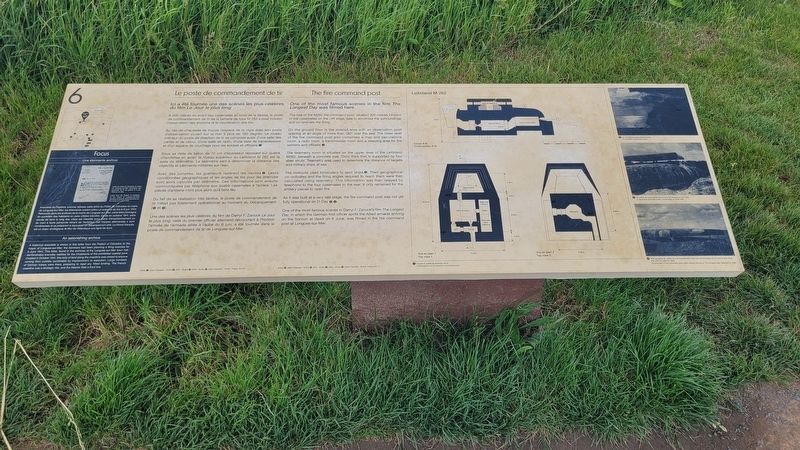
Ici a été tournée une des scènes les plus célèbres du film Le Jour le plus long
A 300 mètres en avant des casemates au bord de la falaise, le poste de commandement de tir de la batterie de type M 262 a pour mission l'observation des environs et la coordination des tirs.
Au rez-de-chaussée se trouve l'espace de la vigie avec son poste d'observation ouvert sur la mer à plus de 180 degrés. Le niveau inférieur du poste de direction de tir se compose aussi d'une salle des cartes et de calcul, d'une salle de radio, d'une salle de transmissions et d'un espace de couchage pour les soldats et officiers (1).
Sous sa dalle de béton de 70 cm d'épaisseur reposant sur quatre chandelles en acier, le niveau supérieur du Leitstand M 262 est la salle de télémétrie. Le télémètre sert à déterminer la distance des objectifs et bâtiments militaires sur l'eau.
Avec des jumelles, les guetteurs repèrent les navires (2). Leurs coordonnées géographiques et les angles de tirs pour les atteindre sont alors calculés par télémètre. Ces informations sont ensuite communiquées par téléphone aux quatre casemates à l'arrière. Les
this page online
Du fait de sa réalisation très tardive, le poste de commandement de tir n'était pas totalement opérationnel au moment du Débarquement (3) et (4). Une des scènes les plus célèbres du film de Darryl F. Zanuck Le Jour le plus long, celle du premier officier allemand découvrant à l'horizon l'arrivée de l'armada alliée à l'aube du 6 juin, a été tournée dans le poste de commandement de tir de Longues-sur-Mer.
© doc.(1), Alain Chazette - doc.(2) D.R. - doc.(3), IWM - doc.(4), Alain Chazette - doc. Focus, AD 14
Une étonnante archive
Anecdote de l'histoire, comme l'atteste cette lettre du Préfet du Calvados au maire de Longues-sur-Mer, les Allemands avaient prévu un exercice de tirs le 6 juin 1944. Retrouvée dans les archives de la mairie de Longues-sur-Mer, cette lettre témoigne du quotidien des habitants en zone côtière interdite. Créée en octobre 1941, cette bande de terre le long des côtes est interdite sous peine d'emprisonnement ou de mort à toute personne venant de l'extérieur. Les troupes allemandes y sont nombreuses et se préparent à repousser un débarquement allié. Le littoral français est un enjeu stratégique, le Mur de l'Atlantique une ligne de front.
Lettre du préfet du Calvados au maire de Longues-sur-Mer annonçant des exercices de tir de guerre le 6 juin 1944 sur la côte.
Légendes
(Photo #1) Coupe du poste de direction de tir
(Photo #2) Un formidable poste d'observation
(Photo #3) Un poste de commandement encore en travaux en juin 1944
(Photo #4) Photographie du poste de commandement prise lors du tournage du Le Jour le plus long, film sorti en salle en 1962.
One of the most famous scenes in the film The Longest Day was filmed here
The

Photographed by James Hulse, June 4, 2025
2. Le poste de commandement de tir / The fire command post Marker
The view of the marker along the trail.
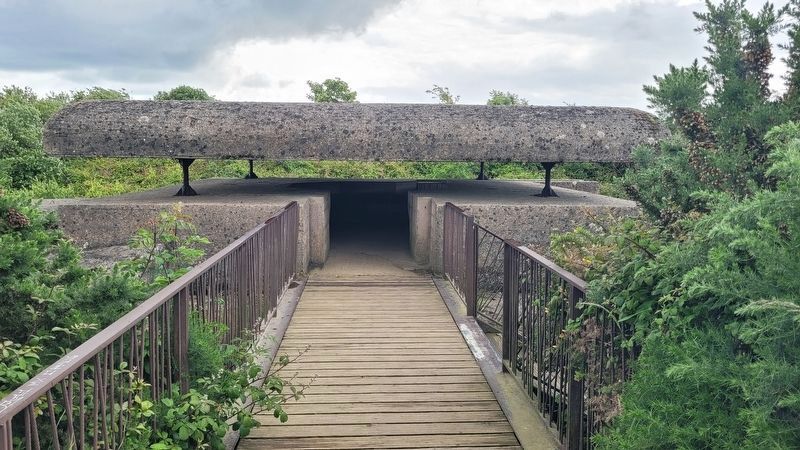
On the ground floor is the lookout area with an observation post opening at an angle of more than 180° over the sea. The lower level of the fire command post also comprises a map and calculations room, a radio room, a transmission room and a sleeping area for the soldiers and officers (1).
The telemetry room is situated on the upper level of the Leitstand M262, beneath a concrete slab 70cm thick that is supported by four steel struts. Telemetry was used to determine the distance of targets and military ships at sea.
The lookouts used binoculars to spot ships (2). Their geographical coordinates and the firing angles required to reach them were then calculated using telemetry. This information was then relayed by telephone to the four casemates to the rear. It only remained for the artillery pieces to open fire.
As it was built at a very late stage, the fire command post was not yet fully operational on D-Day (3)(4). One of the most famous scenes in Darryl F.
Photographed by James Hulse, June 4, 2025
3. Le poste de commandement de tir / The fire command post Marker
The view of the Fire Control Post Bunker.
© doc.(1), Alain Chazette - doc.(2) D.R. - doc.(3), IWM - doc.(4), Alain Chazette - doc. Focus, AD 14
An astonishing archive
A historical anecdote is shown in this letter from the Prefect of Calvados to the mayor of Longues-sur-Mer: the Germans had been planning a firing exercise for 6 June 1944. This letter, found in, the archives of, the Longues-sur-Mer town hall, demonstrates everyday realities for the inhabitants of the prohibited coastal zone. Created in October 1941, this strip of land along the coastline was closed to anyone coming from outside, punishable by imprisonment or execution. Large numbers of German troops were there, preparing to repel any Allied landing. The French coastline was a strategic risk, and the Atlantic Wall a front line.
Letter from the Prefect of Calvados to the mayor of Longues-sur-Mer advising of combat firing exercises on the coast on 6 June 1944.
Captions
(Photo #1) Cross-section of fire direction command post
(Photo #2) An excellent observation post
(Photo #3) A command post still under construction in June 1944
(Photo #4) Photograph of the command post taken during filming of The Longest Day, released in 1962.
Erected by Longues-sur-Mer
Photographed by James Hulse, June 4, 2025
4. Le poste de commandement de tir / The fire command post Marker
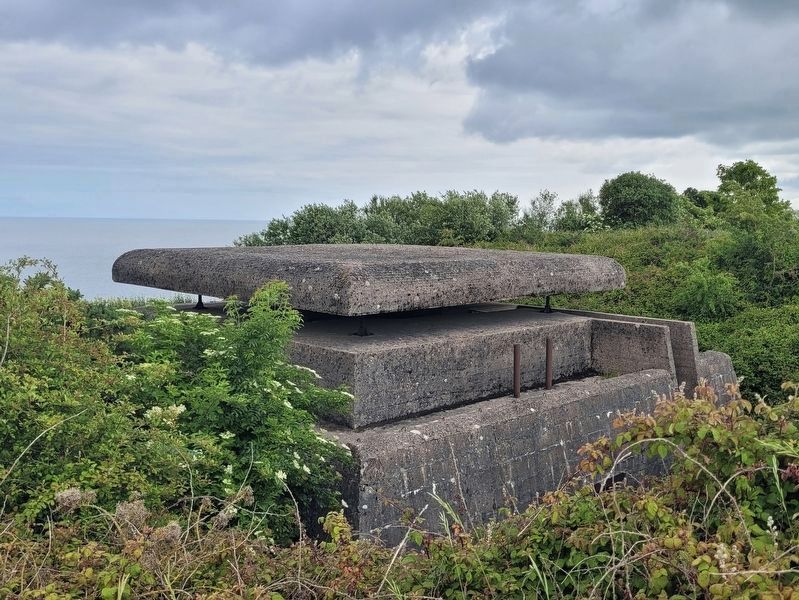
The view of the Fire Control Post Bunker with the English Channel in the background.
Topics. This historical marker is listed in this topic list: War, World II. A significant historical month for this entry is October 1941.
Location. 49° 20.751′ N, 0° 41.639′ W. Marker is in Longues-sur-Mer, Normandie (Normandy), in Calvados. It is on Rue de la Mer just north of Rue des Batteries. The marker is located on the grounds of the Longues-sur-Mer Battery Historical Monument Site. Touch for map. Marker is at or near this postal address: 39 Rue de la Mer, Longues-sur-Mer, Normandie 14400, France. Touch for directions.

Regionally, it is in the North Atlantic Region, Europe, the European Union, Atlantic Europe, the Schengen Area, Western Europe, a coastal Mediterranean country, and the Western World. Historically, it finds itself in what was once a French colony and also the Roman Empire.
Other nearby markers. At least 8 other markers are within walking distance of this marker: Un rédoutable système défensif / A formidable defensive system (a few steps from this marker); La prise de la batterie / Capturing the battery (approx. 0.3 kilometers away); Les casemates / The casemates (approx. 0.3 kilometers
Photographed by James Hulse, June 4, 2025
5. Le poste de commandement de tir / The fire command post Marker
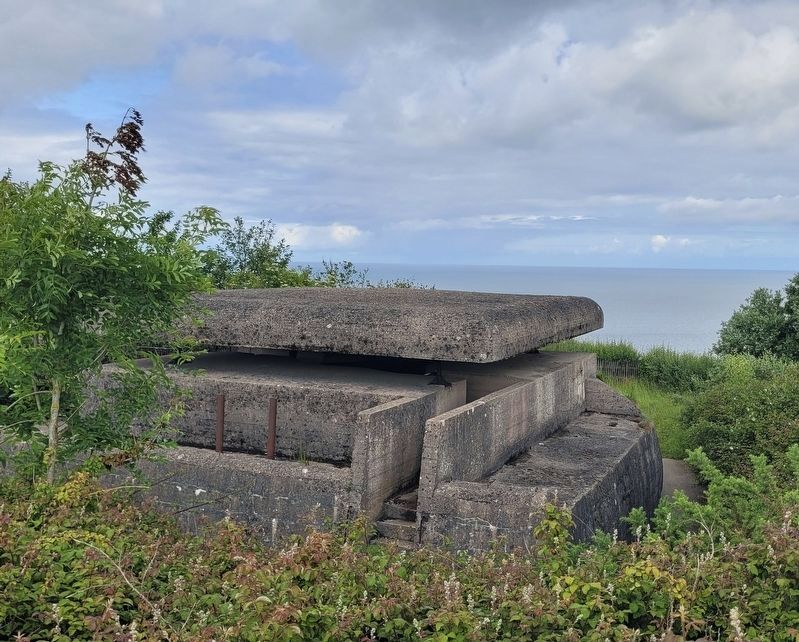
The view of the Fire Control Post Bunker with the English Channel in the background.
Credits. This page was last revised on December 27, 2025. It was originally submitted on December 26, 2025, by James Hulse of Medina, Texas. This page has been viewed 114 times since then and 92 times this year. Photos: 1, 2, 3, 4, 5. submitted on December 27, 2025, by James Hulse of Medina, Texas.
