Longues-sur-Mer in Calvados, Normandy, France — Western Europe
Un site naturel remarquable
⎯⎯⎯
A remarkable natural environment
Photographed by James Hulse, June 4, 2025
1. Un site naturel remarquable / A remarkable natural environment Marker

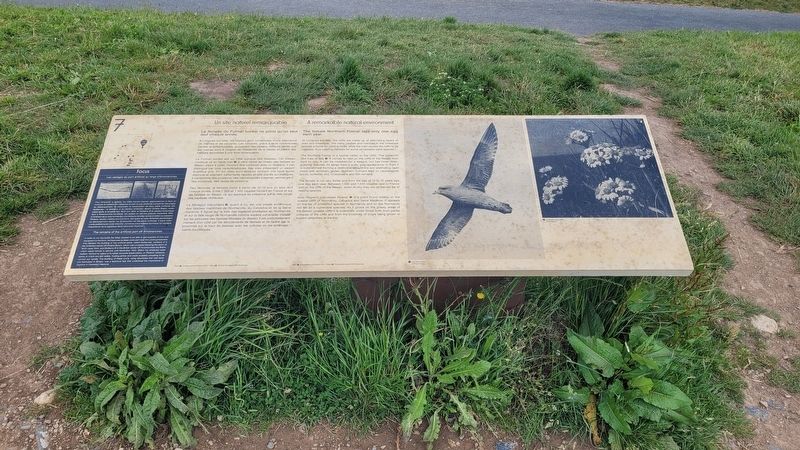
La femelle du Fulmar boréal ne pond qu'un seul œuf chaque année.
A Longues-sur-Mer, les falaises sont constituées d'une alternance de marnes et de calcaires. Les calcaires, grâce à leurs nombreuses cavités et anfractuosités, accueillent des oiseaux nicheurs tandis que les marnes sont à l'origine de l'instabilité de la falaise et créent des habitats favorables à une flore remarquable.
Le Fulmar boréal est un hôte typique des falaises. Cet oiseau nordique vit en haute mer (1). Il vient nicher au niveau des falaises du Bessin d'avril à juillet. Pouvant être confondu avec un Goéland, il s'en distingue par trois caractéristiques. Ses ailes présentent un aspect écailleux gris. En vol, elles sont tendues formant une ligne droite distincte et alternent battements rapides et vols planés acrobatiques. Il consomme des poissons, des céphalopodes (calamar, seiches etc.), des crustacés, des restes de poissons.
Peu féconde, la femelle pond à partir de 10-12 ans un seul œuf chaque année. Entre 1 000 et 1 500 couples nichent en France et sur les falaises du Bessin ce qui explique sa présence sur la liste rouge des
this page online
Le Séneçon blanchâtre (2), quant à lui, est une plante endémique des falaises maritimes de Normandie, du Calvados et de la Seine maritime. Il figure sur la liste des espèces protégées en Normandie et sur la liste rouge de Normandie comme espèce vulnérable. Installé sur les pelouses des falaises littorales du Bessin, il est potentiellement menacé d'un côté par les éboulements de falaises et de l'autre par la proximité sur le haut de falaises avec les cultures ou les aménagements touristiques.
© doc.(1), Conservatorie du littoral-CD14 - © doc.(2), Thomas Bousqure-CBN Normandie
Les vestiges du port artificiel au large d'Arromanches
Pour remporter la bataille, les Alliés doivent pouvoir approvisionner le front en hommes et matériel. En l'absence de port en eau profonde à proximité des plages du Débarquement, ils conçoivent la construction de deux ports artificiels dits Mulberries : le Mulberry A en secteur américain devant Omaha Beach, inutilisable après la tempête des 19-21 juin 1944, le Mulberry B en secteur britannique face à Arromanches-les-Bains, qui restera en service jusqu'en novembre 1944. A l'intérieur de la rade formée par une centaine de brise-lames en béton ou caissons Phoenix, encore visibles pour certains, des quais et voies flottantes permettaient un déchargement rapide. La construction de ces ports artificiels, à partir d'éléments préfabriqués outre-Manche, constitue une prouesse technique qui souligne l'importance de la logistique dans l'opération Neptune.
Légendes
(Photo #1) Le Fulmar boréal
(Photo #2) Le Séneçon blanchâtre
The female Northern Fulmar lays only one egg each year.
At
Photographed by James Hulse, June 4, 2025
2. Un site naturel remarquable / A remarkable natural environment Marker
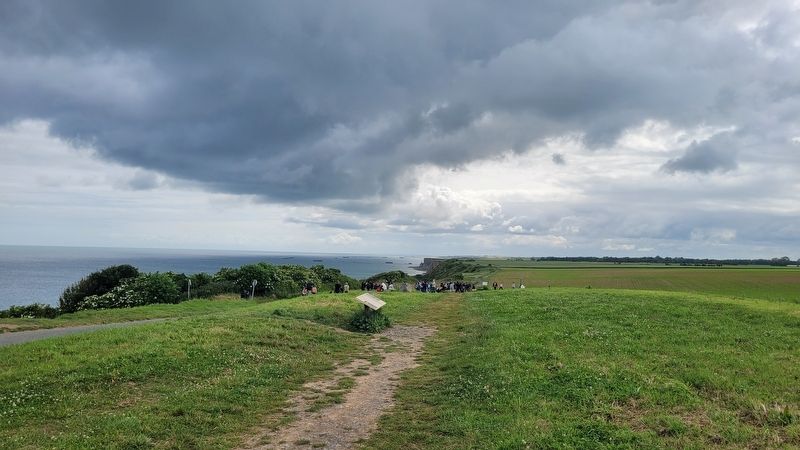
The view of the marker
The Northern Fulmar is a typical visitor to the cliffs. This subarctic bird lives at sea (1). It comes to nest on the cliffs of the Bessin from April to July. It can be mistaken for a seagull, but has three distinguishing features. Its wings have a scaly, grey appearance. In flight it is outstretched, forming a distinctive straight line and alternating rapid beats with acrobatic glides. Northern Fulmars feed on cephalopods (squid, cuttlefish etc), crustaceans and fish remains.
The female is not very fertile and from the age of 10 to 12 years lays one egg each year. Between 1,000 and 1,500 couples nest in France and on the cliffs of the Bessin, which is why they are on the red list of nesting species. Grey Ragwort (Jacobaea incana) (2) is a plant found widely on the coastal cliffs of Normandy, Calvados and Seine Maritime. It appears on the list of protected
Photographed by James Hulse, June 4, 2025
3. Un site naturel remarquable / A remarkable natural environment Marker
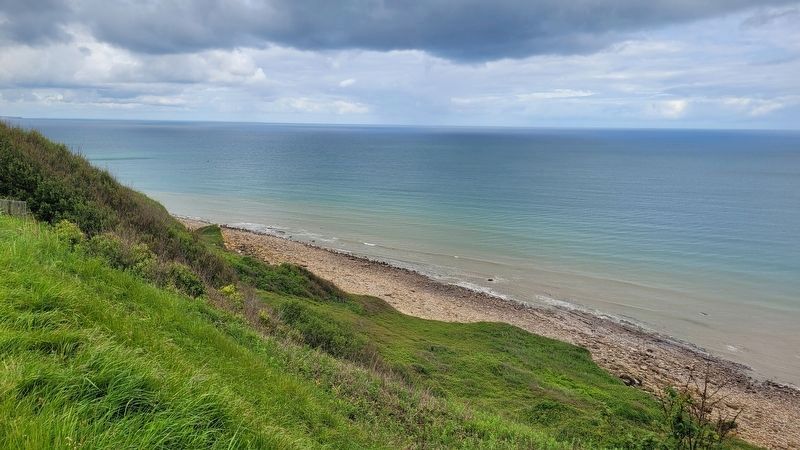
The view of the beach from the marker.
© doc.(1), Conservatorie du littoral-CD14 - © doc.(2), Thomas Bousqure-CBN Normandie
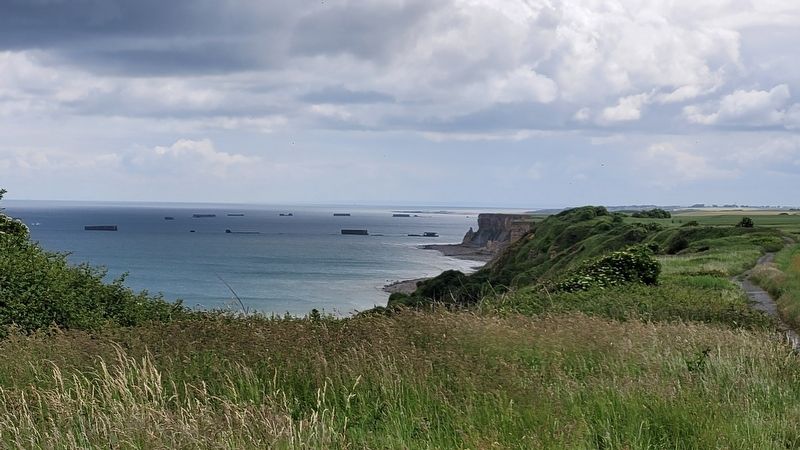
The remains of the artificial port off Arromanches
In order to win the battle the Allies needed to be able to get supplies of men and equipment to the front. As there was no deep water port near the Landings beaches, they devised the building of two artificial ports, called Mulberries: Mulberry A in the American sector off Omaha Beach, which was unusable following the storm of 19-21 June 1944, and Mulberry B in the British sector off Arromanches-les-Bains, which would remain in service until November 1944. Within the sheltered water harbour formed by about a hundred concrete breakwaters, or Phoenix caissons, some of which are still visible, floating jetties and roads enabled unloading to be carried out rapidly. The building of these ports, using structures that had been pre-fabricated in Britain, was a technical feat that underlined the importance of logistics in Operation Neptune.
Captions
(Photo #1) Northern Fulmar
(Photo #2) Grey Ragwort
Erected by Longues-sur-Mer
Photographed by James Hulse, June 4, 2025
4. Un site naturel remarquable / A remarkable natural environment Marker
The view of the concrete breakwaters, or Phoenix caissons in the waters in the background.
Topics. This historical marker is listed in these topic lists: Animals • War, World II. A significant historical month for this entry is June 1944.
Location. 49° 20.753′ N, 0° 41.416′ W. Marker is in Longues-sur-Mer, Normandie (Normandy), in Calvados. It is on Rue de la Mer just north of Rue des Batteries. The marker is located on the grounds of the Longues-sur-Mer Battery Historical Monument Site. Touch for map. Marker is at or near this postal address: 39 Rue de la Mer, Longues-sur-Mer, Normandie 14400, France. Touch for directions.

Regionally, it is in the North Atlantic Region, Europe, the European Union, Atlantic Europe, the Schengen Area, Western Europe, a coastal Mediterranean country, and the Western World. Historically, it finds itself in what was once a French colony and also the Roman Empire.
Other nearby markers. At least 8 other markers are within walking distance of this marker: La piste d'aviation B-11 / The B-11 airfield (about 210 meters away, measured in a direct line); Le poste de commandement de tir / The fire command post (approx. 0.3 kilometers away); Un rédoutable système défensif / A formidable defensive system (approx. 0.3 kilometers away); Une batterie allemande de défense côtière / A German coastal defence battery (approx. 0.3 kilometers away); Un site d'exception / An exceptional site (approx. 0.3 kilometers away); Canon russe Putilov / Putilov Russian cannon (approx. 0.4 kilometers away); Aérodrome B-11 de Longues-sur-Mer / B-11 airfield at Longues-sur-Mer (approx. 0.4 kilometers away); La prise de la batterie / Capturing the battery (approx. 0.4 kilometers away). Touch for a list and map of all markers in Longues-sur-Mer.
Credits. This page was last revised on December 27, 2025. It was originally submitted on December 26, 2025, by James Hulse of Medina, Texas. This page has been viewed 91 times since then and 68 times this year. Photos: 1, 2, 3, 4. submitted on December 27, 2025, by James Hulse of Medina, Texas.
