Palais-Royal in Paris in Département de Paris, Île-de-France, France — Western Europe
Le Quartier du Palais-Royale
⎯⎯⎯
The Palais-Royal and its Neighborhood
| — | Parcours Révolution | — |

Photographed by Andrew Ruppenstein, July 26, 2022
1. The Palais-Royal and its Neighborhood Marker

Propriété du duc d'Orléans, le cousin du roi, le Palais-Royal est un des rares lieux de liberté sous la monarchie. La police n'a pas le droit d'y entrer. On peut s'y promener, jouer aux jeux de hasard, voir des spectacles, boire dans des cafés, acheter les nouveautés à la mode, croiser des prostituées, mais aussi parler plus librement qu'ailleurs. C'est ici que, le 12 juillet 1789, le journaliste Camille Desmoulins et d'autres «patriotes» lancent l'insurrection qui mènera à la prise de la Bastille deux jours plus tard. Après la chute de la monarchie le 10 août 1792, le Palais-Royal est rebaptisé «Palais-Égalité». Le jardin devient le «jardin de la Révolution»: c'est désormais un lieu public. Sous le Directoire (1795-1799), ses restaurants et ses boutiques attirent la nouvelle bourgeoisie. En 1814, il est rendu au du duc d'Orléans, futur Louis-Philippe 1er, et redevient un enjeu politique. Lors de la révolution de 1848 il est envahi avant d'échapper à l'incendie lors de la Commune de 1871.
this page online
(Timeline not transcribed)
Erected by Ville
Photographed by Andrew Ruppenstein, July 26, 2022
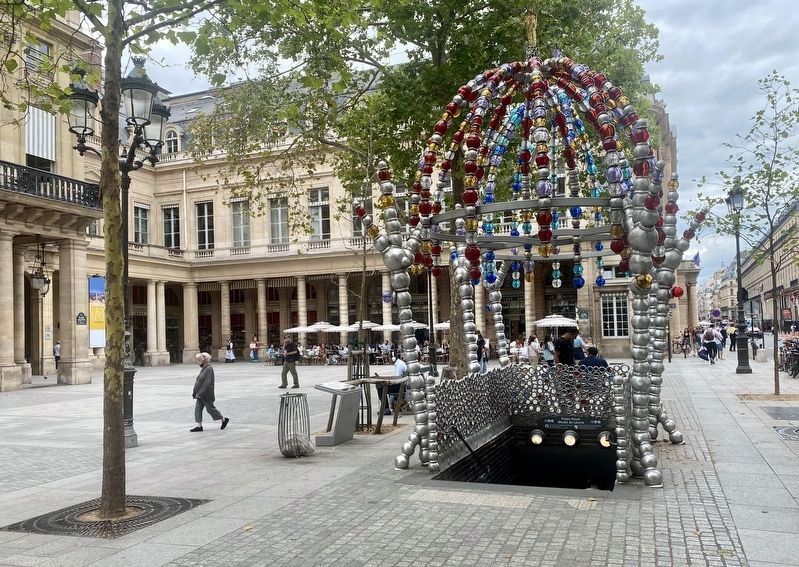
2. The Palais-Royal and its Neighborhood Marker - wide view
The marker is visible here mounted to a pedestal just a few steps to the left of the Metro entrance.
Topics. This historical marker is listed in this topic list: Notable Places. A significant historical date for this entry is July 12, 1789.
Location. 48° 51.79′ N, 2° 20.16′ E. Marker is in Paris, Île-de-France, in Département de Paris. It is in Palais-Royal. It is at the intersection of Rue Saint-Honoré and Avenue de l‘Opera, on the left when traveling east on Rue Saint-Honoré. Touch for map. Marker is in this post office area: Paris, Île-de-France 75001, France. Touch for directions.

Regionally, it is in the North Atlantic Region, Europe, the European Union, Atlantic Europe, the Schengen Area, Western Europe, a coastal Mediterranean country, and the Western World. Historically, it finds itself in what was once a French colony and also the Roman Empire.
Other nearby markers. At least 8 other markers are within walking distance of this marker: Café de la Régence (within shouting distance of this marker); La Cour de Comptes / Court of Accounts (within shouting distance of this marker); Le pavillon de la Bibliothèque et l'aile nord du Louvre (about 90 meters away, measured in a direct line); Auguste Bournonville (1805-1879) (about 120 meters away); Cyprien Ragueneau (about 150 meters away); Antoine de Pluvinel (approx. 0.2 kilometers away); École élémentaire d’Argenteuil Jewish Students Memorial (approx. 0.2 kilometers away); La Ligue des Sociétés de la Croix-Rouge / League of the Societies of the Red Cross (approx. 0.3 kilometers away). Touch for a list and map of all markers in Paris.
More about this marker. This is one of sixteen (?) neighborhood markers showing the local points of interest in each neighborhood that are relevant to the French Revolution. An English-language app is available for download.
Also see . . . The Palais-Royal and its Neighborhood (Ville de Paris - Parcours Revolution). This page provides the same text as the English-language portion of the marker but with the addition of an interactive map showing the 13 points of interest in the Palais-Royal neighborhood, along with explanatory text for each point of interest. (Submitted on December 27, 2025.)
Credits. This page was last revised on January 14, 2026. It was originally submitted on December 27, 2025, by Andrew Ruppenstein of Lamorinda, California. This page has been viewed 50 times since then and 19 times this year. Photos: 1, 2. submitted on December 27, 2025, by Andrew Ruppenstein of Lamorinda, California.
