
Binnenstad Hoorn , North Holland, Netherlands — Northwestern Europe
Statencollege
| — | Rijksmonument | — |
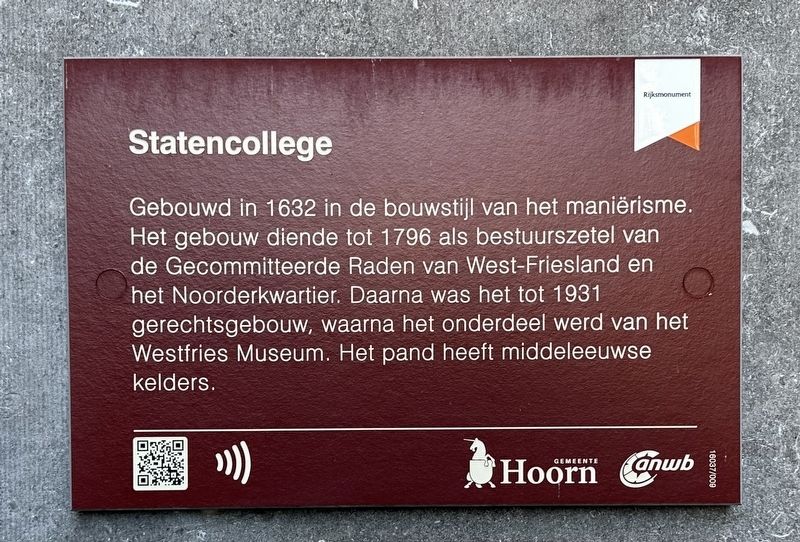
Photographed by Andrew Ruppenstein, March 22, 2025
1. Statencollege Marker

Erected by Gemeente Hoorn, ANWB. (Marker Number 16037/009.)
Topics. This historical marker is listed in this topic list: Notable Buildings. A significant historical year for this entry is 1632.
Location. 52° 38.35′ N, 5° 3.529′ E. Marker is in Hoorn, Noord-Holland (North Holland). It is in Binnenstad Hoorn. It is on Rode Steen, on the right when traveling south. Touch for map. Marker is at or near this postal address: Roode Steen 1, Hoorn, Noord-Holland 1621 CV, Netherlands. Touch for directions.

Regionally,
this page online
Other nearby markers. At least 8 other markers are within walking distance of this marker: Roode Steen 15 (a few steps from this marker); Jan Pieterszoon Coen (Hoorn 1587 - Batavia 1629) (within shouting distance of this marker); Onderduikers in het Duitse hoofdkwartier / People in hiding at the German headquarters (within shouting distance of this marker); Hadrianus Junius (about 90 meters away, measured in a direct line); Kerkstraat 10 (about 90 meters away); Koepelkerk (1882) (about 90 meters away); Grote Kerk (about 150 meters away); Monument bij het Grote Kerk / Grote Kerk Executions Memorial (about 150 meters away). Touch for a list and map of all markers in Hoorn.
Also see . . .
1. Statencollege (Hoorn) (Wikipedia, in Dutch). (Submitted on January 3, 2026.)
2. Statencollege (Erfgoedhoorn, in Dutch). The QR code on the marker leads to this page, with some additional information. Excerpt (in translation):
This(Submitted on January 3, 2026.)historic site once housed one of Hoorn's first stone houses. This former "Grote Stynhuys" (Great Stynhuys) already existed in the 14th century and was succeeded by the "Hoge Huys." The vaulted cellars from this early phase have been preserved and are located beneath the current building. This magnificent building was completed in 1632 as a meeting place for the Gecommitteerde Raden (Committee Councils) of West Friesland and the Noorderkwartier (Northern Quarter). Befitting its purpose, the building was designed in a rich Mannerist style. Its scale, design, and choice of luxurious materials exude power and splendor. A remarkable feature is the use of the so-called "stacked column order," where each floor is adorned with a column with a different type of capital.Photographed by Andrew Ruppenstein, March 22, 20252. Statencollege Marker - wide viewThe marker is visible here to the right of the museum entrance. Note this is only a small portion of the building, with the much larger portion being out of the picture, on the left.


courtesy Rijksdienst voor Cultureel Erfgoed (via Wikimedia Commons), circa 1900
3. Statencollege
Credits. This page was last revised on January 4, 2026. It was originally submitted on January 3, 2026, by Andrew Ruppenstein of Lamorinda, California. This page has been viewed 31 times since then. Photos: 1, 2, 3. submitted on January 3, 2026, by Andrew Ruppenstein of Lamorinda, California.
