Downtown in Regina in Sherwood No. 159, Saskatchewan — The Prairie Region (North America)
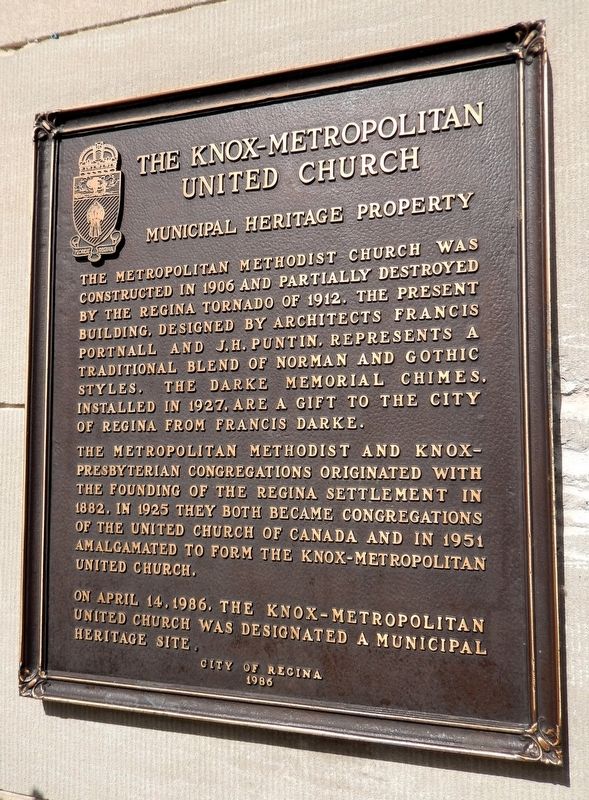
The Knox-Metropolitan United Church
Municipal Heritage Property
Photographed by Cosmos Mariner, June 20, 2022
1. The Knox-Metropolitan United Church Marker
The Metropolitan Methodist Church was constructed in 1906 and partially destroyed by the Regina tornado of 1912. The present building, designed by architects Francis Portnall and J.H. Puntin, represents a traditional blend of Norman and Gothic styles. The Darke Memorial Chimes, installed in 1927, are a gift to the City of Regina from Francis Drake.
The Metropolitan Methodist and Knox-Presbyterian congregations originated with the founding of the Regina settlement in 1882. In 1925 they both became congregations of the United Church of Canada and in 1951 amalgamated to form the Knox-Metropolitan United Church.
On April 14, 1986, the Knox-Metropolitan United Church was designated a Municipal Heritage Site.
Erected 1986 by City of Regina.
Topics. This historical marker is listed in these topic lists: Architecture • Disasters • Religion & Religious Structures • Settlements & Settlers. A significant historical year for this entry is 1906.
Location. 50° 26.854′ N, 104° 36.839′ W. Marker is in Regina, Saskatchewan, in Sherwood No. 159. It is in Downtown. It is on Lorne Street just north of Victoria Avenue, on
this page online

Regionally, this marker is in Southeast Saskatchewan. It is also in the Prairies. Globally, it is in North America, the Western Hemisphere, the Western World, and the Anglosphere. Historically, it finds itself in what was once a British colony and also Rupert’s Land.
Other nearby markers. At least 8 other markers are within walking distance of this marker: Regina Land Titles Building (about 90 meters away, measured in a direct line); Hon. Walter Scott (about 120 meters away); Creation of the Province of Saskatchewan (about 120 meters away); Chief Payepot (about 150 meters away); Saskatchewan Revenue Building (about 180 meters away); St Paul's Anglican Cathedral (about 240 meters away); The Northern Bank (approx. 0.4 kilometers away); Saskatchewan Government Telephones Head Office (approx. 0.7 kilometers away). Touch for a list and map of all markers in Regina.
Regarding The Knox-Metropolitan United Church. Canadian

Photographed by Cosmos Mariner, June 20, 2022
2. The Knox-Metropolitan United Church Marker
The marker is mounted at eye level near the northeast [right] corner of the church.
From the Canadian Register Statement of Significance:
Key elements that contribute to the heritage character of this site include:• those elements which commemorate the Knox Presbyterian and Metropolitan Methodist congregations, such as the addition of the original Knox Presbyterian Church cornerstone within the wall of the south addition;Originally constructed in 1906, the design was a product of the well-known Toronto and Winnipeg architectural firm, Darling and Pearson. Firm
• those elements that relate to its Gothic-and-Norman-style architecture, such as its common bond, pressed red-brick exterior with sandstone trim; cross-gable roof with parapets; crenellated bell tower with louvres and a peal of twelve bells; an integral front entrance marked by three, segmental, Norman-style, stone arches containing oak doors with circular glazing; pointed-arch, Gothic-style windows with label moulding and stops, inset with tracery and stained glass;
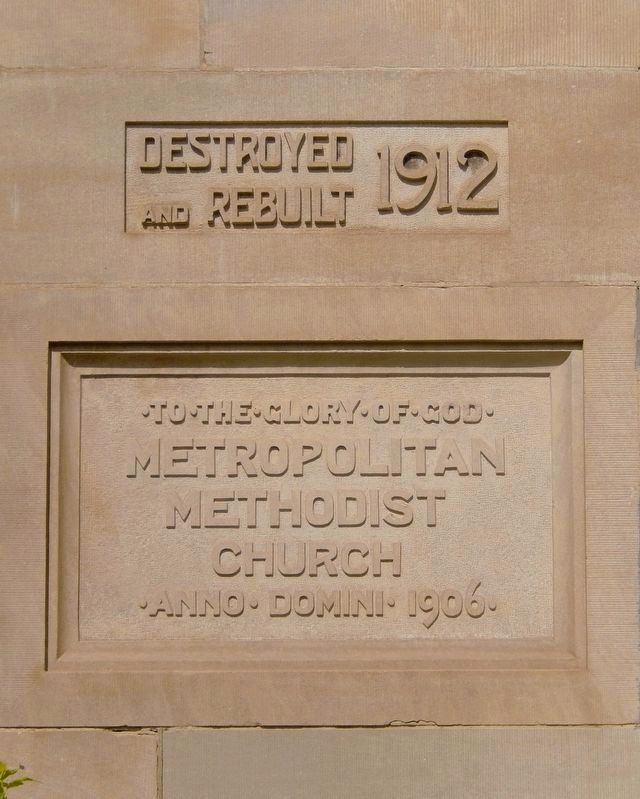
• those elements which pertain to its relationship to Victoria Park, such as its original location on Victoria Avenue facing Victoria Park to the east.architect Francis Portnall was sent to the site as a supervising architect and remained to become one of the city’s most prolific architects. In 1912, the 1200-seat structure was largely destroyed by a devastating tornado but was similarly rebuilt within a year to the specifications of James H. Puntin. Puntin incorporated elements of the original structure, such as portions of the exterior brick walls and the Norman arched entrance, while replicating others such as the bell tower. The church was rebuilt, however, with an increased Gothic style influence, exemplified by the crenellated tower and pointed arch windows with tracery.Photographed by Cosmos Mariner, June 20, 20223. Knox-Metropolitan United Church CornerstoneDestroyed and rebuilt 1912
To the glory of God
Metropolitan Methodist Church
Anno Domini 1906
Also see . . .
1. Knox-Metropolitan United Church (Wikipedia).Excerpt: Both Knox Presbyterian and Metropolitan Methodist’s buildings were destroyed by the Regina Cyclone of 1912. Both church buildings were soon rebuilt; before the economic demands of the First World War, which erupted in 1914 and which Canada immediately joined though the US remained neutral until 1916. Both became United Church of Canada on June 10, 1925, when the new denomination was formed by the national merger of Presbyterian,(Submitted on January 6, 2026, by Cosmos Mariner of Cape Canaveral, Florida.)Methodist and Congregational churches.Photographed by Cosmos Mariner, June 20, 20224. Original Knox Presbyterian Church Cornerstone“The cornerstone of Knox Church, which stood at 12th Avenue & Lorne Street, was laid here June 1956.”
It is beside the contemporary Knox-Metropolitan United Church south entrance facing Victoria Avenue.
In 1927 Mr. and Mrs. Francis Nicholson Darke donated the Darke Memorial Chimes to the Metropolitan Church in memory of their son, Clifford Albert Darke. The twelve hand-rung bells were cast in London, England by the firm that made the bells for Westminster Abbey, Mears and Stainbank of London, England, established in 1570. The peal consists of twelve bells, weighing nearly sixteen tons in all, tuned to the diatonic scale of C, having a span of an octave and a fifth. The largest bell, weighing about two tons, has two clappers since it serves as a toll bell as well. The bells, controlled by individually hung ropes, are arranged in the ringing chamber in a circular fashion where several ringers can work at one time or a single person can play a melody line. The Darke Memorial Chimes are heard every Sunday morning and on other special occasions. The church has a large 3-manual Casavant Frères organ, the gift of Isabel Willoughby and installed in the early 1970s.
Knox-Met has its interior arranged in the Akron Plan, a square auditorium the pews arranged in a fan shape radiating out from the pulpit andportable communion table, perhaps making it more suitable a focus in congregational worship than the formal style of Anglican and Roman Catholic churches.June 20, 20225. Knox-Metropolitan United Church Tower
2. Knox-Metropolitan United Church (Canadian Register of Historic Places).Excerpt: Knox Metropolitan United Church is the home to two of Regina’s oldest congregations, the Metropolitan Methodist congregation and the Knox Presbyterian congregation. Rising from tent beginnings, these congregations were separately formed in 1882, the year of Regina’s founding, but merged in 1951 under the banner of the United Church. The first organized service in the city was conducted, four days after Regina was proclaimed the Territorial capital, by a Methodist minister, for what would become the Methodist Metropolitan Church. As both congregations had become part of the United Church of Canada in 1924, to consolidate the congregations separated by only one city block, the Knox congregation left its church in 1951 to join the Metropolitan congregation. Today the Knox Metropolitan United Church remains the largest(Submitted on January 6, 2026, by Cosmos Mariner of Cape Canaveral, Florida.)United Church in the city, drawing worshippers from the citywide area.Photographed by Cosmos Mariner, June 20, 20226. The Knox-Metropolitan United Church
3. Regina Cyclone of 1912 (Wikipedia).Excerpt: On Sunday, June 30, 1912, a violent and deadly tornado devastated the city of Regina, Saskatchewan, Canada. The tornado, also known as the Regina Cyclone or the Regina tornado of 1912, remains the deadliest tornado in Canadian history with a total of 28 fatalities and about 300 people injured. At about 4:50 p.m., green funnel clouds formed and touched down south of the city, tearing through the residential area between Wascana Lake and Victoria Avenue, and continuing through the downtown business district, rail yards, warehouse district, and northern residential area.(Submitted on January 6, 2026, by Cosmos Mariner of Cape Canaveral, Florida.)
The tornado formed 18 km south of the city and was roughly 150 metres wide by the time it reached Regina. The tornado's wind velocity has been estimated at 250 mph, making it the equivalent of a high-end F4 on the Fujita Scale. It left 2,500 people homeless, out of a population of about 30,213 (in 1911). Around 500 buildings were destroyed or damaged. Property damage was quantified at $1.2 million CAD, and it would be forty years before the $4.5 million CAD private and public debt incurred to rebuild and repair was repaid.
The only remaining "souvenir" of this event is different-coloured bricks on the north wall of Regina's Knox-Metropolitan United Church (the former Metropolitan Methodist church). The bricks show where the wall was rebuilt after its tornado-caused collapse.
Credits. This page was last revised on January 6, 2026. It was originally submitted on January 4, 2026, by Cosmos Mariner of Cape Canaveral, Florida. This page has been viewed 58 times since then. Photos: 1, 2, 3, 4, 5, 6. submitted on January 6, 2026, by Cosmos Mariner of Cape Canaveral, Florida.