Regierungsvierte in Berlin in Mitte, Germany — Northeast German Plain (The European Plain)
Russisches Haus in Berlin
⎯⎯⎯
Russian House in Berlin
Photographed by Andrew Ruppenstein, August 27, 2025
1. Russian House in Berlin Marker

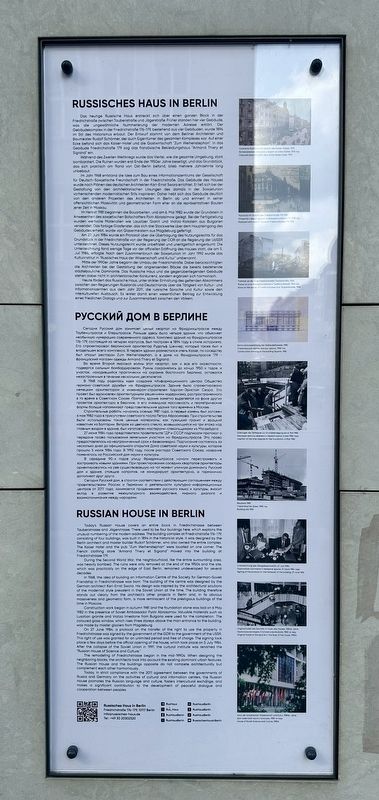
Das heutige Russische Haus erstreckt sich über einen ganzen Block in der Friedrichstraße zwischen Taubenstraße und Jägerstraße. Früher standen hier vier Gebäude, modernen Adresse erklärt. Der was die ungewöhnliche Nummerierung der Gebäudekomplex in der Friedrichstraße 176-179, bestehend aus vier Gebäuden, wurde 1894 im Stil des Historismus erbaut. Der Entwurf stammt von dem Berliner Architekten und Baumeister Rudolf Schönner, der auch Eigentümer des gesamten Komplexes war. Auf einer Ecke befand sich das Kaiser-Hotel und die Gastwirtschaft "Zum Weihenstephan". In das Gebäude Friedrichstraße 179 zog das französische Bekleidungshaus "Armand Thiery et Sigrand" ein.
Während des Zweiten Weltkriegs wurde das Viertel, wie die gesamte Umgebung, stark bombardiert. Die Ruinen wurden erst Ende der 1950er Jahre beseitigt, und das Grundstück, das sich praktisch am Rand von Ost-Berlin befand, blieb mehrere Jahrzehnte lang unbebaut.
Im Jahr 1968 entstand die Idee zum Bau eines Informationszentrums der Gesellschaft für Deutsch-Sowjetische Freundschaft in der Friedrichstraße. Das Gebäude des Hauses wurde nach Plänen des deutschen Architekten Karl-Ernst Swora errichtet. Er ließ sich bei der Gestaltung von den architektonischen Lösungen des damals in der Sowjetunion vorherrschenden modernistischen Stils inspirieren. Daher hebt sich das Gebäude deutlich von den anderen Projekten des Architekten in Berlin ab und erinnert in seiner offensichtlichen Massivität und geometrischen Form eher an die repräsentativen Bauten jener Zeit in Moskau.
Im Herbst 1981 begannen die Bauarbeiten, und am 6. Mai 1982 wurde der Grundstein in Anwesenheit des sowjetischen Botschafters Pjotr Abrassimow gelegt. Bei der Fertigstellung wurden wertvolle Materialien wie Lausitzer Granit und Vratza-Kalkstein aus Bulgarien
this page online
Am 27. Juni 1984 wurde ein Protokoll über die Übertragung des Nutzungsrechts für das Grundstück in der Friedrichstraße von der Regierung der DDR an die Regierung der UdSSR unterzeichnet. Dieses Nutzungsrecht wurde unbefristet und unentgeltlich eingeräumt. Die Unterzeichnung fand wenige Tage vor der offiziellen Eröffnung des Hauses statt, die am 5. Juli 1984, erfolgte. Nach dem Zusammenbruch der Sowjetunion im Jahr 1992 wurde das Kulturinstitut in "Russisches Haus der Wissenschaft und Kultur" umbenannt.
Mitte der 1990er Jahre begann der Umbau der Friedrichstraße. Dabei berücksichtigten die Architekten bei der Gestaltung der angrenzenden Blöcke die bereits bestehende städtebauliche Dominante. Das Russische Haus und die gegenüberliegenden Gebäude stehen dabei nicht in architektonischer Konkurrenz, sondern ergänzen sich harmonisch.
Heute fördert das Russische Haus, unter strikter Einhaltung des geltenden Abkommens zwischen den Regierungen Russlands und Deutschlands über die Tätigkeit
Photographed by Andrew Ruppenstein, August 27, 2025
2. Russian House in Berlin and Marker
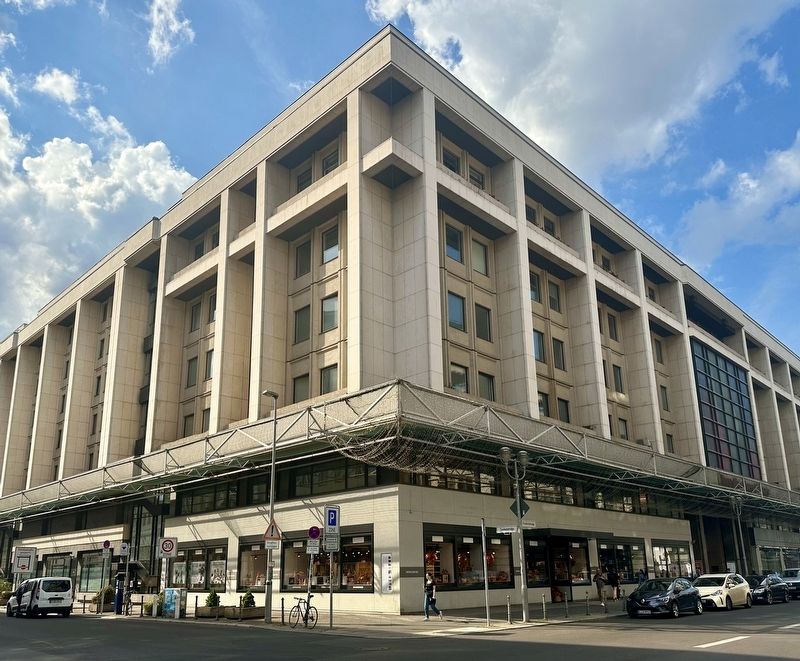
The marker is visible here attached to the corner of the building.
Сегодня Русский дом занимает целый квартал на Фридрихштрассе между Таубенштрассе и Егерштрассе. Раньше здесь было четыре здания,
Photographed by Andrew Ruppenstein, August 27, 2025
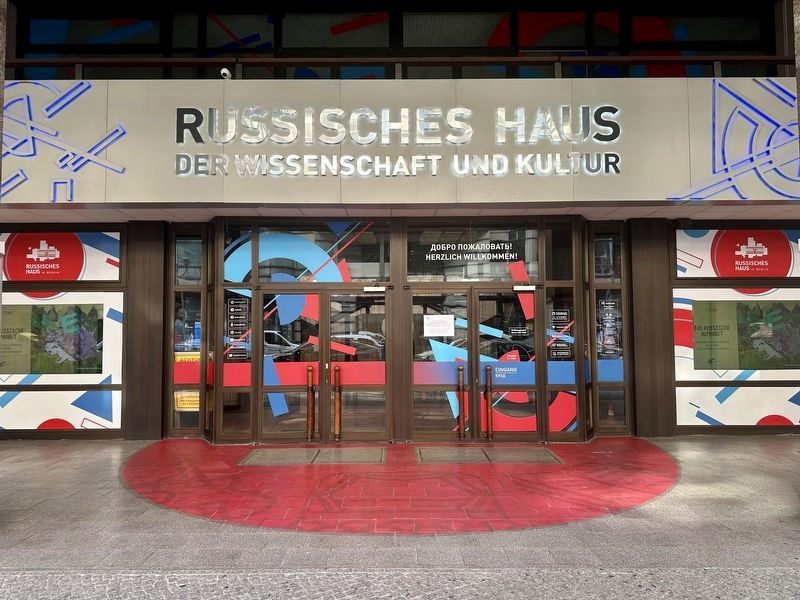
3. Russian House entrance
circa 1980s
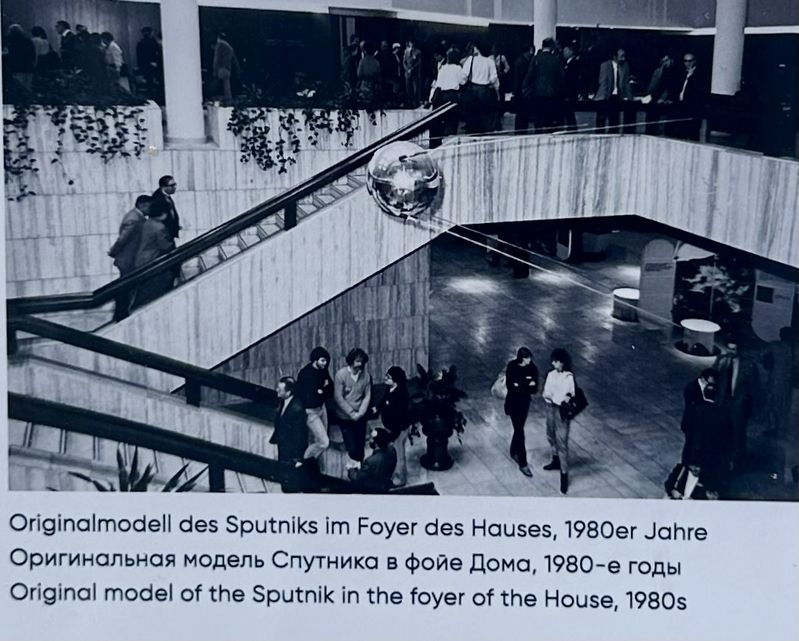
4. Marker photo: original model of Sputnik satellite at the Russian House
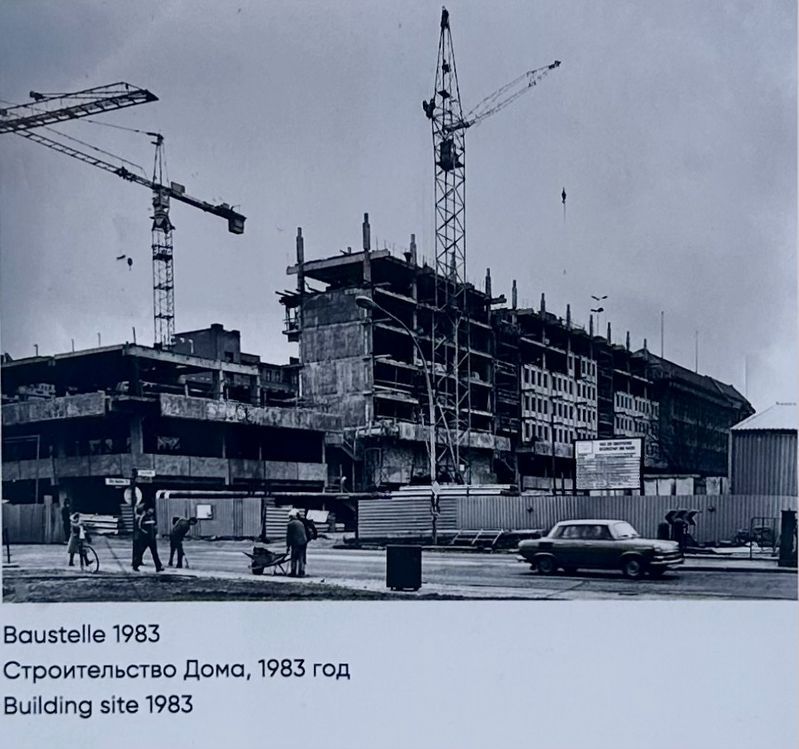
1983
5. Marker photo: construction of the Russian House
Во время Второй мировой войны этот квартал, как и все его окрестности, подвергся сильным бомбардировкам. Руины сохранялись до конца 1950-х годов, и участок, находившийся практически на окраине Восточного Берлина, оставался незастроенным в течение нескольких десятилетий.
В 1968 году родилась идея создания «Информационного центра Общества германо-советской дружбы» на Фридрихштрассе. Здание было спроектировано немецким архитектором и инженером-строителем Карлом-Эрнстом Свора. Его проект был вдохновлен архитектурными решениями модернизма, распространенного в то время в Советском Союзе. Поэтому здание заметно выделяется на фоне других проектов архитектора в Берлине, а его очевидная массивность и геометрические формы больше напоминают представительские здания того времени в Москве. Строительные работы начались осенью 1981 года, а первый камень был заложен 6 мая 1982 года в присутствии советского посла Петра Абрасимова. При строительстве были использованы такие ценные материалы, как лужицкий гранит и врацкий известняк из Болгарии. Витраж из цветного стекла, возвышающийся на три этажа над главным входом в здание, был изготовлен мастерами-стекольщиками из Магдебурга.
27 июня 1984 года представители правительств ГДР и СССР подписали протокол о передаче права пользования земельным участком на Фридрихштрассе. Это право предоставлялось на неограниченный срок и безвозмездно. Подписание состоялось за несколько дней до официального открытия Дома советской науки и культуры, которое прошло 5 июля 1984 года. В 1992 году, после распада Советского Союза, название поменялось на Российский дом науки и культуры.
В середине 90-х годов улицу Фридрихштрассе начали перестраивать и застраивать новыми зданиями. При проектировании соседних кварталов архитекторы ориентировались на уже существовавшую на тот момент уличную доминанту. Русский дом и здания, стоящие напротив, не конкурируют архитектурно, а гармонично дополняют друг друга.
Сегодня Русский дом, в строгом соответствии с действующим соглашением между правительствами России и Германии о деятельности культурно-информационных центров от 2011 года, занимается продвижением русского языка и культуры, вносит вклад в развитие межкультурного взаимодействия, мирного диалога и взаимопонимания между народами.
Today's Russian House covers an entire block in Friedrichstrasse between Taubenstrasse and Jägerstrasse. There used to be four buildings here, which explains the unusual numbering of the modern address. The building complex at Friedrichstraße 176-179, consisting of four buildings, was built in 1894 in the historicist style. It was designed by the Berlin architect and master builder Rudolf Schönner, who also owned the entire complex. The Kaiser Hotel and the pub "Zum Weihenstephan” were located on one corner. The French clothing store "Armand Thiery et Sigrand” moved into the building at Friedrichstrasse 179.
During the Second World War, the neighbourhood, like the entire surrounding area, was heavily bombed. The ruins were only removed at the end of the 1950s and the site, which was practically on the edge of East Berlin, remained undeveloped for several decades.
In 1968, the idea of building an Information Centre of the Society for German-Soviet Friendship in Friedrichstrasse was born. The building of the centre was designed by the German architect Karl-Ernst Swora. His design was inspired by the architectural solutions of the modernist style prevalent in the Soviet Union at the time. The building therefore stands out clearly from the architect's other projects in Berlin and, in its obvious massiveness and geometric form, is more reminiscent of the prestigious buildings of the time in Moscow.
Construction work began in autumn 1981 and the foundation stone was laid on 6 May 1982 in the presence of Soviet Ambassador Pyotr Abrassimov. Valuable materials such as Lusatian granite and Vratza limestone from Bulgaria were used for the completion. The coloured glass window, which rises three storeys above the main entrance to the building, was made by master glaziers from Magdeburg.
On 27 June 1984, a protocol on the transfer of the right to use the property in Friedrichstrasse was signed by the government of the GDR to the government of the USSR. This right of use was granted for an unlimited period and free of charge. The signing tookplace a few days before the official opening of the house, which took place on 5 July 1984. After the collapse of the Soviet Union in 1991, the cultural institute was renamed the "Russian House of Science and Culture."
The remodeling of Friedrichstrasse began in the mid-1990s. When designing the neighboring blocks, the architects took into account the existing dominant urban features. The Russian House and the buildings opposite do not compete architecturally but complement each other harmoniously.
Today, in strict compliance with the 2011 agreement between the governments of Russia and Germany on the activities of cultural and information centers, the Russian House promotes the Russian language and culture, fosters intercultural exchange, and makes a significant contribution to the development of peaceful dialogue and cooperation between peoples.
Topics. This historical marker is listed in these topic lists: Architecture • Education • War, World II. A significant historical year for this entry is 1894.
Location. 52° 30.785′ N, 13° 23.357′ E. Marker is in Berlin, in Mitte. It is in Regierungsvierte. It is at the intersection of Taubenstraße and Friedrichstrasse, on the left when traveling east on Taubenstraße. Touch for map. Marker is at or near this postal address: Friedrichstrasse 176-179, Berlin 10117, Germany. Touch for directions.

Regionally, it is in Europe, the European Union, Atlantic Europe, Central Europe, the Schengen Area, Western Europe, and the Western World. Historically, it finds itself in what was once the Holy Roman Empire, the former East Germany, and at the Berlin Wall.
Other nearby markers. At least 8 other markers are within walking distance of this marker: Franz Berwald (a few steps from this marker); Kampf gegen das 2. Königs-Regiment / Fight against the 2nd King's Regiment (a few steps from this marker); Deutscher Leichtathletik Verband / German Athletics Association (within shouting distance of this marker); Haus der Demokratie / House of Democracy (approx. 0.3 kilometers away); Leonhard Euler (approx. 0.3 kilometers away); Carl Gotthard Langhans (approx. 0.3 kilometers away); Die Berliner Mauer - The Berlin Wall (approx. 0.3 kilometers away); Wilhelmplatz 8/9 (approx. 0.4 kilometers away). Touch for a list and map of all markers in Berlin.
Also see . . . Geschichte des Ortes (Russian House in Berlin, in German). An extended history of the site, available in German or Russian only. (Submitted on January 5, 2026.)
Credits. This page was last revised on January 5, 2026. It was originally submitted on January 5, 2026, by Andrew Ruppenstein of Lamorinda, California. This page has been viewed 79 times since then. Photos: 1, 2, 3, 4, 5. submitted on January 5, 2026, by Andrew Ruppenstein of Lamorinda, California.
