Boulevard Manor in Arlington in Arlington County, Virginia — The American South (Mid-Atlantic)
Bluemont Junction, ca. 1934

Photographed by Craig Swain, November 22, 2009
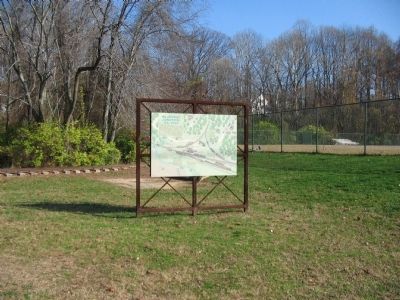
1. Bluemont Junction, ca. 1934 Marker
Bluemont Junction began operation in 1912 as a part of the newly formed Washington & Old Dominion (W&OD) Railway. The station was a busy transfer point for passengers and freight from Alexandria and Georgetown to points west, ending at Bluemont, Virginia - a popular resort in the Blue Ridge Mountains. During the peak years of passenger service, from 1912 and into the 1920s, trains ran between Georgetown and Bluemont Junction every 10-20 minutes. Passenger service ended in 1951, but freight continued until 1968 when the W&OD went out of business. The W&OD Trail from Shirlington to Purcellville follows the former railroad right-of-way.
[Captions:]
Wye Track
Trains from three directions met at Bluemont Junction. A triangular pattern of tracks joined at a "Y" (wye), so that freight trains could reverse direction. Electric-powered passenger trains could go backwards and forwards so they did not need to be turned around on the wye. The wye was also used as a holding place for freight cars. Look for a railroad tie from the wye along the side of the dirt road.
The Routes
The Junction connected two routes - a former steam powered line between Alexandria and the town of Bluemont in Loudoun County with an electric trolley service between Georgetown in Washington, D.C. and Great Falls, Virginia.
Electric Power House
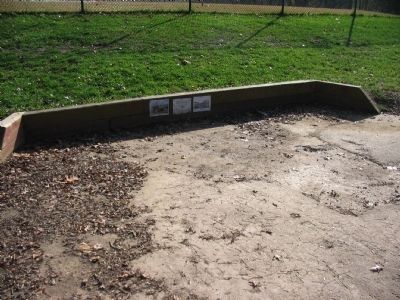
Trains that traveled to and from Bluemont Junction were steam powered until about 1913, when overhead electric wires were added to provide power for the engines. Electricity was generated by the railroad's power plant in Rosslyn and transmitted through a series of transformers like the one housed here. You can see the remains of the building foundation - it's the concrete pad to the left of the soccer field. The railroad converted to diesel power in the 1940s.
Station
The wood building attached to the power transformer house served as a passenger and freight depot. From this building a dispatcher also controlled rail traffic, first by telephone and later by radio.
Interurban Trains
Passenger service was handled by one or two car trains that used self-propelled electric coaches known as "combines." Some combines also carried mail and baggage.
Bluemont Junction
In
this page online
Milk Trains
Loudoun County was a major supplier of milk to the Washington area. And for decades, the railroad was the quickest way for dairy farmers to get their perishable product to market. Beginning at dawn, the train picked up milk cans all along the route from Bluemont, Virginia to Rosslyn. The evening milk train returned the empty cans.
Passenger Service
Passenger service peaked in 1919. Almost from the beginning, the W&OD faced growing competition from autos - more convenient for commuting and weekend excursions. In 1941, the railroad stopped running passenger trains. Service, however, was revived in 1943 as a war-emergency measure to conserve gasoline. After the war, patronage fell off again, and passenger service permanently ended in 1951.
Mail Cars
Carrying mail was relatively more

Photographed by Craig Swain, November 22, 2009
2. Bluemont Junction, ca. 1934 Marker Reverse
Hauling Freight
After World War II, the heavy freight business flourished. Now diesel-powered W&OD trains carried building supplies for new housing and highways in Arlington and eastern Fairfax County. The late 1950s brought another boon to the railroad - the construction of Dulles Airport. The W&OD was the closest railroad to the massive construction site. To do the hauling, the railroad beefed up its equipment, road beds, and bridges. Freight revenues reached an all-time high in 1959.
Topics and series. This historical marker is listed in these topic lists: Industry & Commerce • Railroads & Streetcars • War, World II. In addition, it is included in the Washington and Old Dominion (W&OD) Railroad series list. A significant historical year for this entry is 1912.
Location. 38° 52.376′ N, 77° 7.958′ W. Marker is in Arlington, Virginia, in Arlington County. It is in Boulevard Manor. It is on Washington and
Photographed by Craig Swain, November 22, 2009
3. Bluemont Junction, ca. 1934 Marker

Regionally, this marker is in the Washington Metropolitan Area and in Northern Virginia. It is also in the American South, specifically in the Upper South, in the Mid-Atlantic, and on the Eastern Seaboard. Globally, it is in the North Atlantic Region, North America, the Western Hemisphere, the Western World, and the Anglosphere. Historically, it finds itself in what was once the territory of the Mississippian Culture, one of the original Thirteen Colonies, one of the Confederate States of America, and the Antebellum South.
Other nearby markers. At least 8 other markers are within walking distance of this marker: Rosslyn Station (a few steps from this marker); The Great Falls Line (a few steps from this marker); a different marker also named Bluemont Junction (a few steps from this marker); The W&OD Railway and Jim Crow Laws (within shouting
Photographed by Craig Swain
4. Floor of Electric Substation
Other markers no longer nearby. The Great Falls Line (was a few steps from this marker but has been replaced with another marker now near it); Confederate Outpost (was approx. 0.2 miles away but has been replaced with another marker now near it).
More about this marker. The front of the marker displays an illustration of the Junction as it looked in the 1930s. On the back are several photos of the trains and tracks of the W&OD Railroad.
Regarding Bluemont Junction, ca. 1934. The word "Sherlington" is misspelled. The correct spelling is "Shirlington".
Also see . . .
1. Washington and Old Dominion Railroad. Wikipedia article detailing the history of the railroad and a listing of the train stations. (Submitted on November 29, 2009, by Craig Swain of Leesburg, Virginia.)
2. Washington & Old Dominion Railroad Regional Park. Northern Virginia Regional Park Authority (Submitted on July 27, 2021.)
Credits. This page was last revised on February 2, 2026. It was originally submitted on November 29, 2009, by Craig Swain of Leesburg, Virginia. This page has been viewed 3,666 times since then and 162 times this year. Last updated on January 6, 2026, by Bernard H. Berne of Arlington, Virginia. Photos: 1, 2, 3. submitted on November 29, 2009, by Craig Swain of Leesburg, Virginia. 4. submitted on November 28, 2009, by Craig Swain of Leesburg, Virginia. • Devry Becker Jones was the editor who published this page.
