
Binnenstad Hoorn , North Holland, Netherlands — Northwestern Europe
Ramen
⎯⎯⎯
“Frames”
| — | Rijksmonument | — |
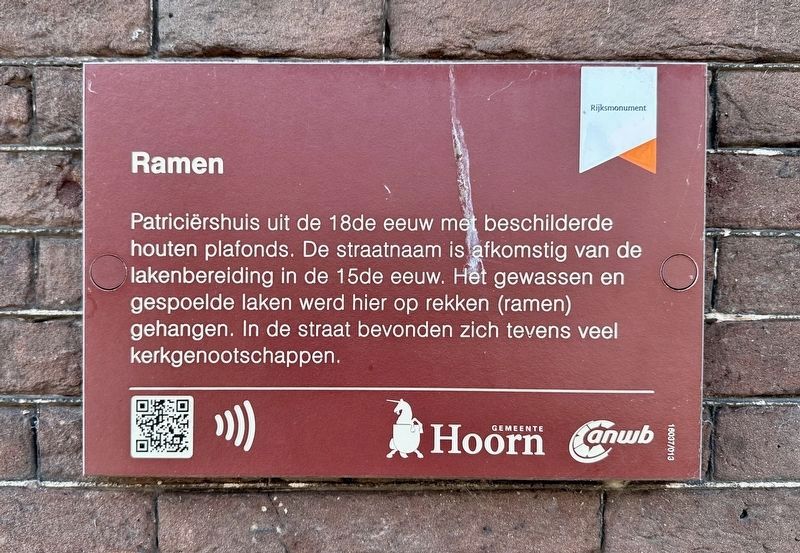
Photographed by Andrew Ruppenstein, March 22, 2025
1. Ramen / “Frames” Marker

Erected by Gemeente Hoorn, ANWB. (Marker Number 16037/013.)
Topics. This historical marker is listed in these topic lists: Industry & Commerce • Notable Places.
Location. 52° 38.487′ N, 5° 3.475′ E. Marker is in Hoorn, Noord-Holland (North Holland). It is in Binnenstad Hoorn. It is on Ramen north of Nieuwsteeg, on the right when traveling north. Touch for map. Marker is at or near this postal address: Ramen 1B, Hoorn, Noord-Holland 1621 EL, Netherlands. Touch for directions.

Regionally, it is in Europe, the European Union, Atlantic Europe,
this page online
Other nearby markers. At least 8 other markers are within walking distance of this marker: Ramen 1-3 (here, next to this marker); Lutherse Kerk / Lutheran Church (a few steps from this marker); Ramen 34 (about 90 meters away, measured in a direct line); Hoorn WWII Memorial (about 120 meters away); Nieuwstraat 18 (about 150 meters away); Koepelkerk (1882) (about 150 meters away); Burgerweeshuis / Orphanage (about 180 meters away); Graaf van Bossu (about 180 meters away). Touch for a list and map of all markers in Hoorn.
Also see . . . Ramen 1-3 (Erfgoedhoorn.nl, in Dutch). The QR code on the marker leads to this page, with additional information and photos. Excerpt (in translation):
An orphanage was established on this site in the 17th century. A century later, the building acquired its current Louis XV-style façade. It was then converted into a double residence. The house on the left belonged to Mayor Albert Coninck, and the house on the right to Regent Pieter Avenhorn.(Submitted on January 7, 2026.)The building subsequently served other purposes, including temporarily serving as a poorhouse and an evening sewing and knitting school. In 1982, the building underwent a thorough renovation and was converted into youth housing.Photographed by Andrew Ruppenstein, March 22, 20252. Ramen / “Frames” MarkerThe marker ís visible here to the left of the door.
The design of the façade is entirely in keeping with its function as a patrician residence. The façade exudes power, taste, and wealth. Taste is often related to the spirit of the times, and this is certainly the case here, as the façade was designed in the rococo style. This style was very popular in the 18th century and is recognizable by the asymmetrical design of the façade. The design of the entrance and the ornamentation in the cornice are also entirely rococo. Shortly after completion, people spoke of a modern facade with ‘ornaments in the latest style’.
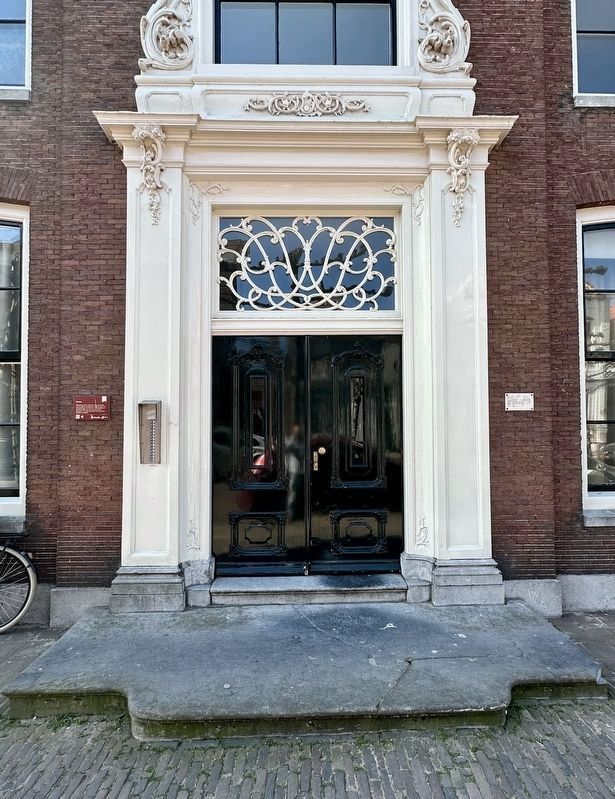
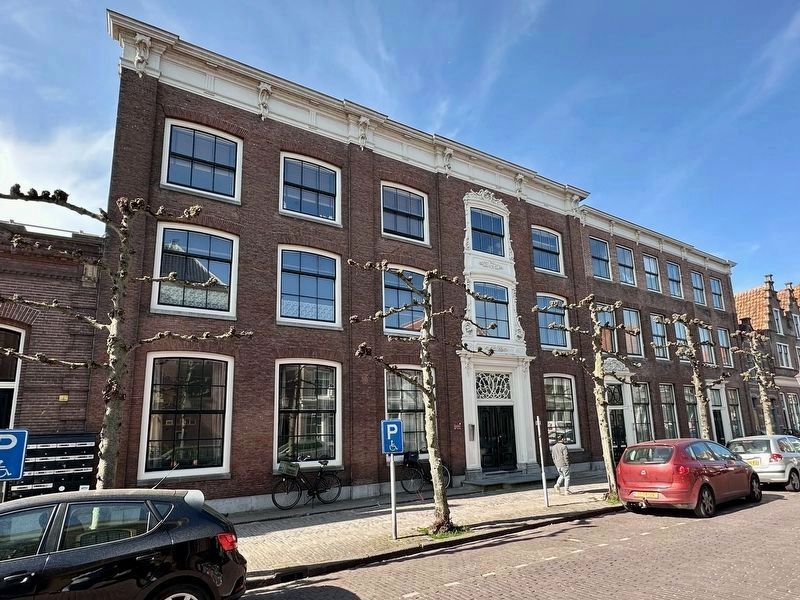
Photographed by Andrew Ruppenstein, March 22, 2025
3. Ramen / “Frames” Marker
Credits. This page was last revised on January 9, 2026. It was originally submitted on January 7, 2026, by Andrew Ruppenstein of Lamorinda, California. This page has been viewed 39 times since then. Photos: 1, 2, 3. submitted on January 7, 2026, by Andrew Ruppenstein of Lamorinda, California.
