Kremmling in Grand County, Colorado — The American Mountains (Southwest)
Kremmling
Photographed by Cosmos Mariner, July 28, 2025
1. Kremmling Marker
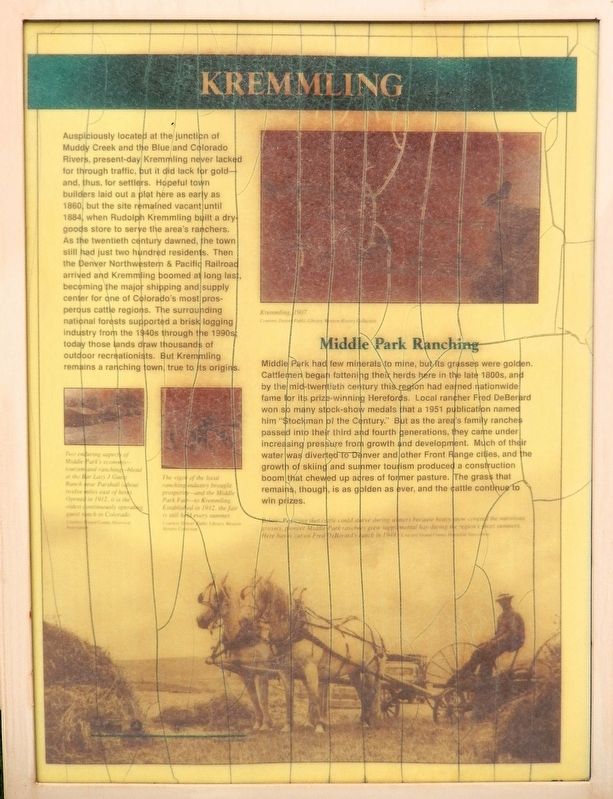
Auspiciously located at the junction of Muddy Creek and the Blue and Colorado Rivers, present-day Kremmling never lacked for through traffic, but it did lack for gold — and, thus, for settlers. Hopeful town builders laid out a plat here as early as 1860, but the site remained vacant until 1884, when Rudolph Kremmling built a dry goods store to serve the area’s ranchers. As the twentieth century dawned, the town still had just two hundred residents. Then the Denver Northwestern & Pacific Railroad arrived and Kremmling boomed at long last becoming the major shipping and supply center for one of Colorado’s most prosperous cattle regions. The surrounding national forests supported a brisk logging industry from the 1940s through the 1990 s; today those lands draw thousands of outdoor recreationists. But Kremmling remains a ranching town, true to its origins.
Middle Park Ranching
Middle Park had few minerals to mine, but its grasses were golden. Cattlemen began fattening their herds here in the late 1800s, and by the mid-twentieth century this region had earned nationwide fame for its prize-winning Herefords. Local rancher Fred
this page online
[photo captions]
• Two enduring aspects of Middle Park’s economy — tourism and ranching — blend at the Bar Lazy J Guest Ranch near Parshall (about twelve miles east of here). Opened in 1912, it is the oldest continuously operating guest ranch in Colorado.
• The vigor of the local ranching industry brought prosperity — and the Middle Park Fair — to Kremmling. Established in 1912, the fair is still held every summer.
• Kremmling, 1907
• Realizing that cattle could starve during winters because heavy snow covered the nutritious grasses, pioneer Middle Park ranchers grew supplemental hay during the region’s short summers. Here
Photographed by Cosmos Mariner, July 28, 2025
2. Kremmling Marker
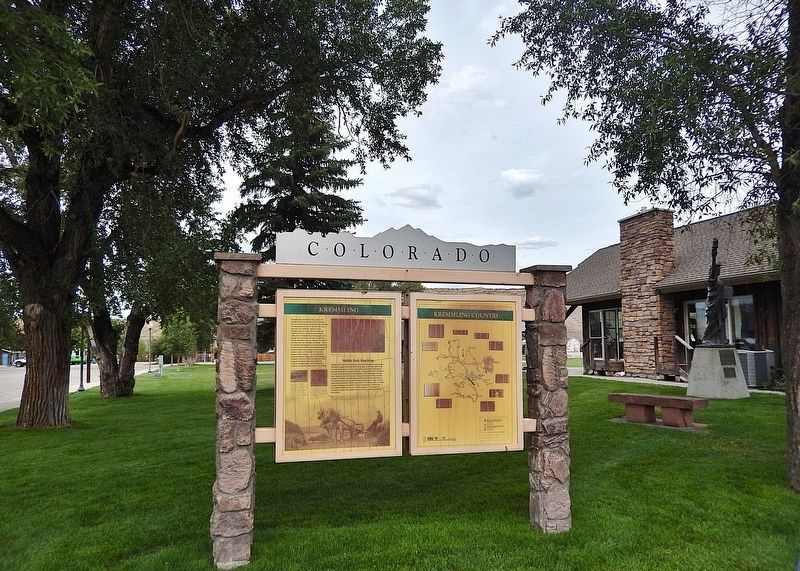
Looking north from Park Avenue. This historical marker is on the left side of the Colorado History interpretive kiosk. The Kremmling Chamber of Commerce and Visitor Center is in the right background.
Erected 2002 by Colorado Historical Society, Colorado Department of Transportation, and Federal Highway Administration.
Topics and series. This historical marker is listed in these topic lists: Horticulture & Forestry • Industry & Commerce • Railroads & Streetcars • Settlements & Settlers. In addition, it is included in the History Colorado series list. A significant historical year for this entry is 1884.
Location. 40° 3.547′ N, 106° 23.598′ W. Marker is in Kremmling, Colorado, in Grand County. It is at the intersection of Park Avenue (U.S. 40) and 2nd Street, on the right when traveling west on Park Avenue. The marker is near the sidewalk at the southwest corner of the Kremmling Chamber of Commerce and Visitor Center grounds. Touch for map. Marker is at or near this postal address: 203 Park Avenue, Kremmling CO 80459, United States of America. Touch for directions.

Regionally, this marker is in the Colorado High Rockies and on the Continental Divide. It is also in the American Mountain West. Globally, it is in North America, the Rocky Mountains, the Western Hemisphere, the Western World, and the Anglosphere.
Other nearby markers. At least 3 other markers are within walking distance of this marker: Middle Park Medicine (here, next to this marker); Wildlife Conservation (here, next to this marker); Replica of the Statue of Liberty (a few steps from this marker).
Also see . . . Kremmling, Colorado (Wikipedia).
Excerpt: The settlement started with only a general store, run by a man named Rudolph "Kare" Kremmling, built on the north side of Muddy Creek. In 1881, two brothers, Aaron and John Kinsey, made part of their ranch into a town and called it Kinsey City. Kare moved his store across the river to the new site and soon people were calling this place Kremmling. The original post office was called Kinsey City and ran from 1881 to 1885, with Kare Kremmling the first postmaster. The name Kremmling was not officially recognized until 1895. After the Moffat railroad—the Denver, Northwestern & Pacific Railway—arrived in July 1906, Kremmling became the county's central shipping point. It was incorporated May 14, 1904. In the 20th century, ranching became the main industry in the valley in the vicinity of the town. In 1906, Kasper Schuler built the first brick building in town.(Submitted on January 7, 2026, by Cosmos Mariner of Cape Canaveral, Florida.)
Credits. This page was last revised on January 7, 2026. It was originally submitted on January 7, 2026, by Cosmos Mariner of Cape Canaveral, Florida. This page has been viewed 85 times since then. Photos: 1, 2. submitted on January 7, 2026, by Cosmos Mariner of Cape Canaveral, Florida.
