What Cheer in Keokuk County, Iowa — The American Midwest (Upper Plains)
Opera House

Photographed by Cosmos Mariner, September 19, 2025
1. Opera House Marker
Restoration started 1965
Entered in the National Register of Historic Places July 1973
Topics and series. This historical marker is listed in these topic lists: Architecture • Entertainment • Fraternal or Sororal Organizations • Notable Buildings. In addition, it is included in the National Register of Historic Places (NRHP) series list. A significant historical year for this entry is 1893.
Location. 41° 24.089′ N, 92° 21.291′ W. Marker is in What Cheer, Iowa, in Keokuk County. It is at the intersection of South Barnes Street and Briney Street, on the left when traveling north on South Barnes Street. The marker is mounted on the northeast corner of the Opera House, facing South Barnes Street. Touch for map. Marker is at or near this postal address: 102 South Barnes Street, What Cheer IA 50268, United States of America. Touch for directions.

Regionally, this marker is in Eastern Iowa. It is also in the American Midwest and in the Corn Belt. Globally, it is in North America, the Western Hemisphere, the Western World, and the Anglosphere. Historically, it finds itself in what was once
this page online
Other nearby markers. At least 8 other markers are within 16 miles of this marker, measured as the crow flies: What Cheer Freedom Rock Veterans Memorial (within shouting distance of this marker); Veterans Memorial (approx. 9.1 miles away); Birthplace of Boys and Girls Rural Clubs (approx. 9.1 miles away); Civil War Memorial (approx. 9.1 miles away); Court of Keokuk County and Keokuk County Court House (approx. 9.1 miles away); Poweshiek County Freedom Rock (approx. 15.4 miles away); WTC Steel (approx. 15.4 miles away); The Bill of Rights (approx. 15.4 miles away).
Regarding Opera House. National Register of Historic Places № 73000733.
From the National Register Nomination prepared by Thomas O. Burriss, 2/7/1973:
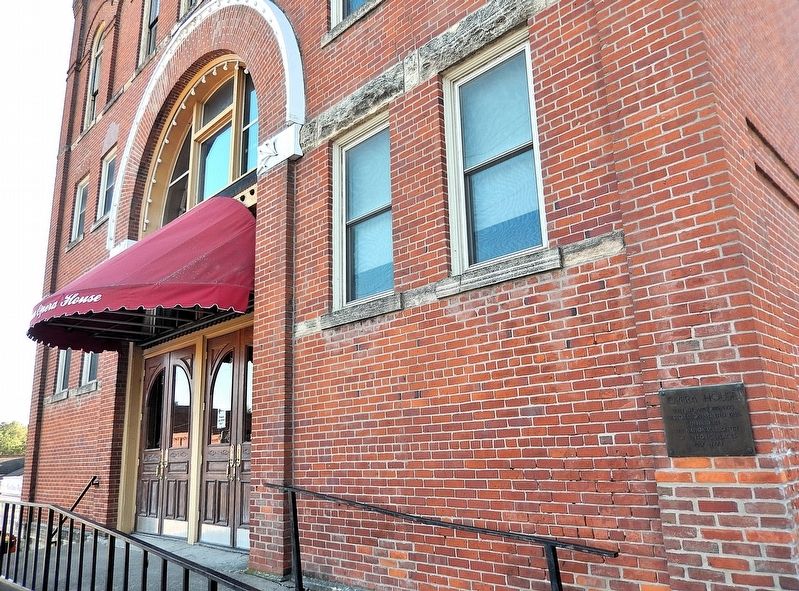
The What Cheer Opera House has become quite significant, because it was a very important part of our way of living at one time. It was the only source of entertainment for many towns; opera houses were in every city. Gradually they were altered beyond restoration into movie houses, torn down or gutted and entire new uses were made of theshell. Here is one that has been saved and is in good condition. Life has been put back into it and provides entertainment which draws people from a radius of two hundred miles. At the turn of the century, nationally known repertoire companies appeared in What Cheer, a few weeks after they appeared on Broadway.Photographed by Cosmos Mariner, September 19, 20252. Opera House MarkerThe marker is mounted at eye level on the northeast corner of the Opera House.
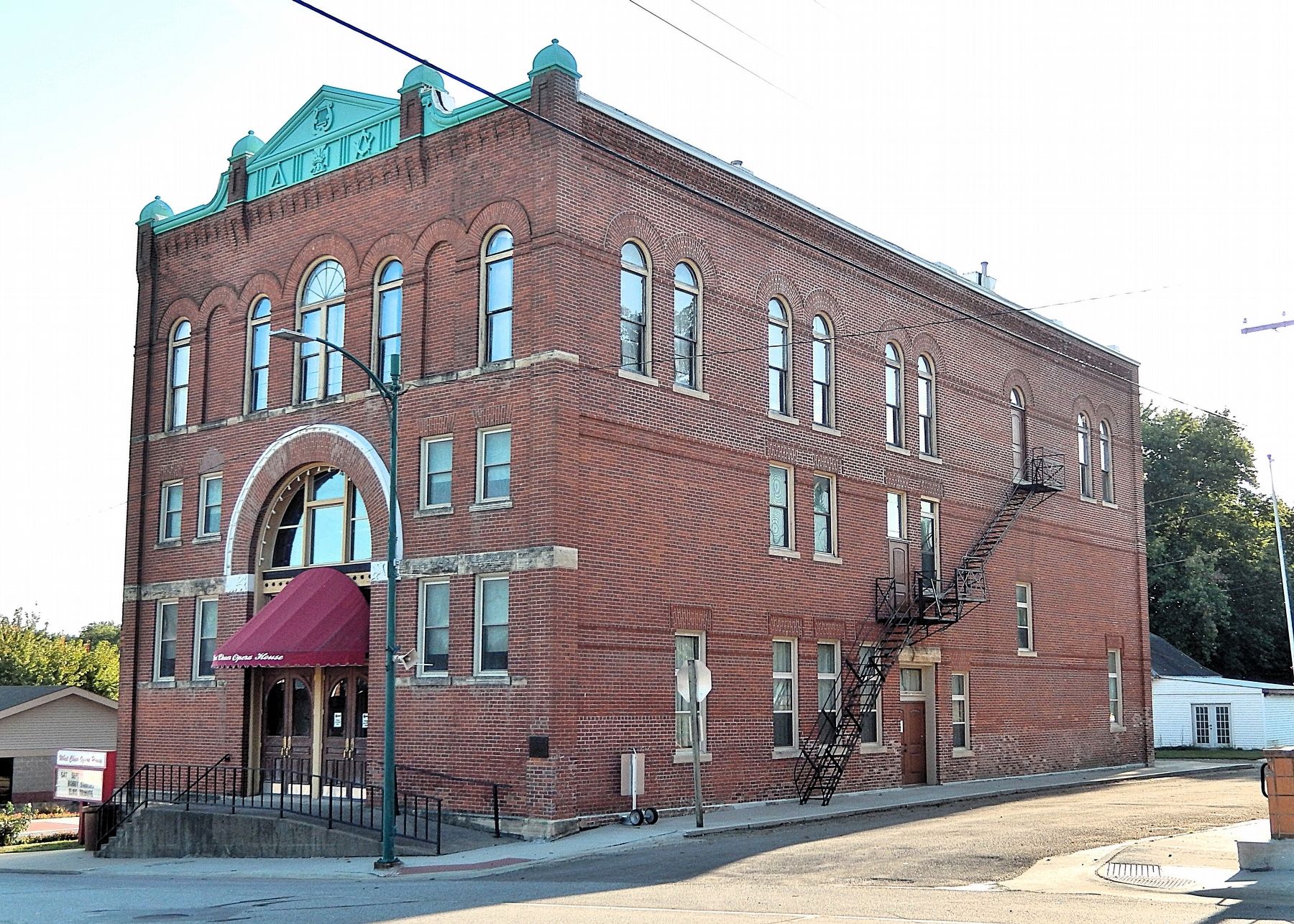
The What Cheer Opera House has the appearance of a three-story building, 50 feet wide and 100 feet long, the middle story being the balcony level. The top floor was originally built as a Masonic Temple, the emblems associated with Freemasonry are still in existence in the decorative pediment at the top of the building. The building is brick with a hint of Romanesque detail in round head windows and the corbels at cornice. The horizontal bands of rock faced stone more or less divide the building into story height.
The structure was remodeled into a movie theatre many years ago, but fortunately original exterior window and main entrance mill work was either stored within the building or covered up with new material in a manner not destroying same. The only original items missing are the four front doors, these have been reconstructedsame as original.Photographed by Cosmos Mariner, September 19, 20253. What Cheer Opera House (east/front elevation)
The lobby is quite small, too small to provide any waiting space during intermissions; there is equal space off the balcony. The doors to the auditorium were stored and are now hanging as originally. The auditorium seats 350, the balcony 240. Both balcony and auditorium have been restored, again, interesting original detail was found under late period alterations. Both auditorium and balcony seating is basically horseshoe. The front ten rows, being an area just in front of the stage, sunken a bit, were known as the “Pit.” The three rows immediately back of the Pit were known as the “Dress Circle,” and the rows behind the Dress Circle were known as the “Parquet Circle.”
The third floor Masonic Temple was supported by rows of cast iron columns parallel to the side walls. These columns also support the balcony. The curving balcony shape and rail are possibly the outstanding architectural details in the building.

Also see . . .
1. Masonic Opera House (Wikipedia).
Excerpt: The Masonic Opera House, also known as the What Cheer Opera House, is a Romanesque Revival style building from 1893. The 100-by-50-foot(Submitted on January 11, 2026, by Cosmos Mariner of Cape Canaveral, Florida.)facility has served as a clubhouse, an auditorium, a music facility, and a cinema. The third floor originally housed a Masonic hall. It was listed on the National Register of Historic Places in 1973.Photographed by Cosmos Mariner, September 19, 20254. What Cheer Opera House (northeast elevation)
2. What Cheer Opera House History.
Excerpt: In 1868 a group of Master Masons decided to organize a lodge at Coal Creek, Iowa. On July 29, 1869, Universe Lodge No. 242 AF & AM was organized under the authorization of R. Mickel, Grand Master of Masons of Iowa. A movement was made to move the organization to Indianapolis, but it failed.(Submitted on January 11, 2026, by Cosmos Mariner of Cape Canaveral, Florida.)
By 1877, there was a large number of men from What Cheer that had joined the lodge. A movement to move the lodge to What Cheer was made, and on January 12, 1878, the first meeting was held at the Odd Fellows Hall in What Cheer. Meanwhile, by 1885, the Lortscher Opera House was entertaining locals in the top floor of the Savings Bank which was located just North of where the Opera House stands today.
The great fire of Sunday, August 3, 1890 cost What Cheer approximately $200,000 in damaged and lost property. It destroyed 28 dwellings and 20 businesses; fortunately, no lives were lost. The Lortscher Opera House was a casualty of the fire. The origin of the fire was never determined. After the big fire, the masons decided to build a Masonic Hall & Opera House.
The site of the new opera house was purchased in 1892 by the Masonic lodge. By April 5, 1893, activity at the corner of Barnes and Briney streets signaled the rapid progress of the Masonic Opera House. Fifteen carloads of stone were in route, signifying a commitment to efficient and energetic construction.
The new Masonic Opera House, built to modern specifications with the auditorium on the ground floor, was completed on February 28, 1894. The $15,000 structure boasted a metropolitan-style finish and was ready to open.
Credits. This page was last revised on January 11, 2026. It was originally submitted on January 7, 2026, by Cosmos Mariner of Cape Canaveral, Florida. This page has been viewed 62 times since then. Photos: 1. submitted on January 10, 2026, by Cosmos Mariner of Cape Canaveral, Florida. 2, 3, 4. submitted on January 11, 2026, by Cosmos Mariner of Cape Canaveral, Florida.
