Kingston in Ulster County, New York — The American Northeast (Mid-Atlantic)
Vansteenburgh Home
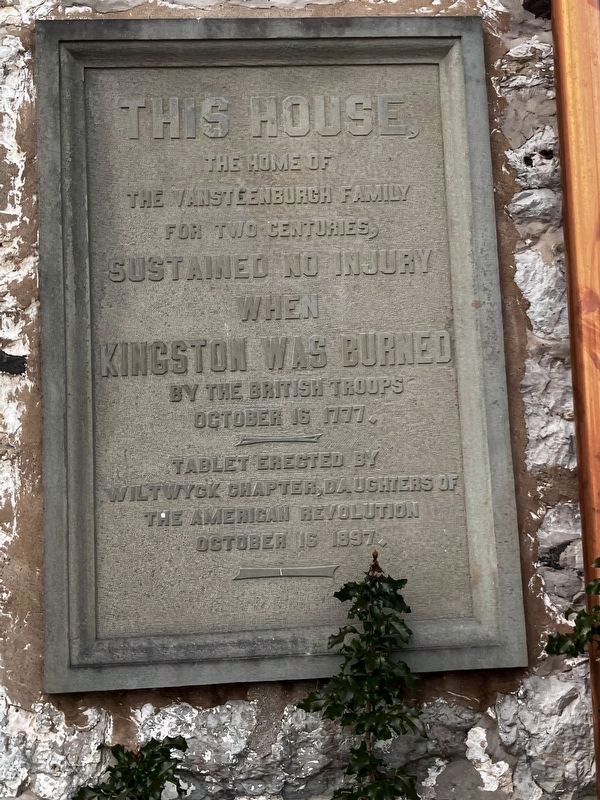
Photographed by Trudi Jacobson, January 9, 2026
1. Vansteenburgh Home Marker
Erected 1897 by Wiltwyck Chapter, Daughters of the American Revolution.
Topics and series. This historical marker is listed in this topic list: Notable Buildings. In addition, it is included in the Daughters of the American Revolution (DAR) series list. A significant historical date for this entry is October 16, 1777.
Location. 41° 55.618′ N, 74° 0.932′ W. Marker is in Kingston, New York, in Ulster County. It is at the intersection of Wall Street and Franklin Street, on the right when traveling north on Wall Street. Touch for map. Marker is at or near this postal address: 97 Wall Street, Kingston NY 12401, United States of America. Touch for directions.

Regionally, this marker is in Upstate New York and in the Hudson Valley. It is also in the American Northeast, in the Mid-Atlantic, and on the Eastern Seaboard. Globally, it is in the North Atlantic Region, North America, the Western Hemisphere, the Western World, and the Anglosphere. Historically, it finds itself
this page online
Other nearby markers. At least 8 other markers are within walking distance of this marker: Van Keuren Homestead (approx. ¼ mile away); Tobias Van Buren House (approx. ¼ mile away); Bogardus Tavern (approx. 0.3 miles away); New York State Assembly (approx. 0.3 miles away); Fair Street Church (approx. 0.3 miles away); Academy Green Statues (approx. 0.4 miles away); Kingston Academy (approx. 0.4 miles away); Stuyvesant Indian Treaty (approx. 0.4 miles away). Touch for a list and map of all markers in Kingston.
Also see . . . Tobias Van Steenburgh House.
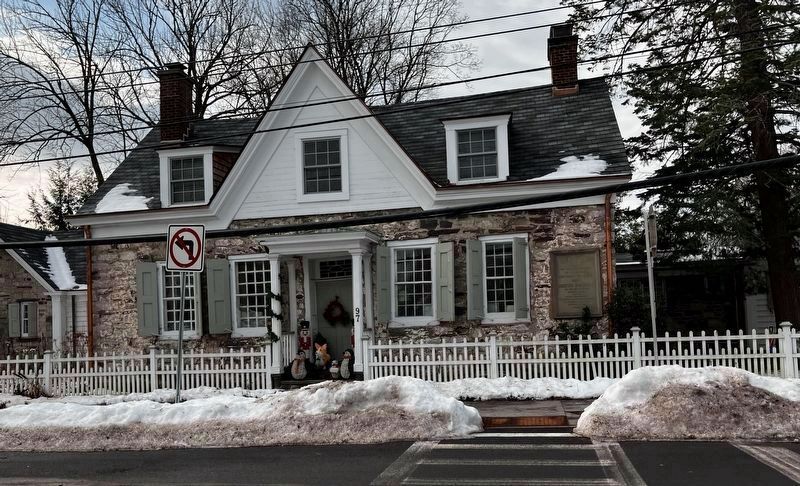
Why the house was not burned in 1777 is not known. Legend has it that it was the home of a Mrs. Hammersly, a woman with Loyalist sympathies, who was in love with a British officer who spared the house. Others have it that the British began to burn the house, but the order to withdraw was sounded soon after and slaves who were hiding in the nearby woods quickly extinguished what little fire there was after the troops left. A variant on that tale says that since the house was used as an inn at(Submitted on January 13, 2026, by Trudi Jacobson of Slingerlands, New York.)the time, the slaves rolled a barrel of rum they had tapped and treated the soldiers to free drink until the order came to leave.Photographed by Trudi Jacobson, January 9, 20262. This Vansteenburgh Home marker, mounted on right side of house in photo
Additional commentary.
1. Architecture of the house
According to Kingston New York: The Architectural Guide by William B. Rhoads (Black Dome Press, 2003), "The fieldstone, story-and-a-half house has a symmetrical arrangement of front door...and two windows on either side of the door, which suggests a post-1750 date of construction....An early-twentieth-century photo records a now-replaced Gothic Revival window in the central gable, but neither of the dormers that flank this gable. The wooden wings also date from the twentieth century" (p. 73).
— Submitted September 6, 2026, by Trudi Jacobson of Slingerlands, New York.
Credits. This page was last revised on October 20, 2026. It was originally submitted on January 12, 2026, by Trudi Jacobson of Slingerlands, New York. This page has been viewed 80 times since then. Photos: 1, 2. submitted on January 12, 2026, by Trudi Jacobson of Slingerlands, New York. • Andrew Ruppenstein was the editor who published this page.
