Regierungsvierte in Berlin in Mitte, Germany — Northeast German Plain (The European Plain)
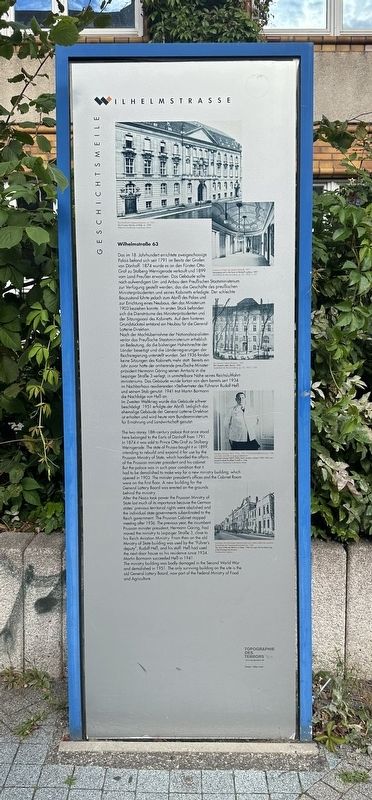
Wilhelmstraße 63
| — | Geschichtsmeile Wilhelmstraße | — |
Photographed by Andrew Ruppenstein, September 3, 2025
1. Wilhelmstraße 63 Marker

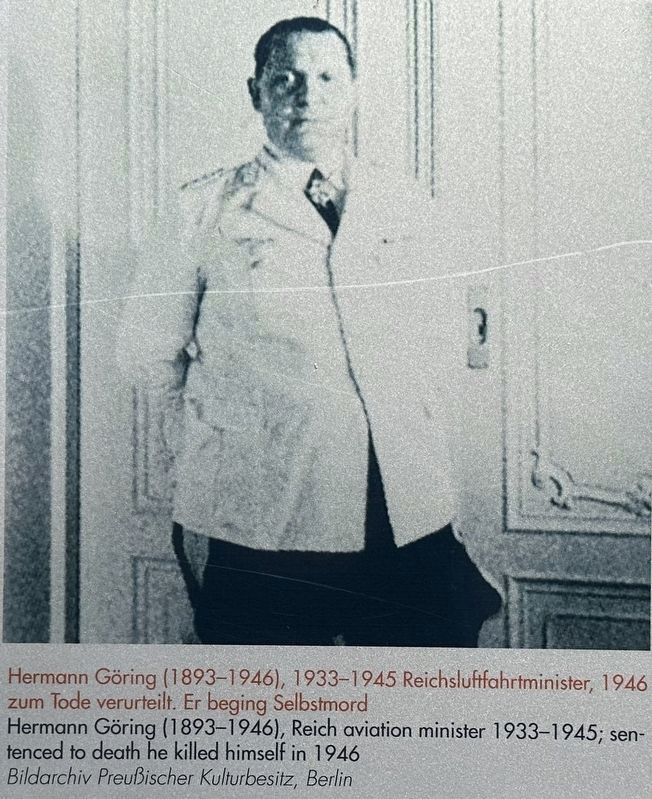
Nach der Machtübernahme der Nationalsozialisten verlor das Preußische Staatsministerium erheblich an Bedeutung, da die bisherigen Hoheitsrechte der Länder beseitigt und die Länderregierungen der Reichsregierung unterstellt wurden. Seit 1936 fanden keine Sitzungen des Kabinetts mehr statt. Bereits ein Jahr zuvor hatte der amtierende preußische Minister-präsident Hermann Göring seinen Amtssitz in dieLeipziger Straße 3 verlegt, in unmittelbare Nähe seines Reichsluftfahrtministeriums. Das Gebäude wurde fortan von dem bereits seit 1934 im Nachbarhaus residierenden »Stellvertreter des Führers« Rudolf Heß und seinem Stab genutzt. 1941 trat Martin Bormann die Nachfolge von Heß an.
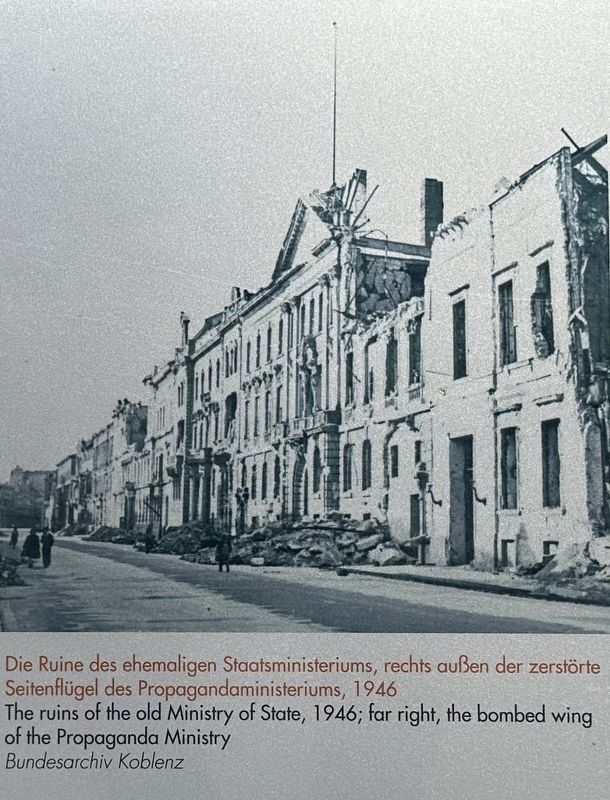
Im Zweiten Weltkrieg wurde das Gebäude schwer beschädigt. 1951 erfolgte der Abriß. Lediglich das ehemalige Gebäude der General-Lotterie-Direktion ist erhalten und wird heute vom Bundesministerium für Ernährung und Landwirtschaft genutzt.
this page online
After the Nazis took power the Prussian Ministry of State lost much of its importance because the German states' previous territorial rights were abolished and the individual state governments subordinated to the Reich government. The Prussian Cabinet stopped meeting after 1936. The previous year, the incumbent Prussian minister president, Hermann Göring, had moved the ministry to Leipziger Straße 3, close to his Reich Aviation Ministry. From then on the old Ministry of State building was used by the "Führer's deputy", Rudolf Heß, and his staff. Heß had used the next-door house as his residence since
Photographed by Andrew Ruppenstein, September 3, 2025
2. Wilhelmstraße 63 Marker - wide view
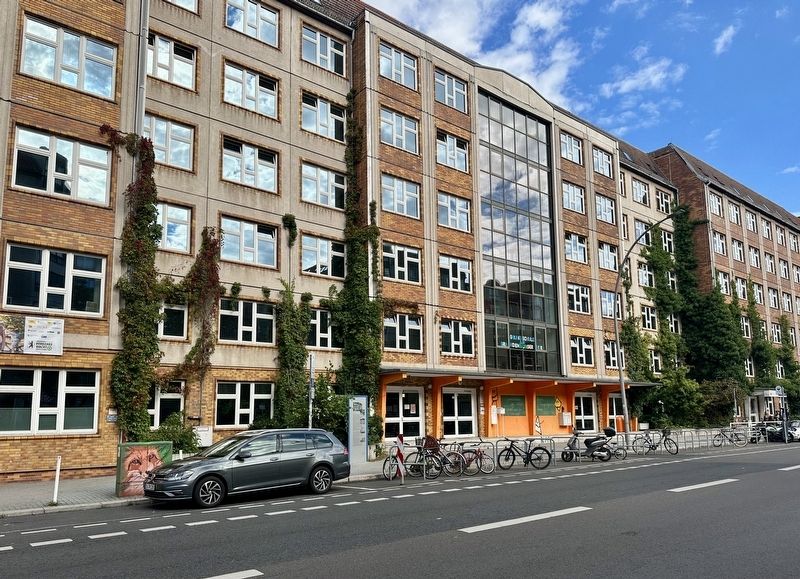
The marker is visible here between the rear of the automobile and the bicycles.
The ministry building was badly damaged in the Second World War and demolished in 1951. The only surviving building on the site is the old General Lottery Board, now part of the Federal Ministry of Food and Agriculture.
Topics. This historical marker is listed in these topic lists: Government & Politics • War, World II. A significant historical year for this entry is 1791.
Location. 52° 30.792′ N, 13° 22.959′ E. Marker is in Berlin, in Mitte. It is in Regierungsvierte. It is on Wilhelmstraße south of Hannah-Arendt-Straße, on the left when traveling south. Touch for map. Marker is at or near this postal address: Wilhelmstraße 52, Berlin 10117, Germany. Touch for directions.

Regionally, it is in Europe, the European Union, Atlantic Europe, Central Europe, the Schengen Area, Western Europe, and the Western World. Historically, it finds itself in what was once the Holy Roman Empire, the former East Germany, and at the Berlin Wall.
Other nearby markers. At least 8 other markers are within walking distance of this marker: Wilhelmstraße 75 (a few steps from this marker); Konrad Adenauer
courtesy Bundesarchiv Koblenz, 1946
3. Marker photo: The ruins of the old Ministry of State
courtesy Bildarchiv Preußischer Kulturbesitz, Berlin
4. Marker photo: Hermann Göring (1893-1946)
Credits. This page was last revised on January 13, 2026. It was originally submitted on January 13, 2026, by Andrew Ruppenstein of Lamorinda, California. This page has been viewed 62 times since then. Photos: 1, 2, 3, 4. submitted on January 13, 2026, by Andrew Ruppenstein of Lamorinda, California.
