
Regierungsvierte in Berlin in Mitte, Germany — Northeast German Plain (The European Plain)
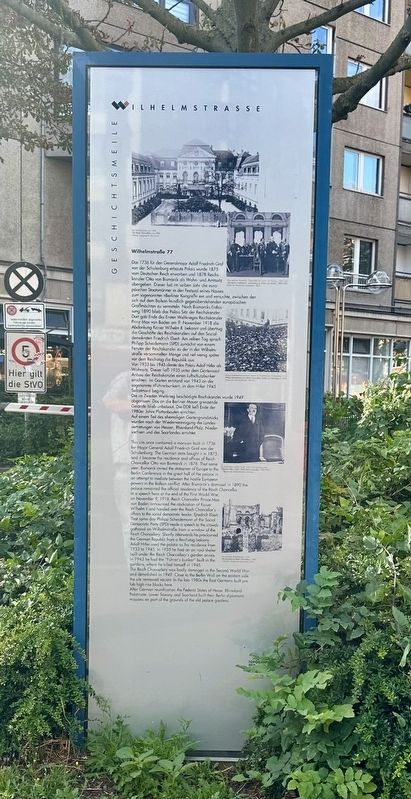
Wilhelmstraße 77
| — | Geschichtsmeile Wilhelmstraße | — |
Photographed by Andrew Ruppenstein, September 3, 2025
1. Wilhelmstraße 77 Marker

Von 1933 bis 1945 diente das Palais Adolf Hitler als Wohnsitz. Dieser ließ 1935 unter dem Gartensaal-Anbau der Reichskanzlei einen Luftschutzbunker errichten. Im Garten entstand von 1943 an der sogenannte »Führerbunker«, in dem Hitler 1945 Selbstmord beging.
Die im Zweiten Weltkrieg beschädigte Reichskanzlei wurde 1949 abgerissen. Das an die Berliner Mauer grenzende Gelände blieb unbebaut. Die DDR ließ Ende der 1980er Jahre Plattenbauten errichten. Auf einem Teil des ehemaligen Gartengrundstücks wurden nach der Wiedervereinigung die Landesvertretungen von Hessen, Rheinland-Pfalz, Niedersachsen und des Saarlandes errichtet.
this page online
Adolf Hitler used the palace as his residence from 1933 to 1945. In 1935 he had an air raid shelter built under the Reich Chancellery's garden annex. In 1943 he had the "Führer's bunker" built in the gardens, where he killed himself in 1945.
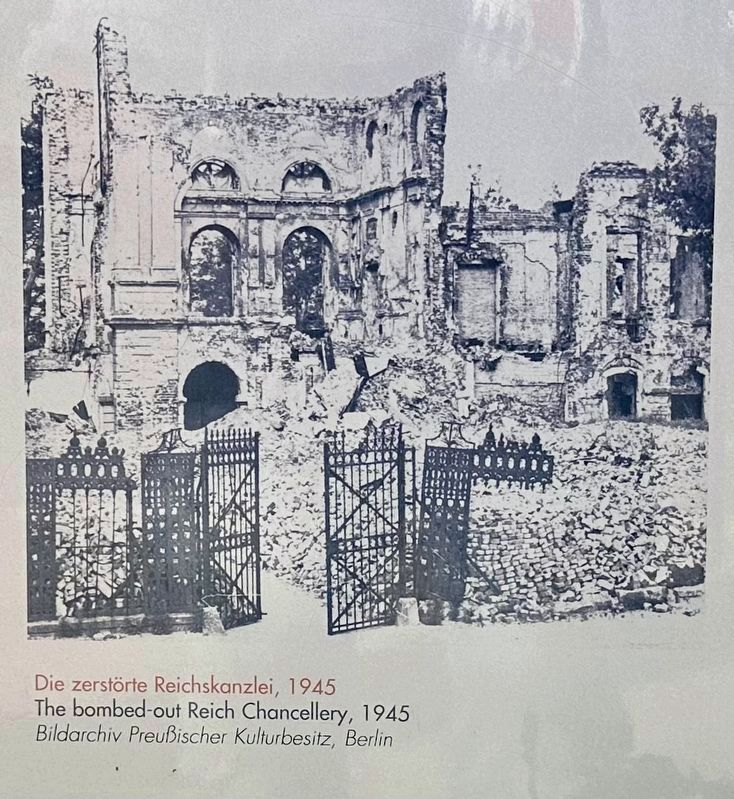
The Reich Chancellery was badly damaged in the Second World War and demolished in 1949. Close to the Berlin Wall on the eastern side, the site remained vacant. In the late 1980s the East Germans built pre-fab high-rise blocks here.
After German reunification the Federal States of Hesse, Rhineland- Palatinate, Lower Saxony and Saarland built their Berlin
Photographed by Andrew Ruppenstein, September 3, 2025
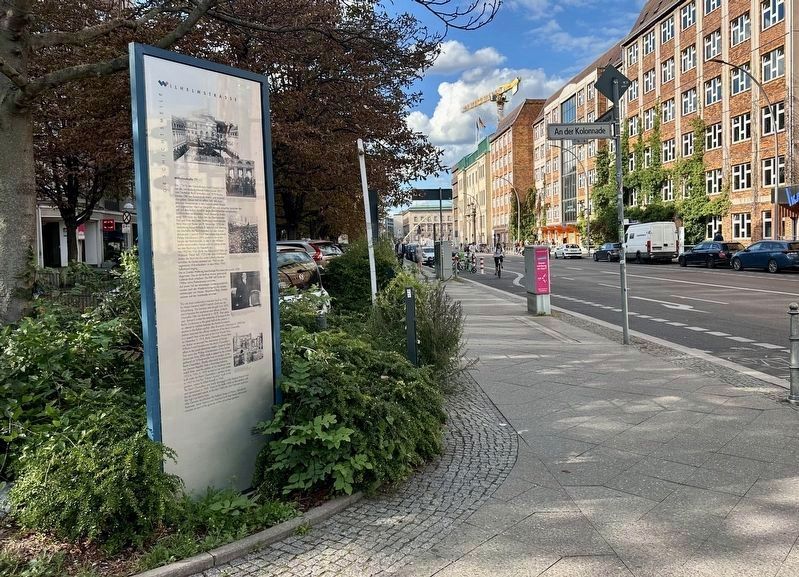
2. Wilhelmstraße 77 Marker - wide view, looking north on Wilhelmstraße
Topics. This historical marker is listed in these topic lists: Government & Politics • War, World II. A significant historical date for this entry is November 9, 1918.
Location. 52° 30.739′ N, 13° 22.965′ E. Marker is in Berlin, in Mitte. It is in Regierungsvierte. It is at the intersection of Wilhelmstraße and An der Kolonnade, on the right when traveling south on Wilhelmstraße. Touch for map. Marker is at or near this postal address: Wilhelmstraße 49, Berlin 10117, Germany. Touch for directions.

Regionally, it is in Europe, the European Union, Atlantic Europe, Central Europe, the Schengen Area, Western Europe, and the Western World. Historically, it finds itself in what was once the Holy Roman Empire.
Other nearby markers. At least 8 other markers are within walking distance of this marker: Berliner Kongo-Konferenz / Berlin Congo Conference (a few steps from this marker); Wilhelmplatz 8/9 (within shouting distance of this marker); Dr. Friedrich Leyden (within shouting distance of this marker); Ulrich von Hassell (within shouting distance of this marker); Dr. Hans Litter (within shouting distance of this marker); Dr. Adam von Trott zu Solz (within shouting distance of this marker);
courtesy Bildarchiv Preußischer Kulturbesitz, Berlin, 1945
3. Marker photo: The bombed-out Reich Chancellery
Also see . . . Reich Chancellery (Wikipedia). Overview:
The Reich Chancellery (German: Reichskanzlei) was the traditional name of the office of the Chancellor of Germany (then called Reichskanzler) in the period of the German Reich from 1878 to 1945. The Chancellery's seat, selected and prepared since 1875, was the former city palace of Adolf Friedrich Count von der Schulenburg (1685–1741) and later Prince Antoni Radziwiłł (1775–1833) on Wilhelmstraße in Berlin. Both the palace and a new Reich Chancellery building (completed in early 1939) were seriously damaged during World War II and subsequently demolished.(Submitted on January 14, 2026.)
Credits. This page was last revised on January 14, 2026. It was originally submitted on January 14, 2026, by Andrew Ruppenstein of Lamorinda, California. This page has been viewed 307 times since then. Photos: 1, 2, 3. submitted on January 14, 2026, by Andrew Ruppenstein of Lamorinda, California.
