Smithfield in Johnston County, North Carolina — The American South (South Atlantic)
Downtown Smithfield Historic District
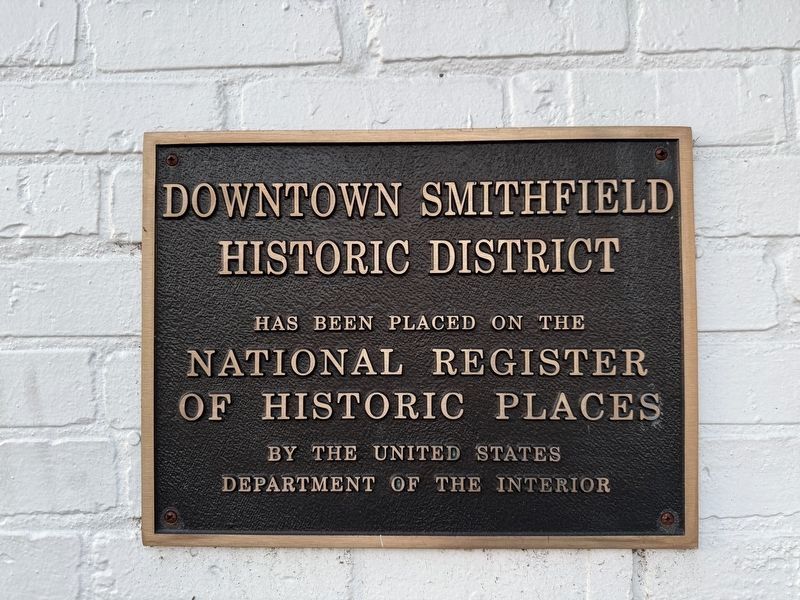
Photographed by Devry Becker Jones (CC0), January 15, 2026
1. Downtown Smithfield Historic District Marker
Historic District
has been placed on the
National Register
of Historic Places
by the United States
Department of the Interior
Topics. This historical marker is listed in these topic lists: Architecture • Industry & Commerce.
Location. 35° 30.665′ N, 78° 20.759′ W. Marker is in Smithfield, North Carolina, in Johnston County. It is at the intersection of East Market Street (Business U.S. 70) and South 3rd Street, on the right when traveling east on East Market Street. Touch for map. Marker is at or near this postal address: 101 S 3rd St, Smithfield NC 27577, United States of America. Touch for directions.

Regionally, this marker is in North Carolina’s Piedmont. It is also in the American South and specifically in the Upper South. Globally, it is in North America, the Western Hemisphere, the Western World, and the Anglosphere. Historically, it finds itself in what was once the territory of the Mississippian Culture, one of the original Thirteen Colonies, one of the Confederate States of America, and the Antebellum South.
this page online
Other nearby markers. At least 8 other markers are within walking distance of this marker: Veterans Memorial (about 300 feet away, measured in a direct line); Sherman Receives News of Lee's Surrender in Smithfield (about 300 feet away); Johnston County Fountain Memorial (about 400 feet away); World War II and Korean Conflict Memorial (about 400 feet away); Johnston County War Memorial (about 400 feet away); Honor Roll (about 500 feet away); a different marker also named Occupation of Smithfield (about 500 feet away); Smithfield Four (about 500 feet away). Touch for a list and map of all markers in Smithfield.
Another marker is no longer nearby. Occupation of Smithfield (was about 500 feet away but has been replaced with another marker now near it).
Also see . . . National Register of Historic Places nomination form for the historic district.
This form was prepared on May 30, 1993 by Beth P. Thomas, Preservation Consultant. A statement of historical significance can be found on pages 18-19:
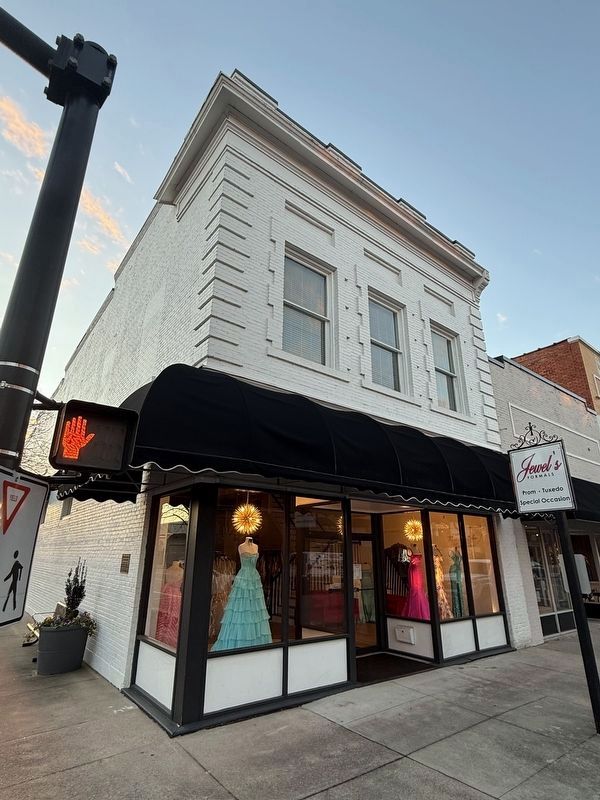
The Downtown Smithfield Historic District, a roughly two-and-one-half block area focused around the main intersection(Submitted on January 18, 2026, by Devry Becker Jones of Washington, District of Columbia.)of Main and Third streets, is eligible for the National Register as a remarkably intact collection of traditional early twentieth century commercial architecture. One- and two-story, modestly decorated brick commercial buildings comprise the majority of the historic streetscapes, though there are also a number of individually significant structures. These include the handsome Neoclassical Hood Brothers Building, individually listed in the National Register and a local landmark business in operation since 1871; the 1913 Neoclassical first Citizens Bank, the flagship building of the financial institution which was founded as the Bank of Smithfield in 1898 and later became First Citizens Bank; the Howell Theater, Smithfield's finest example of Art Deco architecture, and Austin's Department Store, a towering red brick edifice which was billed as eastern North Carolina's largest department store at its opening in 1923.Photographed by Devry Becker Jones (CC0), January 15, 20262. Jewel's Formals at 101 South 3rd Street, a contributing structure to the historic district
The historic district reflect s Smithfield' s commercial development between the 1890s and the mid-1930s. During this period several forces played major roles in shaping the development and appearance of the commercial area. The coming of the railroad in 1882 initiated Smithfield's first, albeit short-lived, real period of growth, but a disastrous 1889 fire destroyed all trace of the early commercial fabric. Rebuilding after the fire was concentrated at the intersection of Market and Third streets, in the heart of the present historic district. In 1898 the town's first tobacco warehouse company was founded and the first warehouse. The Banner, was constructed adjacent to the commercial area. The bright leaf tobacco industry , and later the cotton industry, brought significant economic prosperity to Smithfield and, as a result, the commercial area's greatest growth occurred from the turn of the century until the Depression in the 1920s. Its appearance reflects the designs, materials, scale, and finishes popular in traditional small-town downtowns all over eastern North Carolina in the early twentieth century. The commercial area remains vital , with a majority of the stores occupied for retail purposes. A major rehabilitation of the Austin Building for downtown housing is planned, as well as other smaller projects which will help preserve the significant historic resources of the Downtown Smithfield Historic District.
Credits. This page was last revised on January 18, 2026. It was originally submitted on January 18, 2026, by Devry Becker Jones of Washington, District of Columbia. This page has been viewed 67 times since then. Photos: 1, 2. submitted on January 18, 2026, by Devry Becker Jones of Washington, District of Columbia.
