Tumwater in Thurston County, Washington — The American West (Northwest)
Historic Tumwater
Photographed by Shirley A Stirling, August 18, 2024
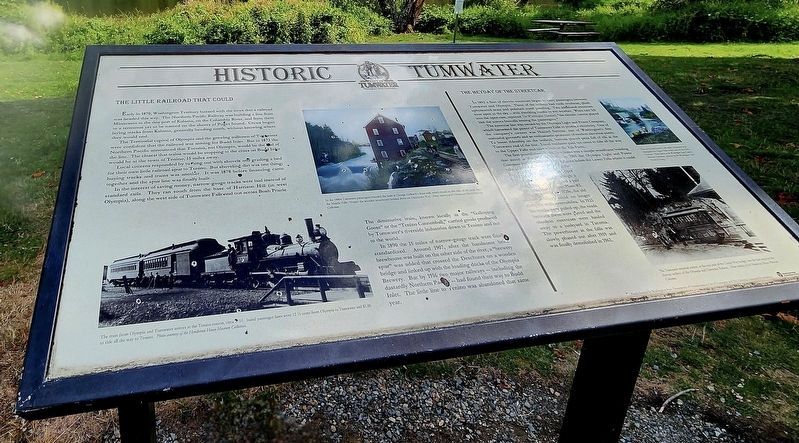
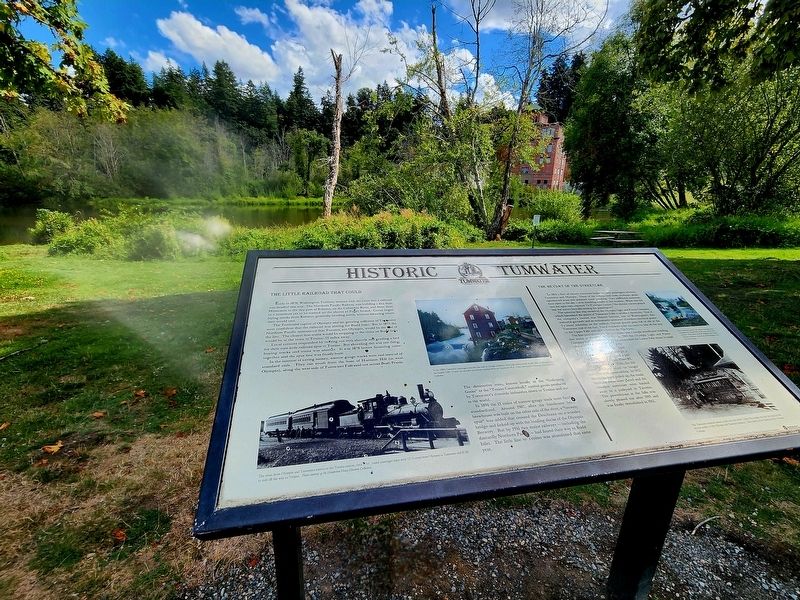
1. Historic Tumwater Marker
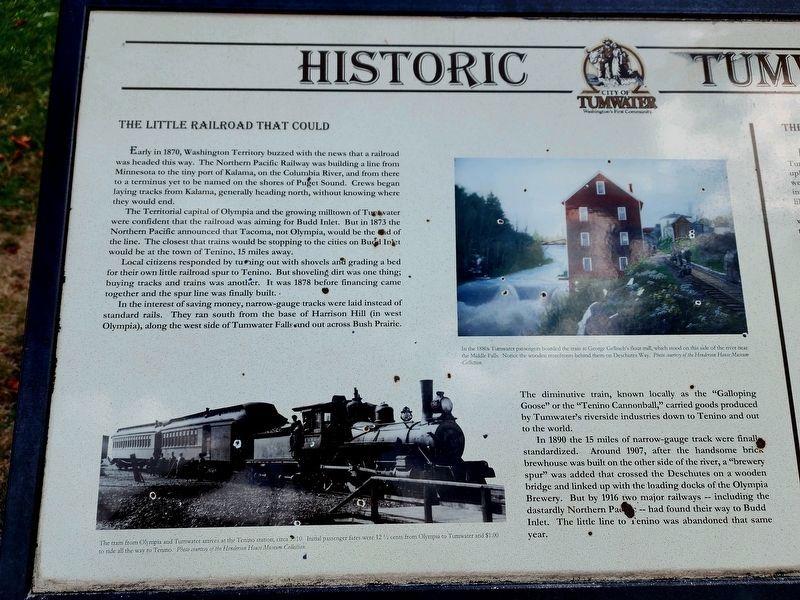
Early in 1870, Washington Territory buzzed with the news that a railroad was headed this way. The Northern Pacific Railway was building a line from Minnesota to the tiny port of Kalama, on the Columbia River, and from there to a terminus yet to be named on the shores of Puget Sound. Crews began laying tracks from Kalama, generally heading north, without knowing where they would end.
The Territorial capital of Olympia and the growing milltown of Tumwater were confident that the railroad was aiming for Budd Inlet. But in 1873 the Northern Pacific announced that Tacoma, not Olympia, would be the end of the line. The closest that trains would be stopping to the cities on Bud Inlet would be at the town of Tenino, 15 miles away.
Local citizens responded by turning out with shovels and grading a bed for their own little railroad spur to Tenino. But shoveling dirt was one thing; buying tracks and trains was another. It was 1878 before financing came together and the spur line was finally built.
In the interest of saving money, narrow-gauge tracks were laid instead of standard rails. They ran south from the base of Harrison Hill (in west Olympia), along the west side of Tumwater Falls and out across Bush Prairie.
The diminutive train, known locally as the "Galloping Goose" or the "Tenino Cannonball," carried goods produced by Tumwater's riverside industries down to Tenino and out to the world.
In 1890 the 15 miles of narrow-gauge track were finally standardized. Around 1907, after the handsome brick Brewhouse was built on the other side of the river, a "brewery spur" was
this page online
The Heyday of the Streetcar
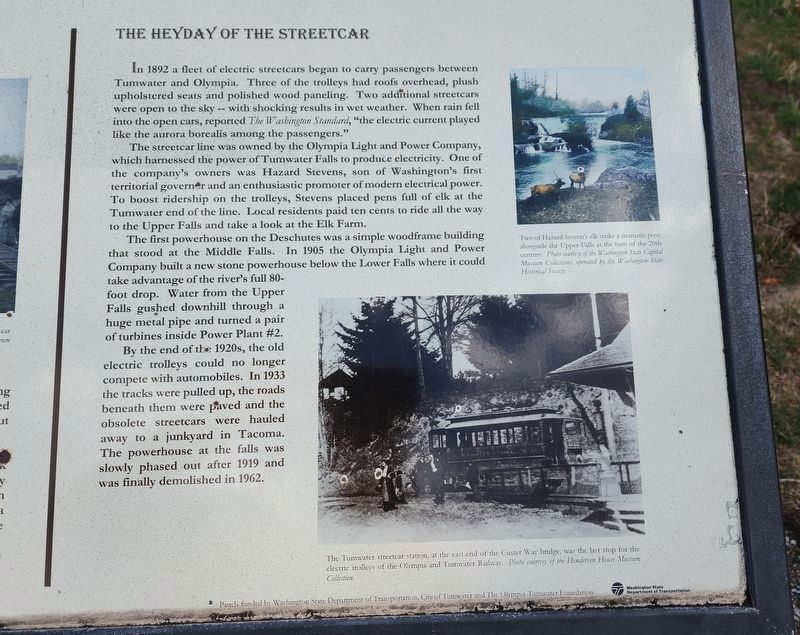
In 1892 a fleet of electric streetcars began to carry passengers between Tumwater and Olympia. Three of the trolleys had roofs overhead, plush upholstered seats and polished wood paneling. Two additional streetcars were open to the sky with shocking results in wet weather. When rain fell into the open cars, reported The Washington Standard, "the electric current played like the aurora borealis among the passengers."
The streetcar line was owned by the Olympia Light and Power Company, which harnessed the power of Tumwater Falls to produce electricity. One of the company's owners was Hazard Stevens, son of Washington's first territorial governor and an enthusiastic promoter of modern electrical power. To boost ridership on the trolleys, Stevens placed pens full of elk at the Tumwater end of the line. Local residents paid ten cents to ride all the way to the Upper Falls and take a look at the Elk Farm.
The first powerhouse on the Deschutes was a simple woodframe building that stood at the Middle Falls. In 1905 the Olympia Light and Power Company built a new stone powerhouse below the Lower Falls where it could take advantage of the river's full 80-foot drop. Water from the Upper Falls gushed downhill through a huge metal pipe and turned a pair of turbines inside Power Plant #2.
By the end of the 1920s, the old
Photographed by Shirley A Stirling, August 18, 2024
2. The little railroad that could side of marker
Captions
(Photo #1) The train from Olympia and Tumwater arrives at the Tenino station circa 1910. Initial passenger fares were 12 1/2 cents from Olympia and Tumwater and $1 to ride all the way to Tenino. Photo Courtesy of the Henderson House Museum Collection.
(Photo #2) In the 1880s, Tumwater passengers boarded the train at George Gelbauch flour mill, which stood on this side of the river near the middle falls. Notice the wooden store fronts behind them on Deschutes Way. Photo courtesy of the Henderson House Museum Collection.
(Photo #3) Two of Hazard Stevens elk strike a dramatic pose along the upper falls at the turn of the 20th century. Photo courtesy of the Washington State Capitol Museum Collection, operated by the Washington State Historical Society.
(Photo #4) The Tumwater street car station, at the east end of the Custer Way bridge, was the last stop for the electric trolleys of the Olympia Tumwater railway. Photo Courtesy of the Henderson House Museum Collection.
Erected by Washington State Department of Transportation, City of Tumwater, Olympia Tumwater Foundation.
Topics. This historical marker is listed in this topic list: Railroads & Streetcars. A significant historical year for this entry is 1870.
Location. 47° 1.242′ N, 122° 54.185′ W. Marker is in Tumwater, Washington, in Thurston County. It is on Deschutes
Photographed by Shirley A Stirling, August 18, 2024
3. The heyday of the streetcar side of marker

Regionally, this marker is in the Puget Sound Region and in Greater Seattle. It is also on the American Pacific Coast, in the Pacific Northwest, and in the Lewis & Clark Corridor. Globally, it is in North America, in the Inside Passage, on the Ring of Fire, on the Pacific Rim, in the Western Hemisphere, in the Western World, and in the Anglosphere.
Other nearby markers. At least 8 other markers are within walking distance of this marker: Ancient Trading Path (a few steps from this marker); Crosby House (about 500 feet away, measured in a direct line); A House from the Pioneer Era (about 500 feet away); The Port Townsend Southern Railroad (about 500 feet away); A house from the early 20th century (about 600 feet away); Oregon Trail (approx. 0.4 miles away); Soldiers' Monument (approx. 0.4 miles away); Tumwater (approx. half a mile away). Touch for a list and map of all markers in Tumwater.
Photographed by Shirley A Stirling, August 18, 2024
4. Historic Tumwater / The heyday of the streetcar Marker
Credits. This page was last revised on January 21, 2026. It was originally submitted on January 20, 2026, by Shirley A Stirling of Lacey, Washington. This page has been viewed 97 times since then. Photos: 1. submitted on January 21, 2026, by Shirley A Stirling of Lacey, Washington. 2, 3, 4. submitted on January 20, 2026, by Shirley A Stirling of Lacey, Washington. • James Hulse was the editor who published this page.
