Miracle Mile in Los Angeles in Los Angeles County, California — The American West (Pacific Coastal)
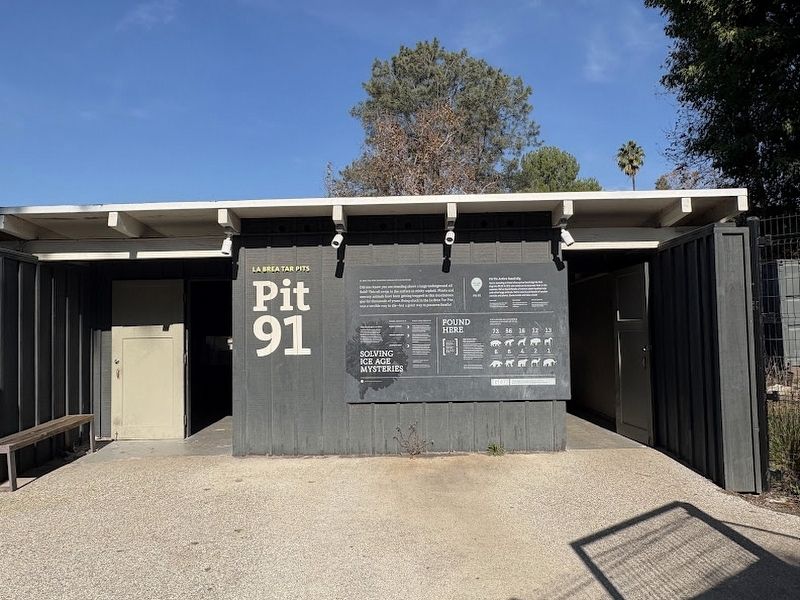
Pit 91
La Brea Tar Pits
Photographed by Darren Jefferson Clay, November 24, 2025
1. Pit 91 Marker
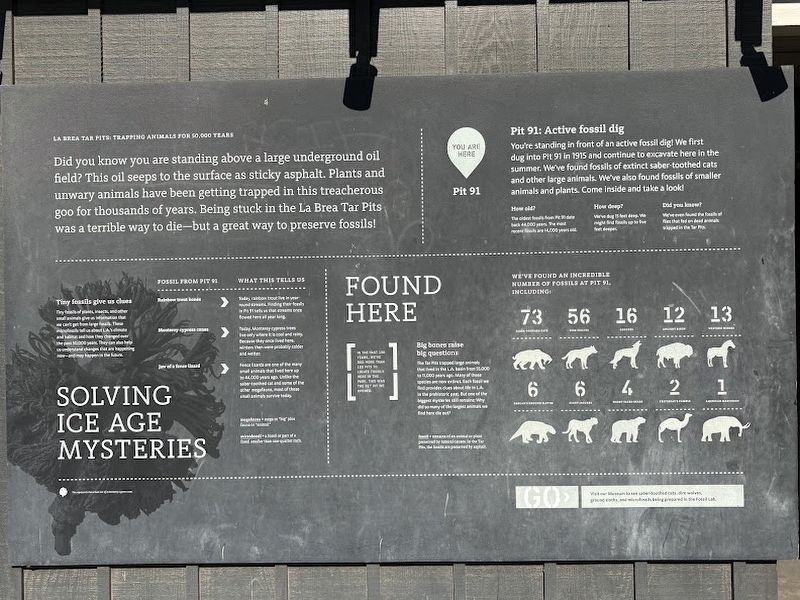
Pit 91: Active fossil dig
You're standing in front of an active fossil dig! We first dug into Pit 91 in 1915 and continue to excavate here in the summer. We've found fossils of extinct saber-toothed cats and other large animals. We've also found fossils of smaller animals and plants. Come inside and take a look! How old?
The oldest fossils from Pit 91 date back 44,000 years. The most recent fossils are 14,000 years old.
How deep?
We've dug 15 feet deep. We might find fossils up to five feet deeper.
Did you know?
We've even found the fossils of flies that fed on dead animals trapped in the Tar Pits.
Solving Ice Age Mysteries
Tiny fossils give us clues.
Tiny fossils of plants, insects, and other small animals give us information that we can't get from large fossils. These microfossils
this page online
Fossils from Pit 91 and what this tells us
Rainbow trout bones: Today, rainbow trout live in year-round streams. Finding their fossils in Pit 91 tells us that streams once flowed here all year long.
Monterey cypress cones: Today Monterrey cypress trees live only where it is cool and rainy. Because they once lived here, winters then were probably colder and wetter.
Jaw of a fence lizard: Fence lizards are one of the many small animals that lived here up to 44,000 years ago. Unlike the saber-toothed cat and some of the other megafauna, most of these small animals survive today.
megafauna= mega or "big" plus fauna or "animal".
microfossil=a fossil or part of a fossil smaller than one-quarter inch.
Found here
In the past 100 years, we've dug more than 100 pits to locate fossils here in the park. This was the 91st pit we opened.
Big bones raise big questions
The tar pits trapped large animals that lived in the L.A. basin from
Photographed by Darren Jefferson Clay, November 24, 2025
2. Pit 91 Marker
fossil=remains of an animal or plant preserved by natural causes. In the Tar Pits the fossils are preserved by asphalt.
We've found an incredible number of fossils at Pit 91, including: Saber-toothed Cats: 73
Dire Wolves: 56
Coyotes: 16
Ancient Bison: 12
Western Horse: 13
Harlan's Ground Sloths: 6
Giant Jaguars: 6
Short-Faced Bears: 4
Yesterday's Camels: 2
American Mastodon: 1
Topics. This historical marker is listed in this topic list: Paleontology.
Location. 34° 3.839′ N, 118° 21.461′ W. Marker is in Los Angeles, California, in Los Angeles County. It is in Miracle Mile. It can be reached from Wilshire Boulevard east of Fairfax Avenue, on the left when traveling east. Touch for map. Marker is at or near this postal address: 5801 Wilshire Boulevard, Los Angeles CA 90036, United States of America. Touch for directions.

Regionally, this marker is in the Transverse Ranges. It is also on the American Pacific Coast. Globally, it is in North America, on the Ring of Fire, on the Pacific Rim, in the Western Hemisphere, in the Western World, and in the Anglosphere. Historically, it finds itself in what was once New Spain and also Mexico’s Alta California.
Other nearby markers. At least 8 other markers are within walking distance of this marker: Death Trap for Meat-Eaters (within shouting distance of this marker); Pits 3, 4, 61/67 (within shouting distance of this marker); Project 23 (within shouting distance of this marker); What's in the crates? (within shouting distance of this marker); Project 23: Who, What, Why, Where, and How? (within shouting distance of this marker); Pit 9 (within shouting distance of this marker); How Did 27 Columbian Mammoths Fit in This Small Pit? (within shouting distance of this marker); a different marker also named Pit 9 (within shouting distance of this marker). Touch for a list and map of all markers in Los Angeles.
Credits. This page was last revised on August 26, 2026. It was originally submitted on January 20, 2026, by Darren Jefferson Clay of Duluth, Georgia. This page has been viewed 56 times since then. Photos: 1, 2. submitted on January 20, 2026, by Darren Jefferson Clay of Duluth, Georgia. • Andrew Ruppenstein was the editor who published this page.
Editor’s want-list for this marker. High-resolution closeup photo of the marker. • Can you help?
