
Binnenstad Hoorn , North Holland, Netherlands — Northwestern Europe
Monument bij het Grote Kerk
⎯⎯⎯
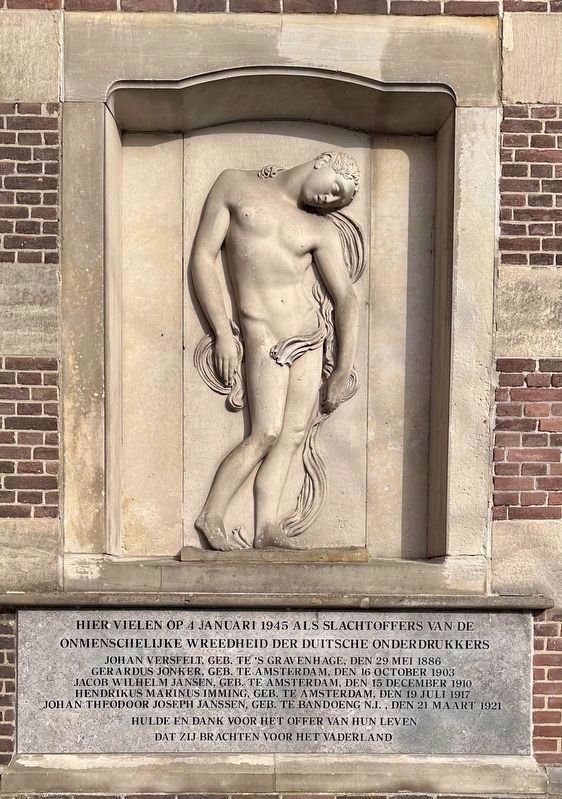
Grote Kerk Executions Memorial
Photographed by Andrew Ruppenstein, March 22, 2025
1. Monument bij het Grote Kerk / Grote Kerk Executions Memorial
The relief was created by artist Pieter Starreveld.

Johan Versfelt, geb. te 's Gravenhage, den 29 mei 1886
Gerardus Jonker, geb. te Amsterdam, den 16 october 1903
Jacob Wilhelm Jansen, geb. te Amsterdam, den 15 december 1910
Hendrikus Marinus Imming, geb. te Amsterdam, den 19 juli 1917
Johan Theodoor Joseph Janssen, geb. te Bandoeng N.I., den 21 maart 1921
Erected 1947.
Topics. This memorial is listed in this topic list: War, World II. A significant historical date for this entry is January 4, 1945.
Location. 52° 38.423′ N, 5° 3.6′ E. Memorial is in Hoorn, Noord-Holland (North Holland). It is in Binnenstad Hoorn. It is at the intersection of Kerkplein and Grote Kerk, on the right when traveling north on Kerkplein. Touch for map. Memorial is at or near this postal address: Grote Kerk 21, Hoorn, Noord-Holland
this page online

Regionally, it is in Europe, the European Union, Atlantic Europe, the Benelux Low Countries, the Schengen Area, Western Europe, and the Western World. Historically, it finds itself in what was once the Holy Roman Empire.
Other nearby markers. At least 8 other markers are within walking distance of this marker: Grote Kerk (here, next to this marker); Kerkstraat 10 (within shouting distance of this marker); Hadrianus Junius (within shouting distance of this marker); Nieuwstraat 18 (about 90 meters away, measured in a direct line); Admiraliteitspoortje / Admiralty Gate (1607) (about 90 meters away); Kloosterpoort / “Convent” Gate (1607) (about 120 meters away); Onderduikers in het Duitse hoofdkwartier / People in hiding at the German headquarters (about 120 meters away); Jan Ruiter and Gré Visser Memorial (about 120 meters away). Touch for a list and map of all markers in Hoorn.
More about this memorial. Format of the listing of the victims is name, place óf birth, date of birth.
Also see . . . Hoorn, Monument bij de Grote Kerk (National Comitée 4 en 5 mei, in Dutch).
Photographed by Andrew Ruppenstein, March 22, 2025
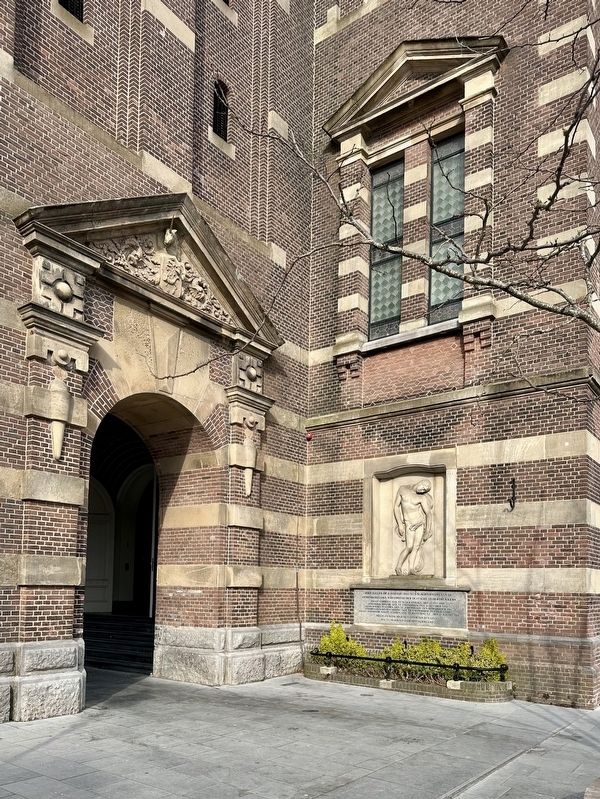
2. Monument bij het Grote Kerk / Grote Kerk Executions Memorial - wide view
The memorial is located on the south corner of the front of the Grote Kerk.
The monument at the Grote Kerk in Hoorn was erected in memory of the five hostages who were executed by the occupying forces here on January 4, 1945.…(Submitted on January 20, 2026.)
The Dutch SS Rottenführer George Herlee had been wanted for some time by the regional resistance in Hoorn. Herlee was one of the most notorious hunters of people in hiding and undocumented immigrants in the northern part of North Holland. He had already tracked down many victims. Most of them ended up in prisons like the Weteringschans House of Detention in Amsterdam. Upon arrival, prisoners were tortured and humiliated in order to extract a confession. Those who survived these tortures were often subsequently executed in the dunes near Bloemendaal aan Zee or on the Waalsdorpervlakte. On December 30, 1944, the Hoorn resistance group received a report that Herlee had been sighted in the city. He was arrested by the KP (Dutch Communist Party) and shot dead in what was then a barbershop on Nieuwstraat in Hoorn.
In retaliation for this resistance action, the occupying forces transferred five prisoners from the Weteringschans House of Detention in Amsterdam to Hoorn on January 4, 1945. The five fellow citizens entered Hoorn by truck via the Westerdijk, the Achterom, the Geldersesteeg, the Grote Noord, and the Rode Steen, and were then executed on Kerkplein, standing against the wall of the Grote Kerk.
Credits. This page was last revised on January 20, 2026. It was originally submitted on January 20, 2026, by Andrew Ruppenstein of Lamorinda, California. This page has been viewed 33 times since then. Photos: 1, 2. submitted on January 20, 2026, by Andrew Ruppenstein of Lamorinda, California.
