
Lake City in Hinsdale County, Colorado — The American Mountains (Southwest)
Crystal Lake Lodge No. 34 A.F. & A.M.
Lodge Built 1908
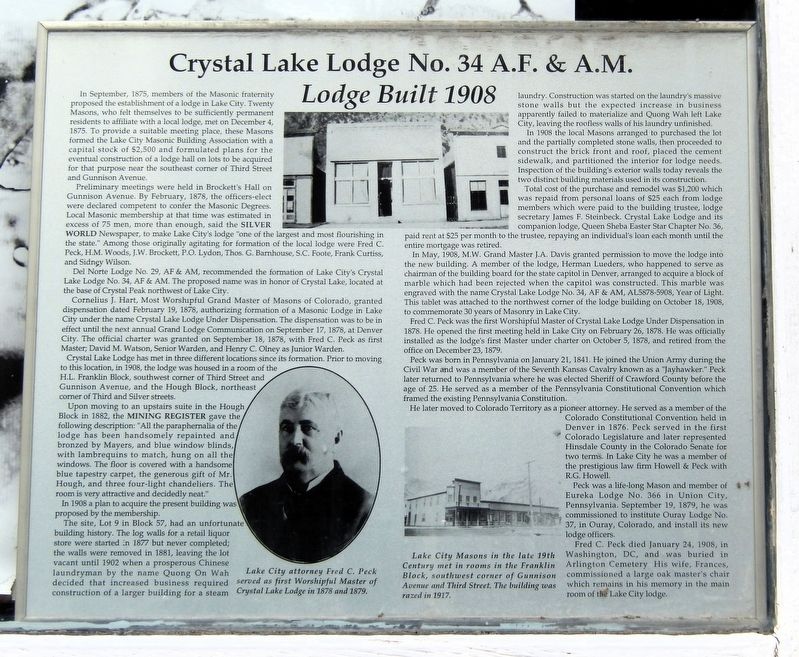
Photographed by Cosmos Mariner, July 21, 2025
1. Crystal Lake Lodge No. 34 A.F. & A.M. Marker
In September, 1875, members of the Masonic fraternity proposed the establishment of a lodge in Lake City. Twenty Masons, who felt themselves to be sufficiently permanent residents to affiliate with a local lodge, met on December 4, 1875. To provide a suitable meeting place, these Masons formed the Lake City Masonic Building Association with a capital stock of $2,500 and formulated plans for the eventual construction of a lodge hall on lots to be acquired for that purpose near the southeast corner of Third Street and Gunnison Avenue.
Preliminary meetings were held in Brockett's Hall on Gunnison Avenue. By February, 1878, the officers-elect were declared competent to confer the Masonic Degrees. Local Masonic membership at that time was estimated in excess of 75 men, more than enough, said the SILVER WORLD Newspaper, to make Lake City's lodge “one of the largest and most flourishing in the state.” Among those originally agitating for formation of the local lodge were Fred C. Peck, H.M. Woods, J.W. Brockett, P.O. Lydon, Thos. G. Barnhouse, S.C. Foote, Frank Curtiss, and Sidney Wilson.
Del Norte Lodge No. 29, AF & AM, recommended
this page online
Cornelius J. Hart, Most Worshipful Grand Master of Masons of Colorado, granted dispensation dated February 19, 1878, authorizing formation of a Masonic Lodge in Lake City under the name Crystal Lake Lodge Under Dispensation. The dispensation was to be in effect until the next annual Grand Lodge Communication on September 17, 1878, at Denver City. The official charter was granted on September 18, 1878, with Fred C. Peck as first Master; David M. Watson, Senior Warden, and Henry C. Olney as Junior Warden.
Crystal Lake Lodge has met in three different locations since its formation. Prior to moving to this location, in 1908, the lodge was housed in a room of the H.L. Franklin Block, southwest corner of Third Street and Gunnison Avenue, and the Hough Block, northeast corner of Third and Silver streets.
Upon moving to an upstairs suite in the Hough Block in 1882, the MINING REGISTER gave the following description: "All the paraphernalia of the lodge has been handsomely
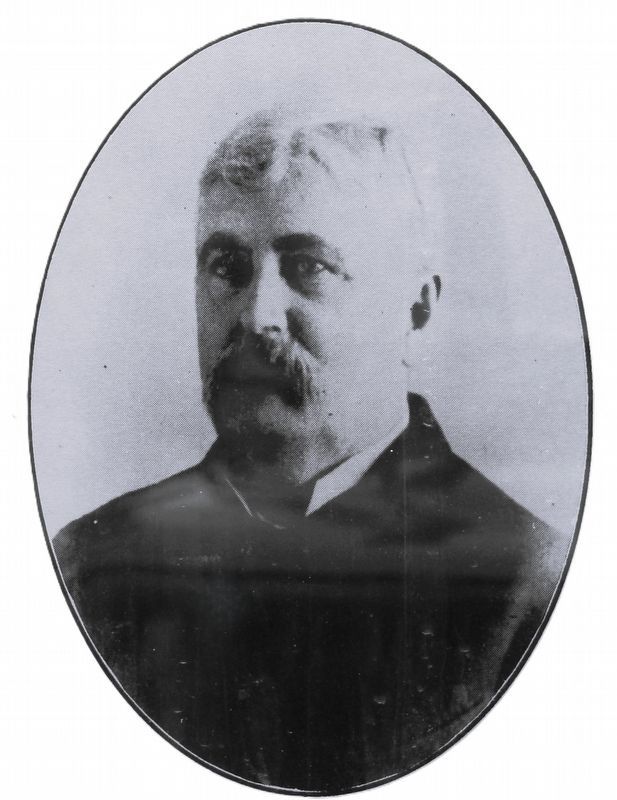
2. Marker detail: Attorney Fred C. Peck
Lake City attorney Fred C. Peck served as the first Worshipful Master of Crystal Lake Lodge in 1878 and 1879.
In 1908 a plan to acquire the present building was proposed by the membership.
The site, Lot 9 in Block 57, had an unfortunate building history. The log walls for a retail liquor store were started in 1877 but never completed; the walls were removed in 1881, leaving the lot vacant until 1902 when a prosperous Chinese laundryman by the name Quong On Wah decided that increased business required construction of a larger building for a steam laundry. Construction was started on the laundry's massive stone walls but the expected increase in business apparently failed to materialize and Quong Wah left Lake City, leaving the roofless walls of his laundry unfinished.
In 1908 the local Masons arranged to purchase the lot and the partially completed stone walls, then proceeded to construct the brick front and roof, placed the cement sidewalk, and partitioned the interior
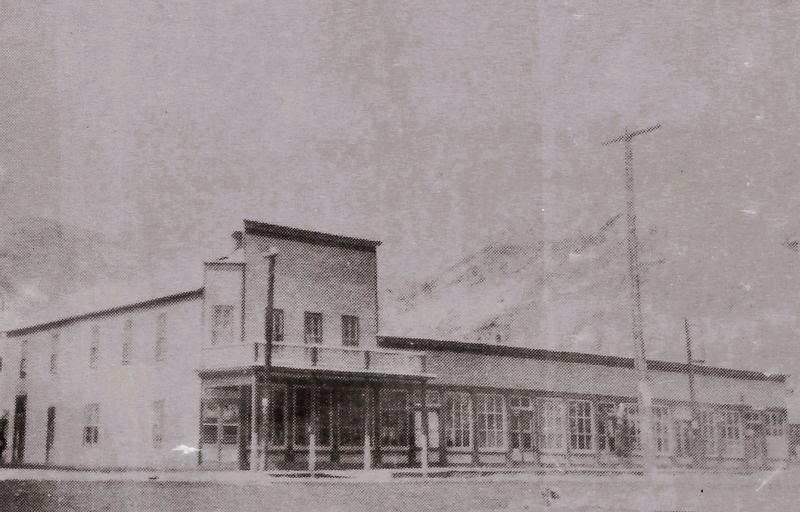
3. Marker detail: The H.L. Franklin Block
Lake City Masons in the late 19th Century met in rooms in the Franklin Block, southwest corner of Gunnison Avenue and Third Street. The building was razed in 1917.
Total cost of the purchase and remodel was $1,200 which was repaid from personal loans of $25 each from lodge members which were paid to the building trustee, lodge secretary James F. Steinbeck. Crystal Lake Lodge and its companion lodge, Queen Sheba Easter Star Chapter No. 36, paid rent at $25 per month to the trustee, repaying an individual's loan each month until the entire mortgage was retired.
In May, 1908, M.W. Grand Master J.A. Davis granted permission to move the lodge into the new building. A member of the lodge, Herman Lueders, who happened to serve as chairman of the building board for the state capitol in Denver, arranged to acquire a block of marble which had been rejected when the capitol was constructed. This marble was engraved with the name Crystal Lake Lodge No. 34, AF & AM, AL5878-5908, Year of Light. This tablet was attached to the northwest corner of the lodge building on October 18, 1908, to commemorate 30 years of Masonry in Lake City.
Fred C. Peck was the first Worshipful Master
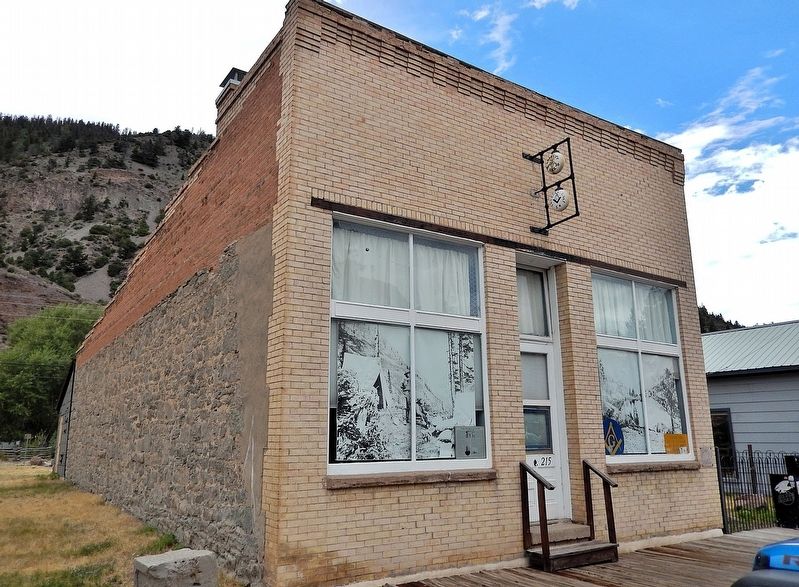
Photographed by Cosmos Mariner, July 21, 2025
4. Crystal Lake Lodge (southeast elevation)
The marker is mounted in the window frame on the left side of the east/front entrance.
Peck was born in Pennsylvania on January 21, 1841. He joined the Union Army during the Civil War and was a member of the Seventh Kansas Cavalry known as a "Jayhawker." Peck later returned to Pennsylvania where he was elected Sheriff of Crawford County before the age of 25. He served as a member of the Pennsylvania Constitutional Convention which framed the existing Pennsylvania Constitution.
He later moved to Colorado Territory as a pioneer attorney. He served as a member of the Colorado Constitutional Convention held in Denver in 1876. Peck served in the first Colorado Legislature and later represented Hinsdale County in the Colorado Senate for two terms. In Lake City he was a member of the prestigious law firm Howell & Peck with R.G. Howell.
Peck was a life-long Mason and member of Eureka Lodge No. 366 in Union City, Pennsylvania. September 19, 1879, he was commissioned to institute
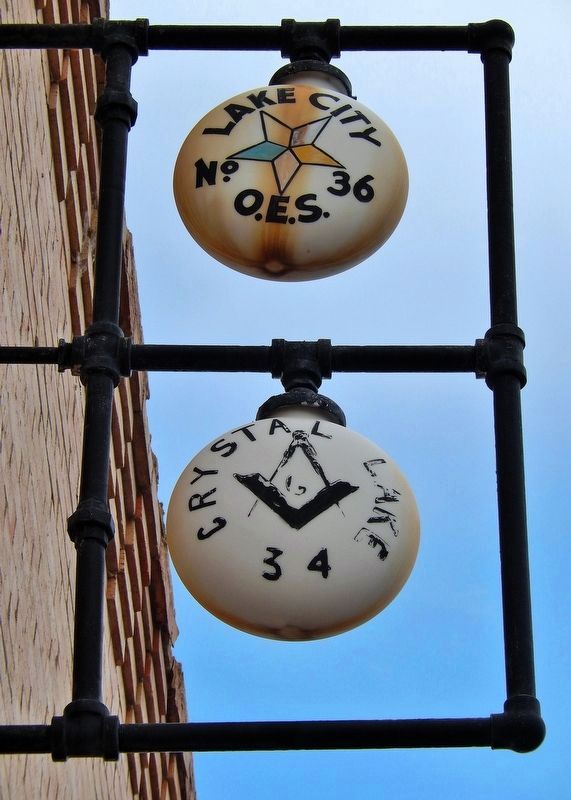
Photographed by Cosmos Mariner, July 21, 2025
5. Crystal Lake Lodge Sign
Fred C. Peck died January 24, 1908, in Washington, DC, and was buried in Arlington Cemetery. His wife, Frances, commissioned a large oak master's chair which remains in his memory in the main room of the Lake City lodge.
Topics and series. This historical marker is listed in these topic lists: Architecture • Fraternal or Sororal Organizations • Industry & Commerce. In addition, it is included in the National Register of Historic Places (NRHP) series list. A significant historical year for this entry is 1908.
Location. 38° 1.703′ N, 107° 19.058′ W. Marker is in Lake City, Colorado, in Hinsdale County. It is on Silver Street just north of 2nd Street (County Road 20), on the left when traveling north. The marker is on the left side of the front entrance. Touch for map. Marker is at or near this postal address: 215 Silver Street, Lake City CO 81235, United States of America. Touch for directions.

Regionally, this marker is in the Colorado High Rockies. It is also in the American Mountain West. Globally, it is in North America, the Rocky Mountains, the
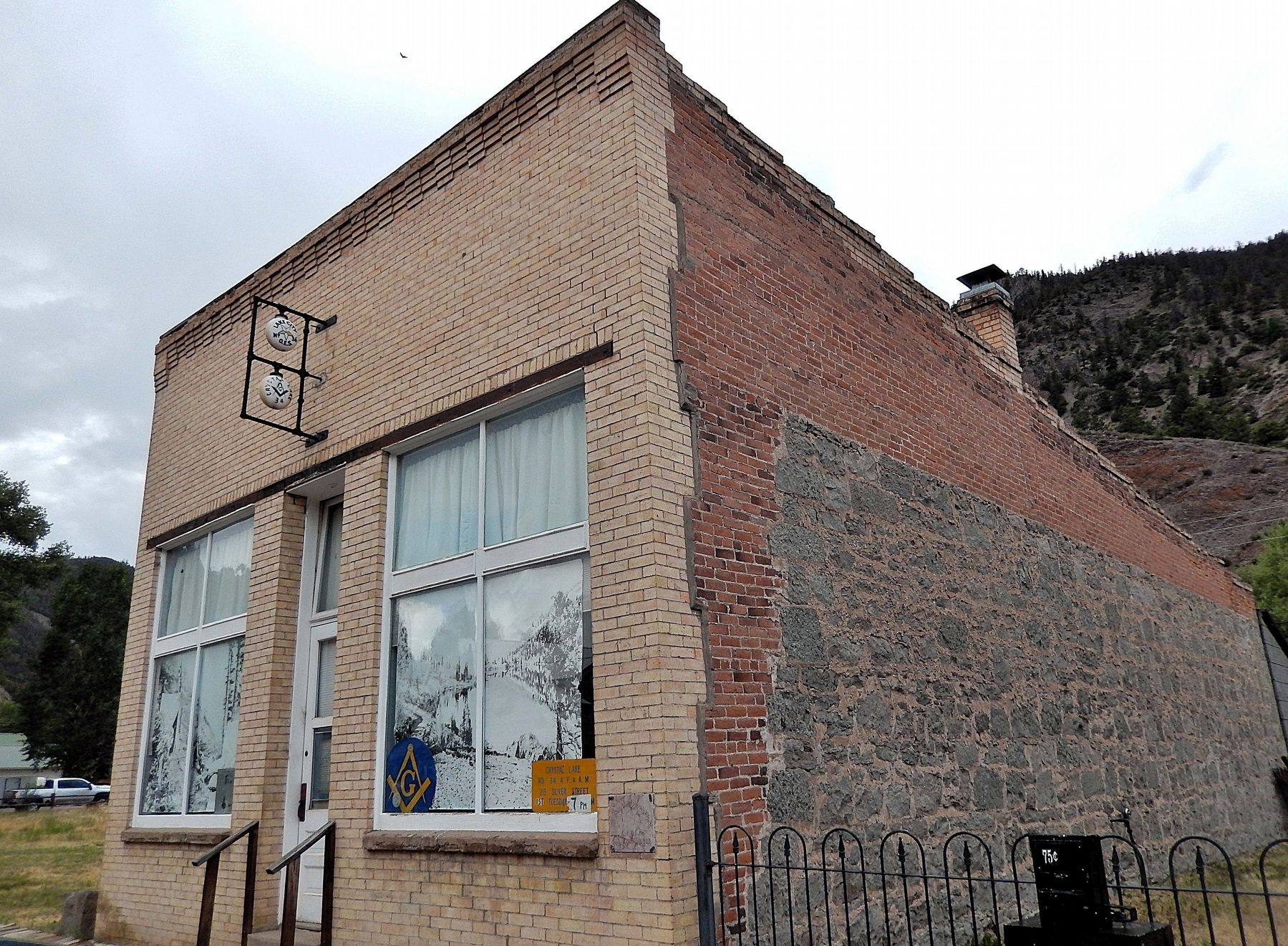
Photographed by Cosmos Mariner, July 21, 2025
6. Crystal Lake Lodge No. 34 A.F. & A.M. (northeast elevation)
The partial stone wall from the original construction is clearly visible on the north side of the building. The original marble cornerstone is visible between the window and building edge.
Other nearby markers. At least 8 other markers are within walking distance of this marker: Lake City Historic Loop (within shouting distance of this marker); Stone Bank Block — Built 1877 (within shouting distance of this marker); 1984 New Orleans World's Fair Flag Pole (within shouting distance of this marker); The Colorado-Yule Marble Company (about 300 feet away, measured in a direct line); Armory Hall — Built 1883 (about 300 feet away); Bachelor Cabins, Carson (about 300 feet away); Colonel Channing Franklin Meek (about 300 feet away); Finley Block — Built 1877 (about 300 feet away). Touch for a list and map of all markers in Lake City.
Regarding Crystal Lake Lodge No. 34 A.F. & A.M.. Contributing property, Lake City Historic District, National Register of Historic Places № 78000859. Also Colorado State Register of Historic Properties Site № 5HN.68.21
From the National Register Nomination prepared by Suzanne Mason, 3/1/1977:
The flat-roofed building originally contained a confectionery shop. The local Masonic Lodge, Crystal Lake Lodge No. 34, AF & AM, acquired the property in 1908 and replaced the original iron-clad facade with the present beige brick, windowed storefront. The building has stone side walls and an asphalt roof. The building interior retains its original decorative stamped metal ceiling.
Credits. This page was last revised on January 23, 2026. It was originally submitted on January 21, 2026, by Cosmos Mariner of Cape Canaveral, Florida. This page has been viewed 47 times since then. Photos: 1, 2, 3, 4, 5, 6. submitted on January 23, 2026, by Cosmos Mariner of Cape Canaveral, Florida.
