Lake City in Hinsdale County, Colorado — The American Mountains (Southwest)
Stone Bank Block — Built 1877
Photographed by Cosmos Mariner, July 21, 2025
1. Stone Bank Block — Built 1877 Marker
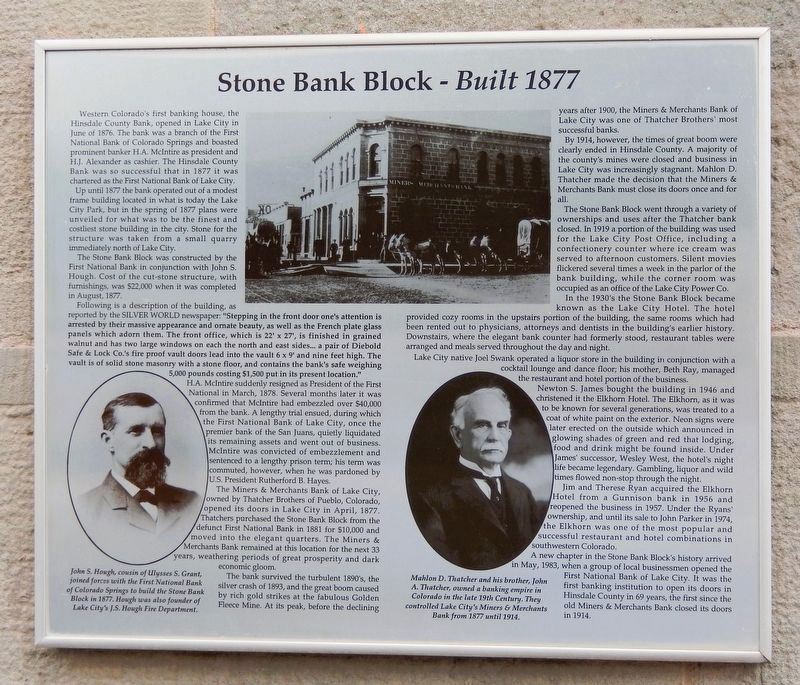
Western Colorado's first banking house, the Hinsdale County Bank, opened in Lake City in June of 1876. The bank was a branch of the First National Bank of Colorado Springs and boasted prominent banker H.A. McIntire as president and H.J. Alexander as cashier. The Hinsdale County Bank was so successful that in 1877 it was chartered as the First National Bank of Lake City.
Up until 1877 the bank operated out of a modest frame building located in what is today the Lake City Park, but in the spring of 1877 plans were unveiled for what was to be the finest and costliest stone building in the city. Stone for the structure was taken from a small quarry immediately north of Lake City.
The Stone Bank Block was constructed by the First National Bank in conjunction with John S. Hough. Cost of the cut-stone structure, with furnishings, was $22,000 when it was completed in August, 1877.
Following is a description of the building, as reported by the SILVER WORLD newspaper: "Stepping in the front door one's attention is arrested by their massive appearance and ornate beauty, as well as the French plate glass panels which adorn them. The
this page online
H.A. McIntire suddenly resigned as President of the First National in March, 1878. Several months later it was confirmed that McIntire had embezzled over $40,000 from the bank. A lengthy trial ensued, during which the First National Bank of Lake City, once the premier bank of the San Juans, quietly liquidated its remaining assets and went out of business. McIntire was convicted of embezzlement and sentenced to a lengthy prison term; his term was commuted, however, when he was pardoned by U.S. President Rutherford B. Hayes.
The Miners & Merchants Bank of Lake City, owned by Thatcher Brothers of Pueblo, Colorado, opened its doors in Lake City in April, 1877. Thatchers purchased the Stone Bank Block from the defunct First National Bank in 1881 for $10,000 and
2. Marker detail: John S. Hough
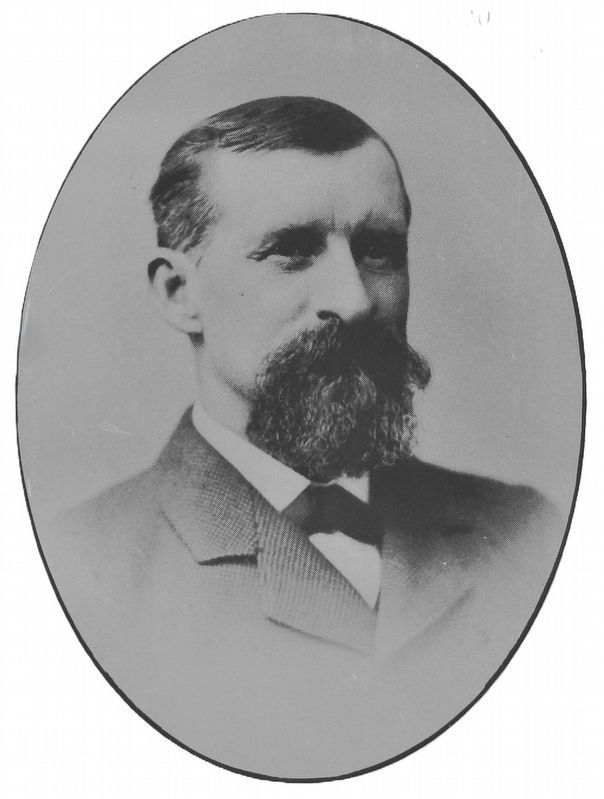
John S. Hough, cousin of Ulysses S. Grant, joined forces with the First National Bank of Colorado Springs to build the Stone Bank Block in 1877. Hough was also founder of Lake City’s J.S. Hough Fire Department.
The bank survived the turbulent 1890's, the silver crash of 1893, and the great boom caused by rich gold strikes at the fabulous Golden Fleece Mine. At its peak, before the declining years after 1900, the Miners & Merchants Bank of Lake City was one of Thatcher Brothers' most successful banks.
By 1914, however, the times of great boom were clearly ended in Hinsdale County. A majority of the county's mines were closed and business in Lake City was increasingly stagnant. Mahlon D. Thatcher made the decision that the Miners & Merchants Bank must close its doors once and for all.
The Stone Bank Block went through a variety of ownerships and uses after the Thatcher bank closed. In 1919 a portion of the building was used for the Lake City Post Office, including a confectionery counter where ice cream was served to afternoon customers. Silent movies flickered several times a week in the parlor of the bank building, while the corner room was occupied as an office of the
3. Marker detail: Mahlon D. Thatcher
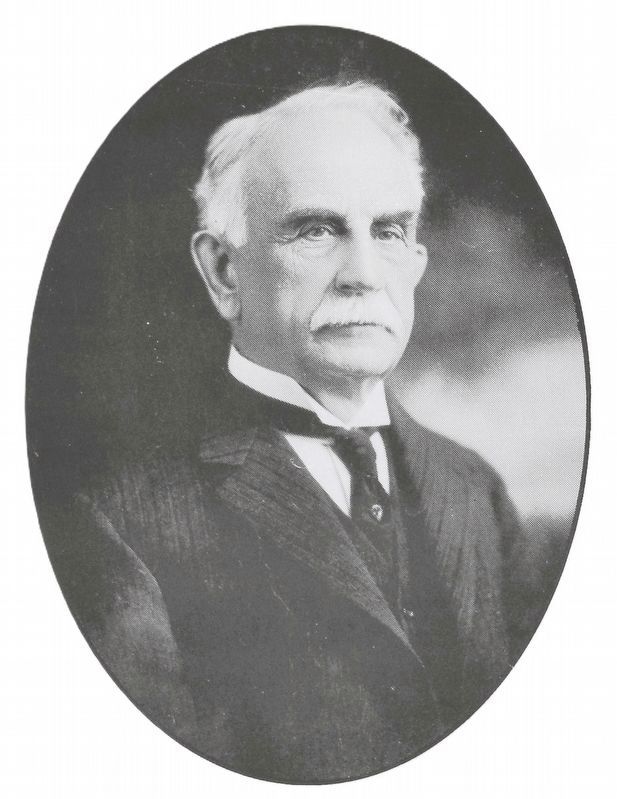
Mahlon D. Thatcher and his brother, John A. Thatcher, owned a banking empire in Colorado in the late 19th Century. They controlled Lake City’s Miners & Merchants Bank from 1877 until 1914.
In the 1930's the Stone Bank Block became known as the Lake City Hotel. The hotel provided cozy rooms in the upstairs portion of the building, the same rooms which had been rented out to physicians, attorneys and dentists in the building's earlier history. Downstairs, where the elegant bank counter had formerly stood, restaurant tables were arranged and meals served throughout the day and night.
Lake City native Joel Swank operated a liquor store in the building in conjunction with a cocktail lounge and dance floor; his mother, Beth Ray, managed the restaurant and hotel portion of the business.
Newton S. James bought the building in 1946 and christened it the Elkhorn Hotel. The Elkhorn, as it was to be known for several generations, was treated to a coat of white paint on the exterior. Neon signs were later erected on the outside which announced in glowing shades of green and red that lodging, food and drink might be found inside. Under James' successor, Wesley West, the hotel's night life became legendary. Gambling, liquor and wild times flowed non-stop through the night.
Jim and Therese Ryan acquired the Elkhorn
Photographed by Cosmos Mariner, July 21, 2025
4. Stone Bank Block — Built 1877 Marker
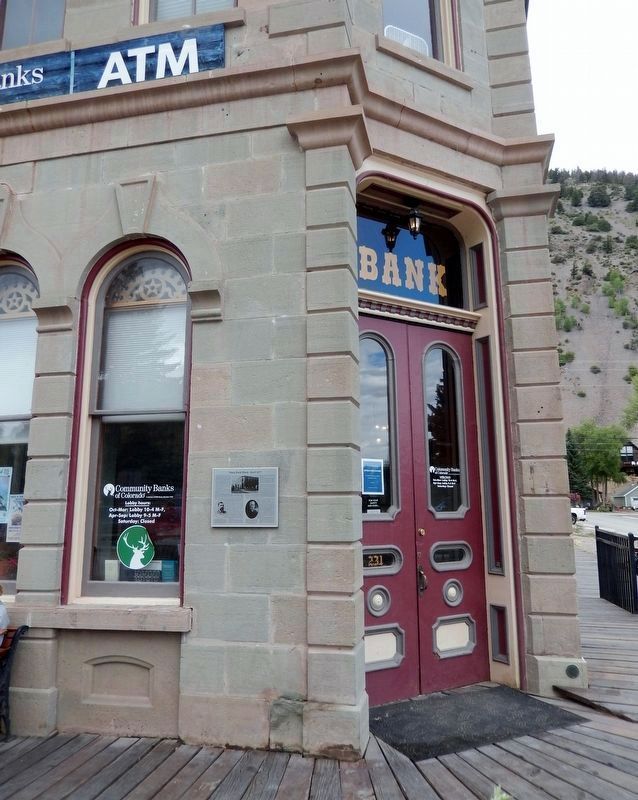
The marker is mounted at eye level on the left side of the northeast corner building entrance.
A new chapter in the Stone Bank Block's history arrived in May, 1983, when a group of local businessmen opened the First National Bank of Lake City. It was the first banking institution to open its doors in Hinsdale County in 69 years, the first since the old Miners & Merchants Bank closed its doors in 1914.
Topics and series. This historical marker is listed in these topic lists: Architecture • Industry & Commerce. In addition, it is included in the National Register of Historic Places (NRHP) series list. A significant historical month for this entry is August 1877.
Location. 38° 1.734′ N, 107° 19.043′ W. Marker is in Lake City, Colorado, in Hinsdale County. It is at the intersection of Silver Street and 3rd Street, on the left when traveling north on Silver Street. The marker is mounted near the northeast corner of the subject building, facing Silver Street. Touch for map. Marker is at
Photographed by Cosmos Mariner, July 21, 2025
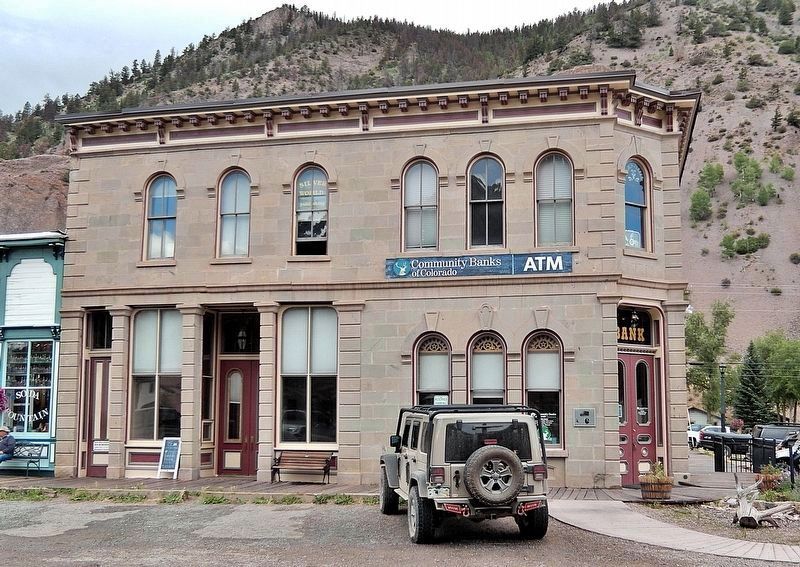
5. Stone Bank Block (east elevation)

Regionally, this marker is in the Colorado High Rockies. It is also in the American Mountain West. Globally, it is in North America, the Rocky Mountains, the Western Hemisphere, the Western World, and the Anglosphere.
Other nearby markers. At least 8 other markers are within walking distance of this marker: 1984 New Orleans World's Fair Flag Pole (here, next to this marker); Lake City Historic Loop (within shouting distance of this marker); Hough Block — Built 1880-82 (within shouting distance of this marker); Hughes Cabin — 1876 (within shouting distance of this marker); Armory Hall — Built 1883 (within shouting distance of this marker); Crystal Lake Lodge No. 34 A.F. & A.M. (within shouting distance of this marker); Architectural Contrasts — 1877, 1947 (about 400 feet away, measured in a direct line); Susan B. Anthony in Lake City (about 500 feet away). Touch for a list and map of all markers in Lake City.
Regarding Stone Bank Block — Built 1877. Contributing property, Lake City Historic District, National
Photographed by Cosmos Mariner, July 21, 2025
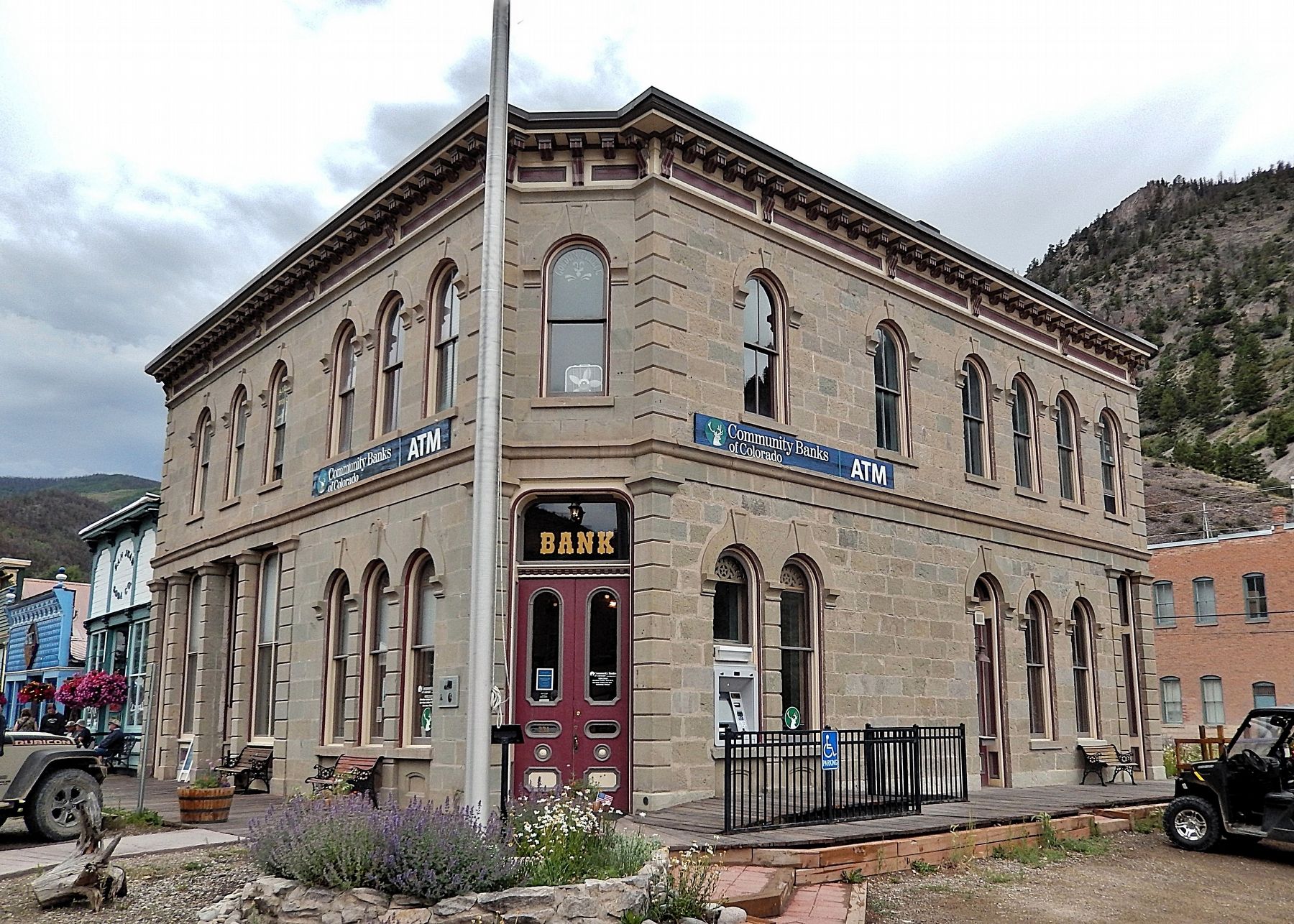
6. Stone Bank Block (northeast elevation)
From the National Register Nomination prepared by Suzanne Mason, 3/1/1977:
The Miners and Merchants Bank is a two-story stone building with all wood cornice accented by intricately scrolled wood trusses. Rusticated pilasters, again from locally quarried stone, are combined with well-proportioned arched windows and oversized keystones to provide an Italian Renaissance feeling to the structure. A large walk-in vault with three-foot-thick walls of local brick is still in place. Recent restoration has revealed master craftsmanship in the use of mortice and tenon joints throughout the building.
John Simpson Hough, one of Lake City's founding businessmen and mining capitalists, erected the Bank Block with proceeds from his Frank Hough and Palmetto gold mines on Engineer Pass west of Lake City. The two-story building is constructed of ashlar stone block with a flat asphalt roof. Its Italianate style is reflected in the prominent bracketed cornice and tall narrow windows with elaborate carved stone window heads. Window and entrance openings are framed by ashlar columns capped by curved molding and pilasters. Upper story comers are finished with ashlar quoins. The building features belt course between upper and lower stories and an oblique double leaf entrance.
Also see . . . Miners & Merchants Bank, circa 1877 (Western Mining History Gallery). (Submitted on January 25, 2026, by Cosmos Mariner of Cape Canaveral, Florida.)
Credits. This page was last revised on January 25, 2026. It was originally submitted on January 22, 2026, by Cosmos Mariner of Cape Canaveral, Florida. This page has been viewed 31 times since then. Photos: 1, 2, 3, 4, 5, 6. submitted on January 24, 2026, by Cosmos Mariner of Cape Canaveral, Florida.
