Lake City in Hinsdale County, Colorado — The American Mountains (Southwest)
Hough Block — Built 1880-82
Photographed by Cosmos Mariner, July 21, 2025
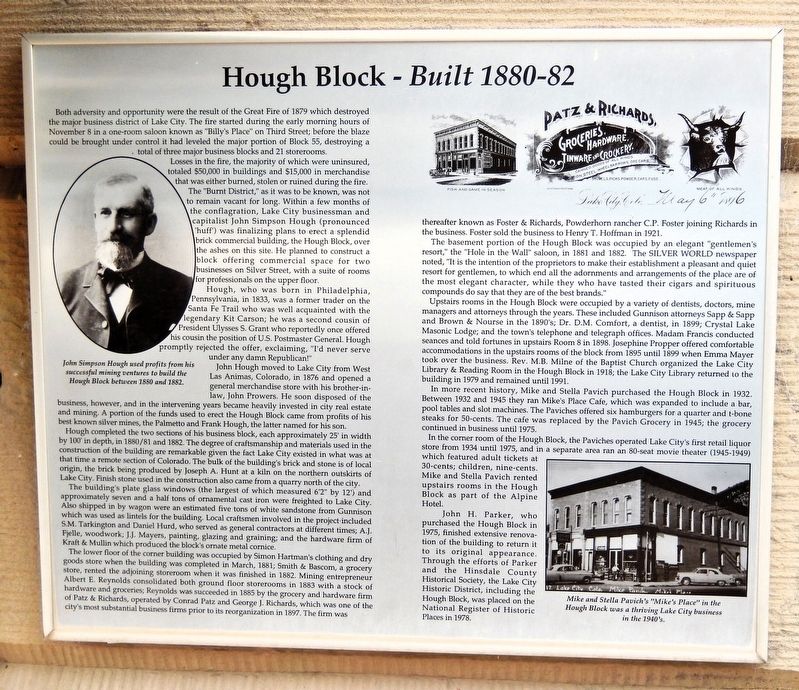
1. Hough Block — Built 1880-82 Marker
Both adversity and opportunity were the result of the Great Fire of 1879 which destroyed the major business district of Lake City. The fire started during the early morning hours of November 8 in a one-room saloon known as "Billy's Place" on Third Street; before the blaze could be brought under control it had leveled the major portion of Block 55, destroying a total of three major business blocks and 21 storerooms.
Losses in the fire, the majority of which were uninsured, totaled $50,000 in buildings and $15,000 in merchandise that was either burned, stolen or ruined during the fire.
The "Burnt District," as it was to be known, was not to remain vacant for long. Within a few months of the conflagration, Lake City businessman and capitalist John Simpson Hough (pronounced 'huff') was finalizing plans to erect a splendid brick commercial building, the Hough Block, over the ashes on this site. He planned to construct a block offering commercial space for two businesses on Silver Street, with a suite of rooms for professionals on the upper floor.
Hough, who was born in Philadelphia, Pennsylvania, in 1833, was a former trader
this page online
John Hough moved to Lake City from West Las Animas, Colorado, in 1876 and opened a general merchandise store with his brother-in-law, John Prowers. He soon disposed of the business, however, and in the intervening years became heavily invested in city real estate and mining. A portion of the funds used to erect the Hough Block came from profits of his best known silver mines, the Palmetto and Frank Hough, the latter named for his son.
Hough completed the two sections of his business block, each approximately 25' in width by 100' in depth, in 1880/81 and 1882. The degree of craftsmanship and materials used in the construction of the building are remarkable given the fact Lake City existed in what was at that time a remote section of Colorado. The bulk of the building's brick and stone is of local origin, the brick being produced by Joseph
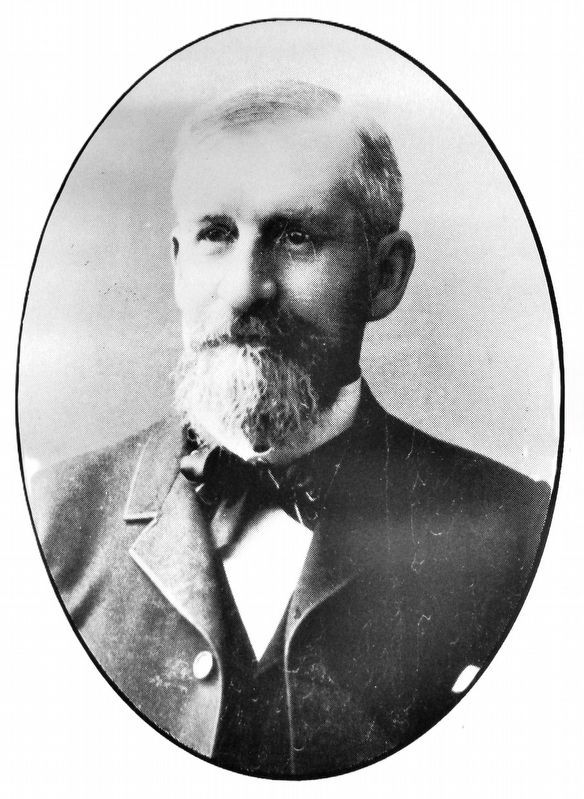
2. Marker detail: John Simpson Hough
John Simpson Hough used profits from his successful mining ventures to build the Hough Block between 1880 and 1882.
The building's plate glass windows (the largest of which measured 6'2" by 12') and approximately seven and a half tons of ornamental cast iron were freighted to Lake City. Also shipped in by wagon were an estimated five tons of white sandstone from Gunnison which was used as lintels for the building. Local craftsmen involved in the project included S.M. Tarkington and Daniel Hurd, who served as general contractors at different times; A.J. Fjelle, woodwork; J.J. Mayers, painting, glazing and graining; and the hardware firm of Kraft & Mullin which produced the block's ornate metal cornice.
The lower floor of the corner building was occupied by Simon Hartman's clothing and dry goods store when the building was completed in March, 1881; Smith & Bascom, a grocery store, rented the adjoining storeroom when it was finished in 1882. Mining entrepreneur Albert E. Reynolds consolidated both ground floor storerooms in 1883 with a stock of hardware and groceries; Reynolds was succeeded in 1885 by the grocery
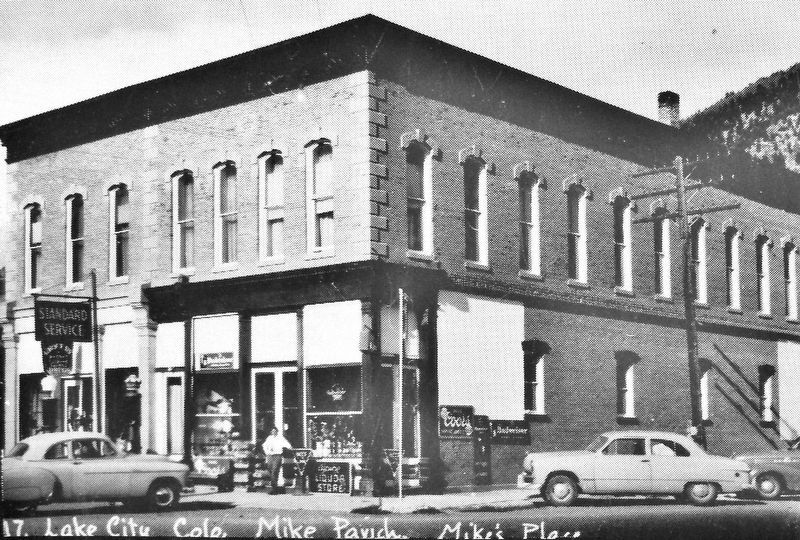
3. Marker detail: “Mike’s Place”
Mile and Stella Pavich’s “Mike’s Place” in the Hough Block was a thriving Lake City business in the 1940’s.
The basement portion of the Hough Block was occupied by an elegant "gentlemen's resort," the "Hole in the Wall" saloon, in 1881 and 1882. The SILVER WORLD newspaper noted, "It is the intention of the proprietors to make their establishment a pleasant and quiet resort for gentlemen, to which end all the adornments and arrangements of the place are of the most elegant character, while they who have tasted their cigars and spirituous compounds do say that they are of the best brands."
Upstairs rooms in the Hough Block were occupied by a variety of dentists, doctors, mine managers and attorneys through the years. These included Gunnison attorneys Sapp & Sapp and Brown & Nourse in the 1890's; Dr. D.M. Comfort, a dentist, in 1899; Crystal Lake Masonic Lodge; and the town's telephone and telegraph
Photographed by Cosmos Mariner, July 21, 2025
4. Hough Block — Built 1880-82 Marker
The marker is mounted at eye level at the left edge of the front façade.
In more recent history, Mike and Stella Pavich purchased the Hough Block in 1932. Between 1932 and 1945 they ran Mike's Place Cafe, which was expanded to include a bar, pool tables and slot machines. The Paviches offered six hamburgers for a quarter and t-bone steaks for 50-cents. The cafe was replaced by the Pavich Grocery in 1945; the grocery continued in business until 1975.
In the corner room of the Hough Block, the Paviches operated Lake City's first retail liquor store from 1934 until 1975, and in a separate area ran an 80-seat movie theater (1945-1949) which featured adult tickets at 30-cents; children, nine-cents. Mike and Stella Pavich rented upstairs rooms in the Hough Block as part of the Alpine Hotel.
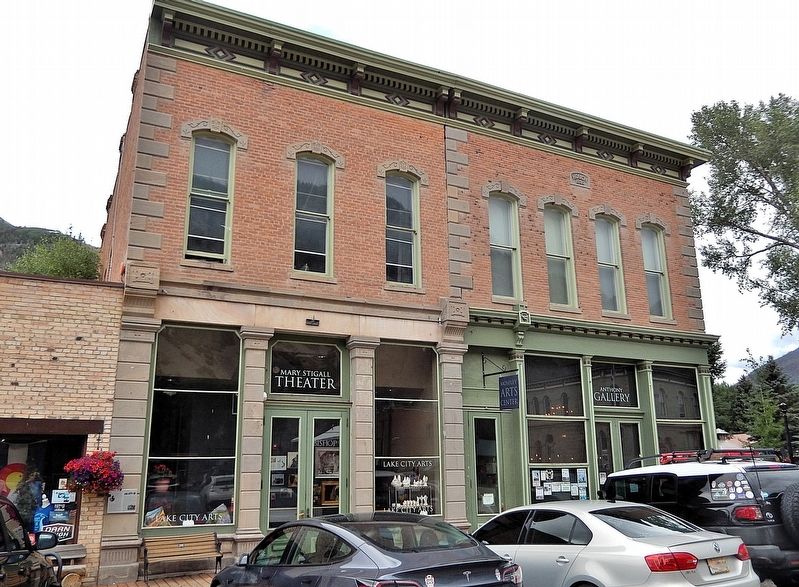
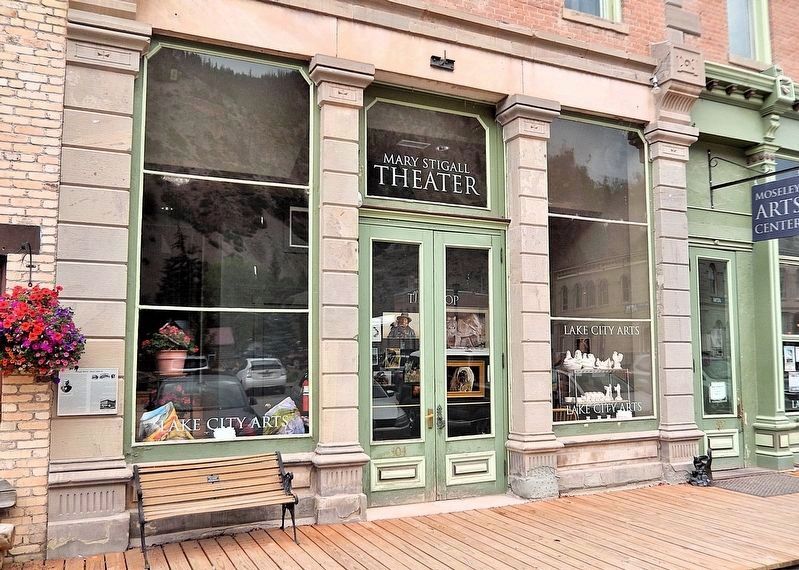
Photographed by Cosmos Mariner, July 21, 2025
5. Hough Block (northwest elevation)
John H. Parker, who purchased the Hough Block in 1975, finished extensive renovation of the building to return it to its original appearance. Through the efforts of Parker and the Hinsdale County Historical Society, the Lake City Historic District, including the Hough Block, was placed on the National Register of Historic Places in 1978.
Topics and series. This historical marker is listed in these topic lists: Architecture • Industry & Commerce. In addition, it is included in the National Register of Historic Places (NRHP) series list. A significant historical year for this entry is 1880.
Location. 38° 1.749′ N, 107° 19.014′ W. Marker is in Lake City, Colorado, in Hinsdale County. It is at the intersection of Silver Street and 3rd Street, on the left when traveling south on Silver Street. The marker is mounted directly on the subject building, at the north edge of the front facade. Touch for map. Marker is at or near this postal address: 300 Silver Street, Lake City CO 81235, United States of America. Touch for directions.

Regionally, this marker is in the Colorado High Rockies. It is also in the American Mountain West. Globally,
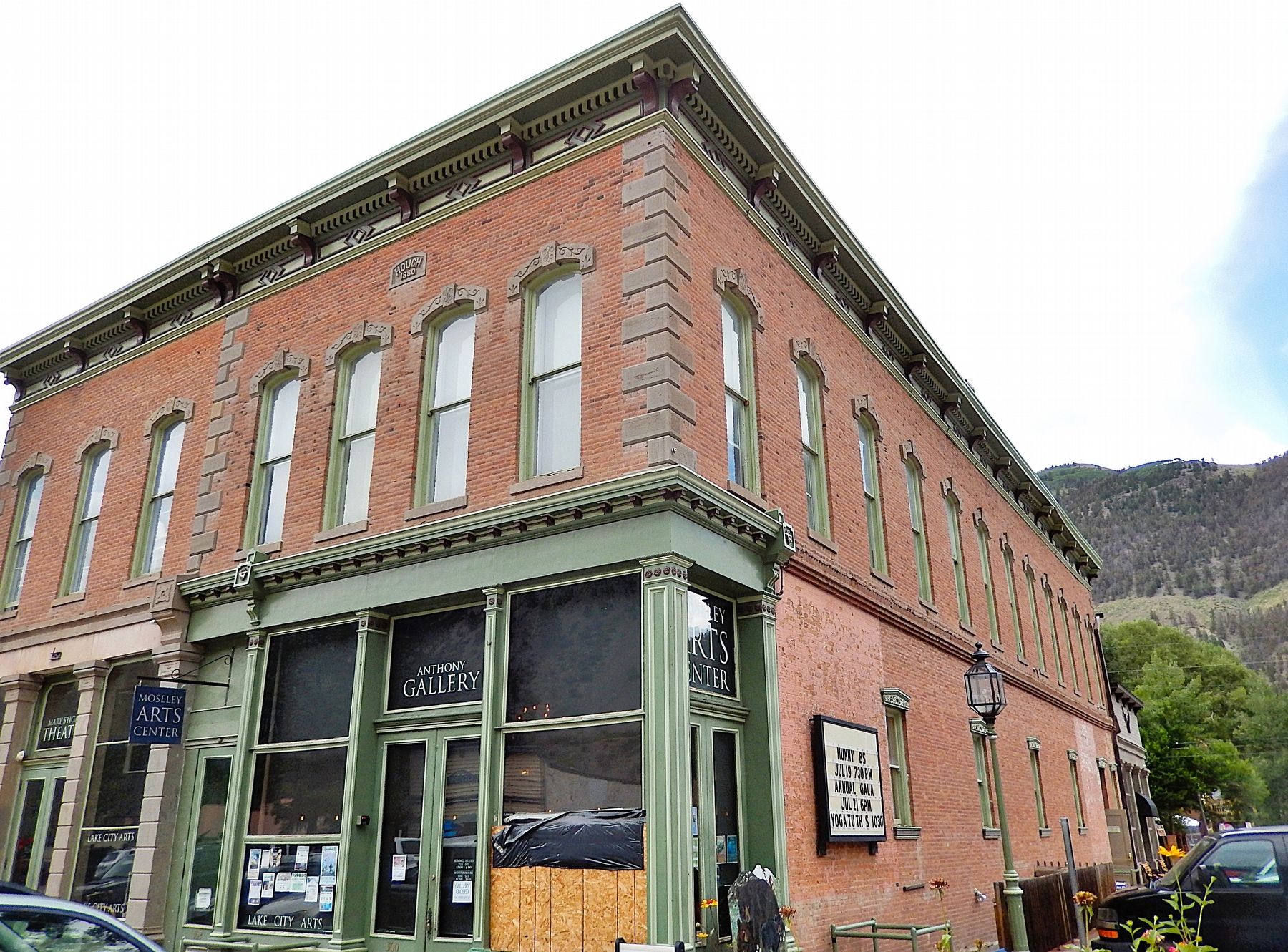
Photographed by Cosmos Mariner, July 21, 2025
6. Hough Block (southwest elevation)
Other nearby markers. At least 8 other markers are within walking distance of this marker: 1984 New Orleans World's Fair Flag Pole (within shouting distance of this marker); Stone Bank Block — Built 1877 (within shouting distance of this marker); Lake City Historic Loop (within shouting distance of this marker); Hughes Cabin — 1876 (about 300 feet away, measured in a direct line); Armory Hall — Built 1883 (about 300 feet away); Crystal Lake Lodge No. 34 A.F. & A.M. (about 300 feet away); Susan B. Anthony in Lake City (about 400 feet away); Lake City's First Post Office (about 400 feet away). Touch for a list and map of all markers in Lake City.
Regarding Hough Block — Built 1880-82. Contributing property, Lake City Historic District, National Register of Historic Places № 78000859. Also Colorado State Register of Historic Properties Site № 5HN.68.25
From the National Register Nomination prepared by Suzanne Mason, 3/1/1977:
The two-story masonry business block is built of brick with stone trim and has a flat asphalt roof. Its Italianate style is evident in the bracketed cornice and tall narrow windows with stone surrounds carved with a curvilinear vegetative design. Architectural features include the belt course separating the first and second stories, prominent ashlar quoining, and transomed entrances. The cast iron storefront has a centered entrance flanked by large three vertical light windows with kickplates below. Openings are framed in square cast iron columns with capitals adorned by small rosettes. Pilasters on low square bases support a secondary cornice with block modillions across the width of the facade. The fireproof storefront was freighted to Lake City from St. Louis, Missouri and hauled by wagon from the D&RG railhead at Sapinero 40 miles to the north.
The Hough Building is constructed of locally produced brick. Jack Wells and Samuel M. Tarkington were the brick masons. The exterior is highlighted by arched lintels, window sills, quoins, and rusticated pilasters all constructed from locally quarried sandstone. This is the only building in Lake City which uses cast iron on the exterior facade. The lower floor on the south features windowsills and pilasters made of cast iron produced by T.R. Pullis and Sons of St. Louis, Missouri.
Also see . . .
1. Hough Block (Society of Architectural Historians).
(by Thomas J. NoelExcerpt: The local brick construction of the Hough Block is highlighted by native sandstone trim and a cast iron storefront from T. R. Pullis and Sons, St. Louis. The store has been in continuous use since it opened, selling everything from hardware to liquor, with offices upstairs. The subterranean Hole-in-the-Wall Saloon contains wildlife dioramas, ranging from a lurking raccoon to a howling coyote.(Submitted on January 25, 2026, by Cosmos Mariner of Cape Canaveral, Florida.)
2. Entrepreneurs: John Simpson Hough (Town of Lake City).
Excerpt: John Simpson Hough (1833-1919) was among the founding businessmen and mining capitalists of Lake City. A prolific Lake City builder, Hough established the Prowers & Hough mercantile firm in Lake City in 1876 at 301 Silver and in subsequent years was responsible — either on his own or in partnership with others — for the Stone Bank Block (1877, 229-231 Silver), Hough Block (1880 and 1882, 300 and 304 Silver), and Avery Store (1880-81, 300 Third Street), as well his personal residence (1877, 500 Gunnison Avenue).(Submitted on January 25, 2026, by Cosmos Mariner of Cape Canaveral, Florida.)
Although closely associated with Lake City business, Hough's early financial backing came from mining. His ownership of the Frank Hough and Palmetto mines on Engineer Pass in the late 1870s and early 1880s coincides with his greatest building activity.
Credits. This page was last revised on January 25, 2026. It was originally submitted on January 22, 2026, by Cosmos Mariner of Cape Canaveral, Florida. This page has been viewed 31 times since then. Photos: 1, 2, 3, 4, 5, 6. submitted on January 25, 2026, by Cosmos Mariner of Cape Canaveral, Florida.
