Lake City in Hinsdale County, Colorado — The American Mountains (Southwest)
St. James Episcopal Chapel — 1876
Photographed by Cosmos Mariner, July 21, 2025
1. St. James Episcopal Chapel — 1876 Marker
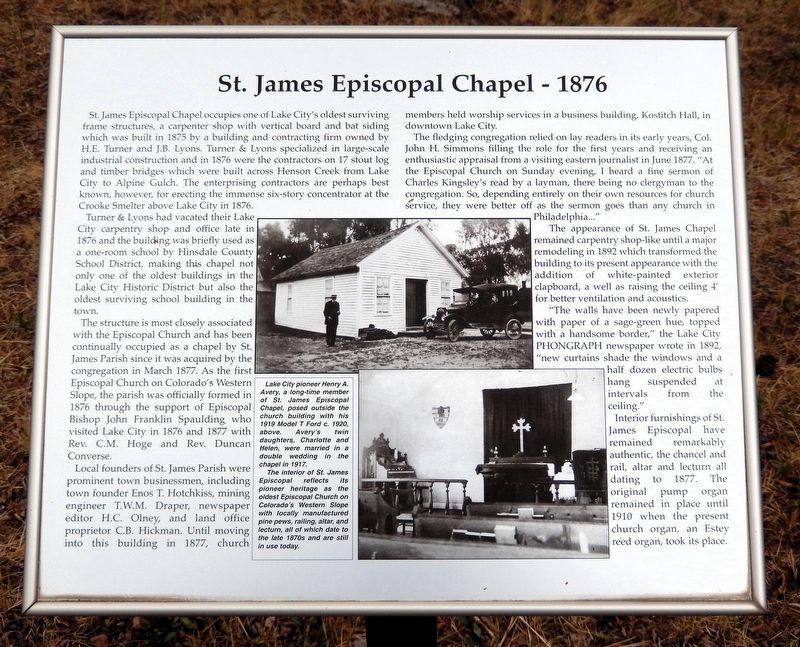
St. James Episcopal Chapel occupies one of Lake City's oldest surviving frame structures, a carpenter shop with vertical board and bat siding which was built in 1875 by a building and contracting firm owned by H.E. Turner and J.B. Lyons. Turner & Lyons specialized in large-scale industrial construction and in 1876 were the contractors on 17 stout log and timber bridges which were built across Henson Creek from Lake City to Alpine Gulch. The enterprising contractors are perhaps best known, however, for erecting the immense six-story concentrator at the Crooke Smelter above Lake City in 1876.
Turner & Lyons had vacated their Lake City carpentry shop and office late in 1876 and the building was briefly used as a one-room school by Hinsdale County School District, making this chapel not only one of the oldest buildings in the Lake City Historic District but also the oldest surviving school building in the town.
The structure is most closely associated with the Episcopal Church and has been continually occupied as a chapel by St. James Parish since it was acquired by the congregation in March 1877. As the first Episcopal Church
this page online
Local founders of St. James Parish were prominent town businessmen, including town founder Enos T. Hotchkiss, mining engineer T.W.M. Draper, newspaper editor H.C. Olney, and land office proprietor C.B. Hickman. Until moving into this building in 1877, church members held worship services in a business building, Kostitch Hall, in downtown Lake City.
The fledging congregation relied on lay readers in its early years, Col. John H. Simmons filling the role for the first years and receiving an enthusiastic appraisal from a visiting eastern journalist in June 1877. “At the Episcopal Church on Sunday evening, I heard a fine sermon of Charles Kingsley's read by a layman, there being no clergyman to the congregation. So, depending entirely on their own resources for church service, they were better off as the sermon goes than any church in Philadelphia...”
The appearance of St. James Chapel remained carpentry shop-like until a
2. Marker detail: Lake City Pioneer Henry A. Avery
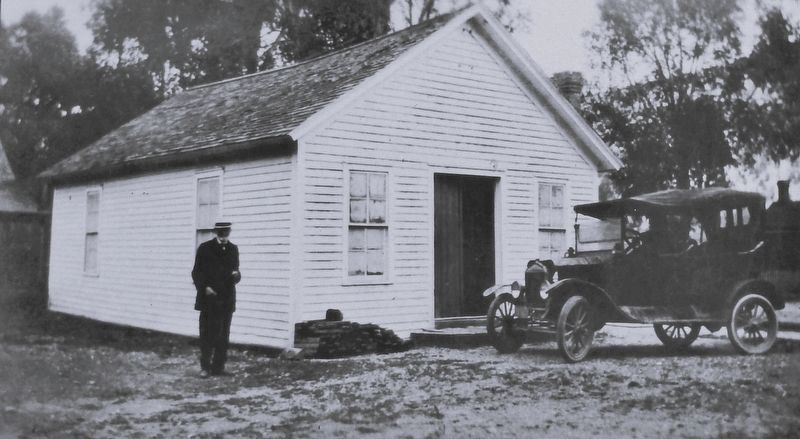
Lake City pioneer Henry A. Avery, a long-time member of St. James Episcopal Chapel, posed outside the church building with his 1919 Model T Ford c. 1920. Avery's twin daughters, Charlotte and Helen, were married in a double wedding in the chapel in 1917.
“The walls have been newly papered with paper of a sage-green hue, topped with a handsome border,” the Lake City PHONOGRAPH newspaper wrote in 1892, “new curtains shade the windows and a half dozen electric bulbs hang suspended at intervals from the ceiling.”
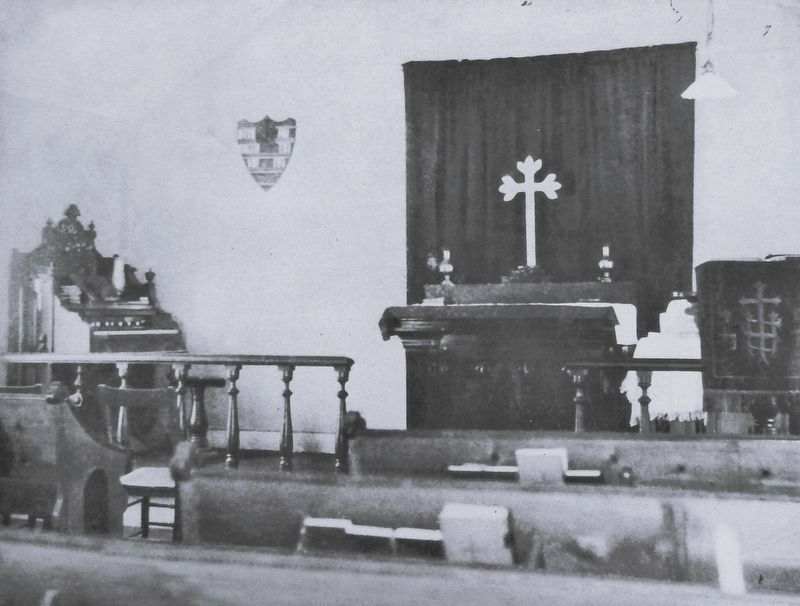
Interior furnishings of St. James Episcopal have remained remarkably authentic, the chancel and rail, altar and lecturn all dating to 1877. The original pump organ remained in place until 1910 when the present church organ, an Estey reed organ, took its place.
Topics and series. This historical marker is listed in these topic lists: Architecture • Education • Religion & Religious Structures • Settlements & Settlers. In addition, it is included in the National Register of Historic Places (NRHP) series list. A significant historical year for this entry is 1876.
Location. 38° 1.872′ N, 107° 18.89′ W. Marker is in Lake City, Colorado, in Hinsdale County. It is at the
3. Marker detail: St. James Episcopal interior
The interior of St. James Episcopal reflects its pioneer heritage as the oldest Episcopal Church on Colorado's Western Slope with locally manufactured pine pews, railing, altar, and lecturn, all of which date to the late 1870s and are still in use today.

Regionally, this marker is in the Colorado High Rockies. It is also in the American Mountain West. Globally, it is in North America, the Rocky Mountains, the Western Hemisphere, the Western World, and the Anglosphere.
Other nearby markers. At least 8 other markers are within walking distance of this marker: John S. Hough House — Built 1877 (within shouting distance of this marker); Presbyterian Church and Manse (within shouting distance of this marker); Henry Kohler House — Built 1880-81 (about 300 feet away, measured in a direct line); Pioneer Education in Western Colorado (about 500 feet away); Green Garage — 1917 (about 500 feet away); G & M Cabins — 1936, 1947 (about 600 feet away); Votes for Women (about 800 feet away); Matterhorn Motel — 1949 (about 800 feet away). Touch for a list and map
Photographed by Cosmos Mariner, July 21, 2025
4. St. James Episcopal Chapel — 1876 Marker
The marker and church are at the northwest corner of the intersection.
Regarding St. James Episcopal Chapel — 1876. Contributing property, Lake City Historic District, National Register of Historic Places № 78000859. Also Colorado State Register of Historic Properties Site № 5HN.68.23
From the National Register Nomination prepared by Suzanne Mason, 3/1/1977:
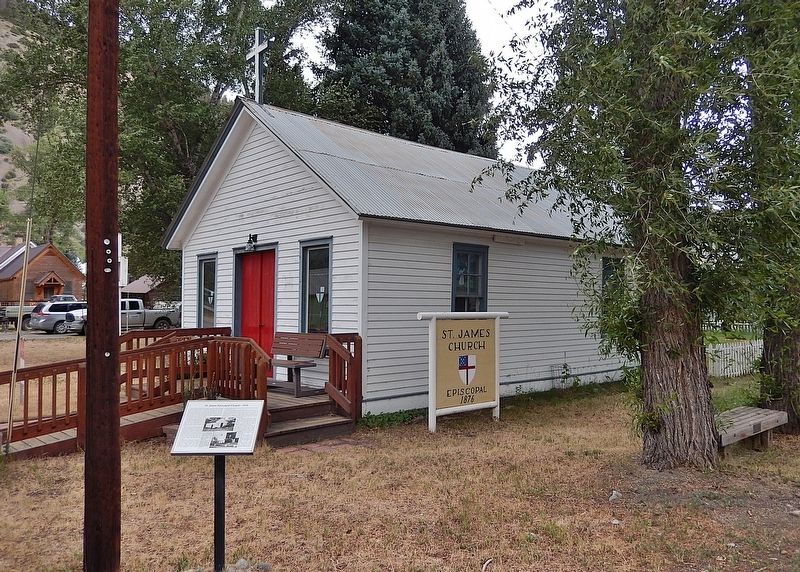
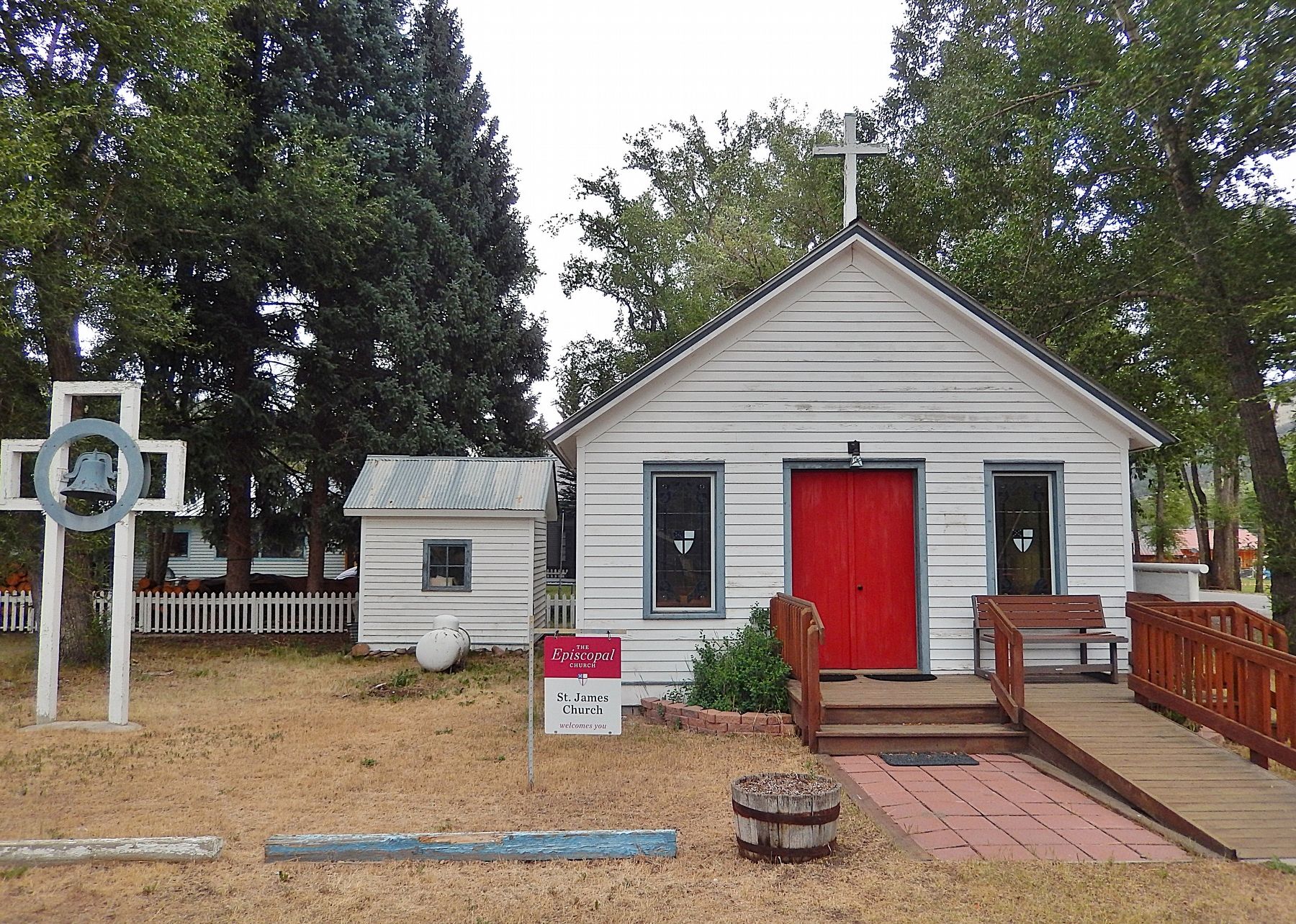
The small, one-story, front-gabled frame church building has a metal roof and walls clad in clapboards and trimmed in cornerboards and friezeboard. A modest wood cross surmounts the gable apex. The centered entrance contains original, paired doors of vertical boards. At the west side of the property is a cross-shaped structure containing a church bell. The original chancel, rail and lectern are all in the church today. The clapboard-sided structure retains its balanced proportion even though the sheet metal roof was added. Though plain, it is elegant in its simplicity.
Unlike many other mining frontier towns, Lake City established churches and a school almost immediately. The modest, front-gabled frame building was built in 1875 as Turner & Lyon's carpenters' workshop and briefly served as a school beforebecoming the St. James Episcopal Church in 1877.Photographed by Cosmos Mariner, July 21, 20255. St. James Episcopal Chapel — 1876Looking north from 5th Street.
Also see . . .
1. St. James Episcopal Chapel.
Excerpt: St. James Church is the oldest Episcopal congregation on Colorado’s western slope, established in the 1870s. The church building originally housed a carpenter's shop in the booming mining town of Lake City, high in the San Juan Mountains, and was later used briefly as a public school. Local Episcopalians purchased the building in December 1876 and converted it into a worship space. For nearly a century, a rare Estey reed organ has provided music for our services.(Submitted on January 27, 2026, by Cosmos Mariner of Cape Canaveral, Florida.)
St. James is a part of the Episcopal Diocese of Colorado and the national Episcopal Church, a member of the worldwide Anglican Communion, born out of the Church of England with roots extending back to the earliest days of Christianity.
2. Lake City National Historic District (Wikipedia).
Excerpt: The Lake City Historic District contains a collection of intact buildings associated with the 1875-1881 boom as well as buildings constructed during the second boom period of the 1890s. The town's remote location and decades of economic decline helped conserve the buildings from the mining era, and the weak local economy discouraged new construction; thus Lake City avoided many of the modern “improvements” to historic buildings that often occurs in more prosperous towns. The Hinsdale County Historical Society formed in 1973 and began accumulating documents and photographs recording the town's history, and has been a strong advocate for preservation in Lake City since then. In 1978, the Lake City Historic District was listed in the National Register of Historic Places.(Submitted on January 27, 2026, by Cosmos Mariner of Cape Canaveral, Florida.)
Credits. This page was last revised on January 27, 2026. It was originally submitted on January 23, 2026, by Cosmos Mariner of Cape Canaveral, Florida. This page has been viewed 26 times since then. Photos: 1, 2, 3, 4, 5. submitted on January 27, 2026, by Cosmos Mariner of Cape Canaveral, Florida.
