Lake City in Hinsdale County, Colorado — The American Mountains (Southwest)
Presbyterian Church and Manse
1876
Photographed by Cosmos Mariner, July 21, 2025
1. Presbyterian Church and Manse Marker
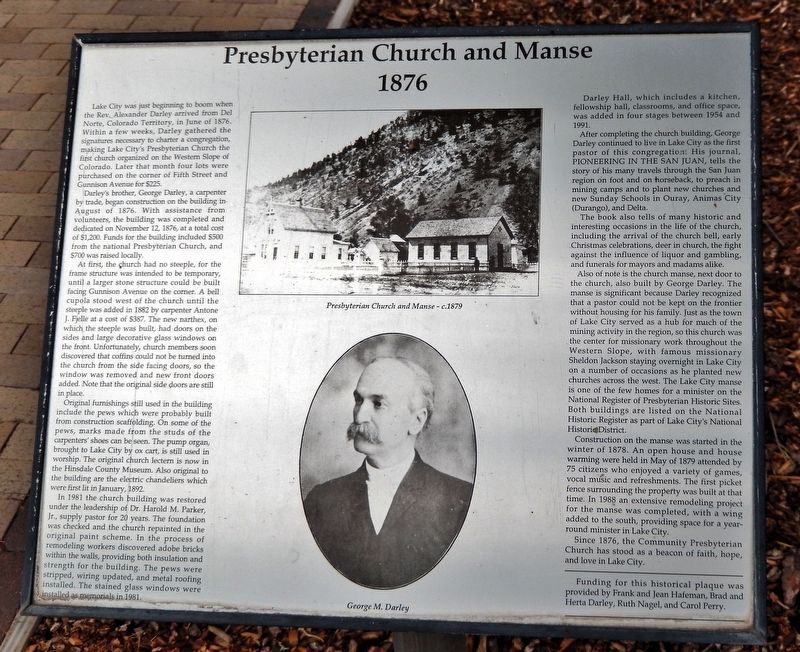
Lake City was just beginning to boom when the Rev. Alexander Darley arrived from Del Norte, Colorado Territory, in June of 1876. Within a few weeks, Darley gathered the signatures necessary to charter a congregation, making Lake City's Presbyterian Church the first church organized on the Western Slope of Colorado. Later that month four lots were purchased on the corner of Fifth Street and Gunnison Avenue for $225.
Darley's brother, George Darley, a carpenter by trade, began construction on the building in August of 1876. With assistance from volunteers, the building was completed and dedicated on November 12, 1876, at a total cost of $1,200. Funds for the building included $500 from the national Presbyterian Church, and $700 was raised locally.
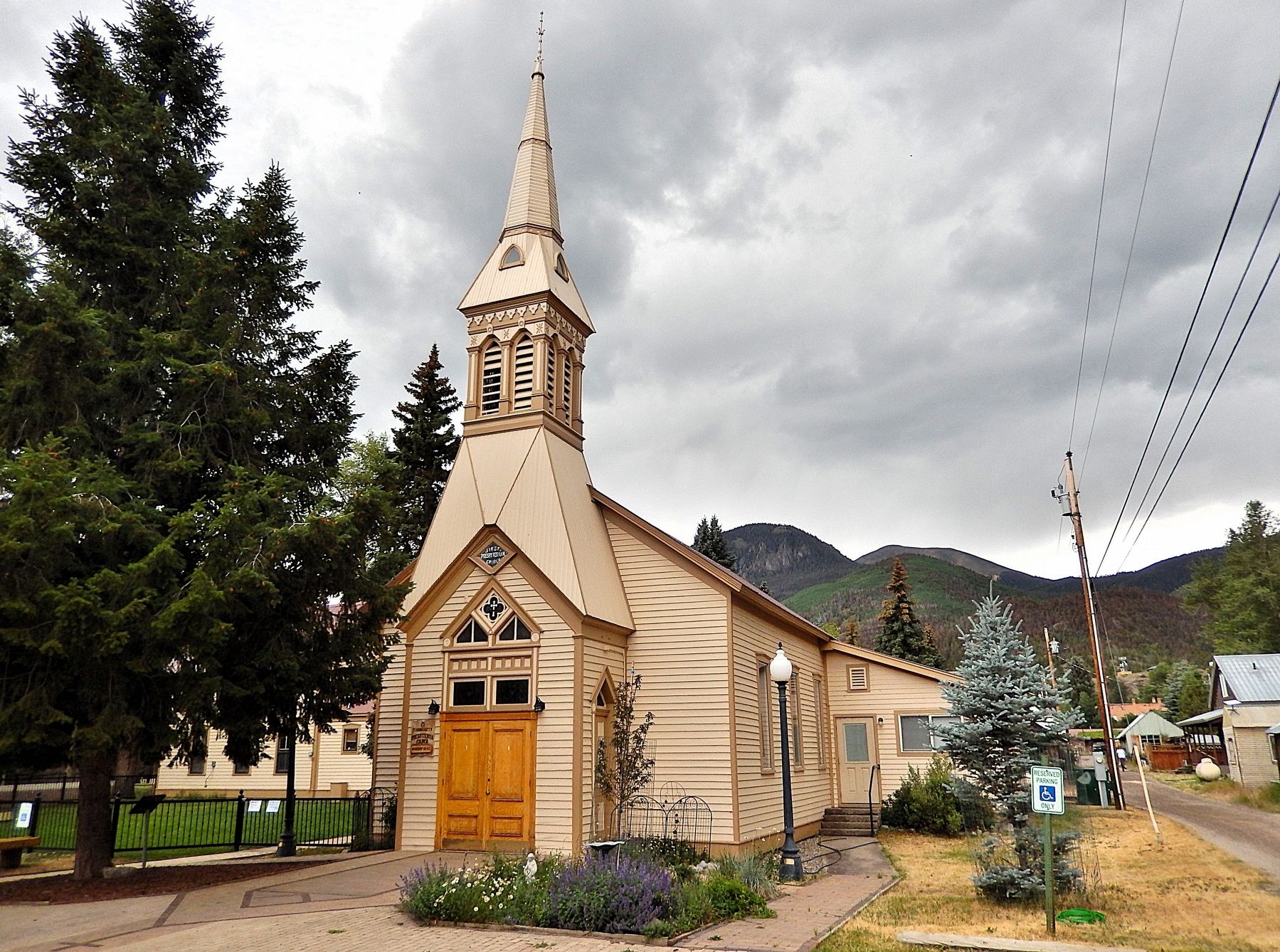
At first, the church had no steeple, for the frame structure was intended to be temporary, until a larger stone structure could be built facing Gunnison Avenue on the corner. A bell cupola stood west of the church until the steeple was added in 1882 by carpenter Antone J. Fjelle at a cost of $387. The new narthex, on which the steeple was built, had doors on the sides and large
this page online
Original furnishings still used in the building include the pews which were probably built from construction scaffolding. On some of the pews, marks made from the studs of the carpenters' shoes can be seen. The pump organ, brought to Lake City by ox cart, is still used in worship. The original church lectern is now in the Hinsdale County Museum. Also original to the building are the electric chandeliers which were first lit in January, 1892.
In 1981 the church building was restored under the leadership of Dr. Harold M. Parker, Jr., supply pastor for 20 years. The foundation was checked and the church repainted in the original paint scheme. In the process of remodeling workers discovered adobe bricks within the walls, providing both insulation and strength for the building. The pews were stripped, wiring updated, and metal roofing installed. The stained glass windows were
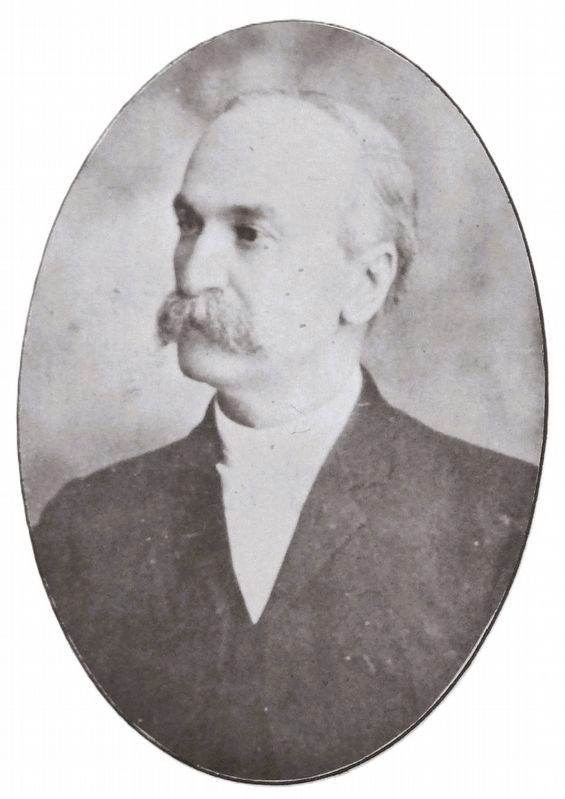
2. Marker detail: George M. Darley
Darley Hall, which includes a kitchen, fellowship hall, classrooms, and office space, was added in four stages between 1954 and 1991.
After completing the church building, George Darley continued to live in Lake City as the first pastor of this congregation. His journal, PIONEERING IN THE SAN JUAN, tells the story of his many travels through the San Juan region on foot and on horseback, to preach in mining camps and to plant new churches and new Sunday Schools in Ouray, Animas City (Durango), and Delta.
The book also tells of many historic and interesting occasions in the life of the church, including the arrival of the church bell, early Christmas celebrations, deer in church, the fight against the influence of liquor and gambling, and funerals for mayors and madams alike.
Also of note is the church manse, next door to the church, also built by George Darley. The manse is significant because Darley recognized that a pastor could not be kept on the frontier without housing for his family. Just as the town of Lake City served as a hub for much of the mining activity in the region, so this church was the

Photographed by Cosmos Mariner, July 21, 2025
3. Presbyterian Church and Manse Marker
Construction on the manse was started in the winter of 1878. An open house and housewarming were held in May of 1879 attended by 75 citizens who enjoyed a variety of games, vocal music and refreshments. The first picket fence surrounding the property was built at that time. In 1988 an extensive remodeling project for the manse was completed, with a wing added to the south, providing space for a year-round minister in Lake City.
Since 1876, the Community Presbyterian Church has stood as a beacon of faith, hope, and love in Lake City.
Funding for this historical plaque was provided by Frank and Jean Hafeman, Brad and Herta Darley, Ruth Nagel, and Carol Perry.
[photo caption] Presbyterian Church and Manse — c.1879
Topics and series.
Photographed by Cosmos Mariner, July 21, 2025
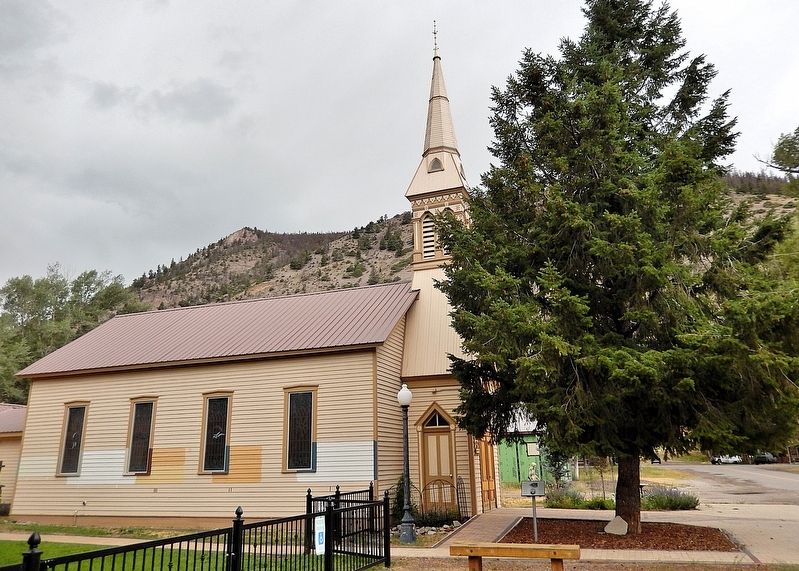
4. Presbyterian Church (northeast elevation)
Location. 38° 1.865′ N, 107° 18.913′ W. Marker is in Lake City, Colorado, in Hinsdale County. It is on 5th Street just west of Gunnison Avenue (State Highway 149), on the left when traveling west. The marker is beside the walkway, near the northeast corner of the sanctuary. Touch for map. Marker is at or near this postal address: 429 Gunnison Avenue, Lake City CO 81235, United States of America. Touch for directions.

Regionally, this marker is in the Colorado High Rockies. It is also in the American Mountain West. Globally, it is in North America, the Rocky Mountains, the Western Hemisphere, the Western World, and the Anglosphere.
Other nearby markers. At least 8 other markers are within walking distance of this marker: St. James Episcopal Chapel — 1876 (within shouting distance of this marker); John S. Hough House — Built 1877 (within shouting distance
Photographed by Cosmos Mariner, July 21, 2025
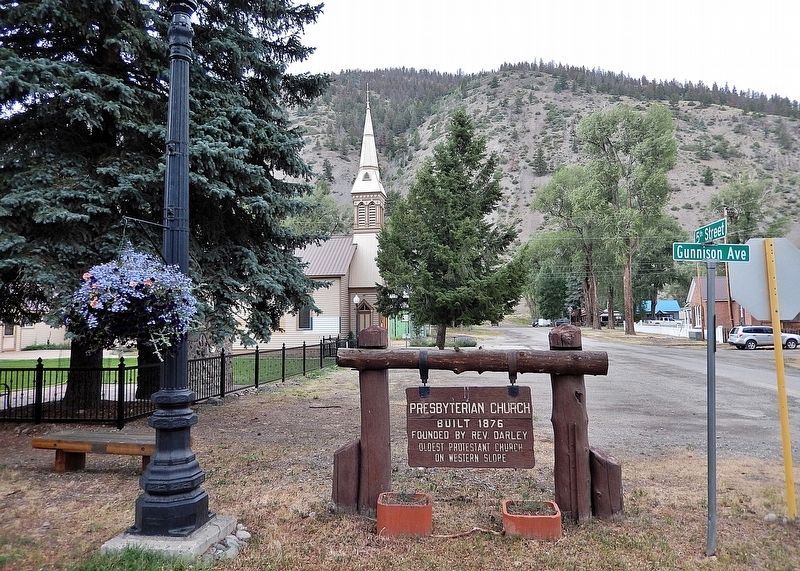
5. Presbyterian Church Sign
Built 1876
Founded by Rev. Darley
Oldest Protestant Church on Western Slope
Regarding Presbyterian Church and Manse. Contributing property, Lake City Historic District, National Register of Historic Places № 78000859. Also Colorado State Register of Historic Properties Site № 5HN.68.1
From the National Register Nomination prepared by Suzanne Mason, 3/1/1977:
The one-and-one-half story, front-gabled frame church has a metal roof and walls clad in clapboards with cornerboard trim. Its Carpenter Gothic style is reflected by the steep gabled roof, elaborately decorated steeple, wooden shingles, and pedimented window heads. The bell housing is enclosed by eight louvered pointed arches. The clapboard siding is typical of a country church. Adobe bricks, made from clay of the Slumgullion EarthFlow, line the inside walls for purposes of insulation.Photographed by Cosmos Mariner, July 21, 20256. Presbyterian Church (northwest elevation)
The church interior contains the original beadboard wainscoting and pews hand made by Reverend Alexander M. Darley and the original organ. The original wallpaper, in excellent repair, is still in place on the ceiling. The building is notable as the first church constructed on Colorado's Western Slope. The adjacent Presbyterian Manse (1879) is a one-and-one-half story, front-gabled frame dwelling with a metal roof and walls clad in clapboards. Built by George Darley, it too is an example of Carpenter Gothic, as evidenced by its steep gabled roof and elaborate window heads.
Completed November 12, 1876, this was the first church building to be erected on the western slope of Colorado. The church was organized by Alexander Darley who was already famous throughout the San Juan area for his indomitable energy in reaching remote mining camps to spread the word of God. His brother George, pastor here from 1876 to 1880, regularly travelled to Ouray via Engineer Pass to fill the pulpit there. In the wintertime, this would mean a snowshoe crossing of the rugged 12,700-foot-high pass.
Also see . . .
1. Presbyterian Church (Society of Architectural Historians).
(by Thomas J. Noel) Excerpt: The Reverend George Darley, a skilled carpenter, built his own church and an adjacent two-story manse to help keep succeeding Presbyterian ministers happy in isolated Lake City. The white clapboard church with pedimented lintels was a typical country church until 1882, when its vernacular Second Empire tower was added. This 60-foot bell tower has shingles and eight lancet louvers beneath a graceful, soaring spire.(Submitted on January 27, 2026, by Cosmos Mariner of Cape Canaveral, Florida.)
The clapboard L-shaped manse (1879, George Darley), 429 Gunnison Avenue (southwest corner of 5th Street), is likewise an exercise in vernacular Second Empire detailing with its pedimented and bracketed lintels, double windows, and double quatre-foil cutout in the front gable end. Darley's painstaking carpentry paid off: ministers have lived here to this day. Darley also built a Presbyterian church in Ouray and another in Del Norte, where he also worked to build the Presbyterian College of the Southwest.
2. Community Presbyterian Church (church website).
Excerpt: Founded by George Marshall Darley (1847-1917), Community Presbyterian Church is not only Lake City’s oldest church, it was the first Protestant church established on the Western Slope of Colorado’s Rocky Mountains.(Submitted on January 27, 2026, by Cosmos Mariner of Cape Canaveral, Florida.)
Darley was a Nebraskan raised son of a carpenter, who’s path took him to the shores of Galveston, Texas where he first felt a sense of calling toward religious work. He was known for preaching to the dock workers in Galveston and inmates at the local YMCA, before he joined his brother Alexander M. Darley in ministry in Del Norte.
Learning about the promise of ministry in Lake City, the Darley brothers made their way to the bustling little mining town with hopes of proclaiming the gospel. They began by preaching in the gambling tents, but before too long they established the Lake City Presbyterian Church on June 18, 1876, making it the oldest Church on the Western Slope of Colorado.
Credits. This page was last revised on January 27, 2026. It was originally submitted on January 23, 2026, by Cosmos Mariner of Cape Canaveral, Florida. This page has been viewed 40 times since then. Photos: 1, 2, 3, 4, 5, 6. submitted on January 26, 2026, by Cosmos Mariner of Cape Canaveral, Florida.
