Sentrum in Oslo, Norway — Northern Europe (a Nordic Country in Scandinavia)
Hjemmefra, 1843-1850
⎯⎯⎯
Away from Home, 1843-1850
Photographed by Andrew Ruppenstein, June 24, 2025
1. Away from Home, 1843-1850 Marker
As depicted on the marker map this is the second marker (heading north) of eight that lead to the Ibsen Museum.

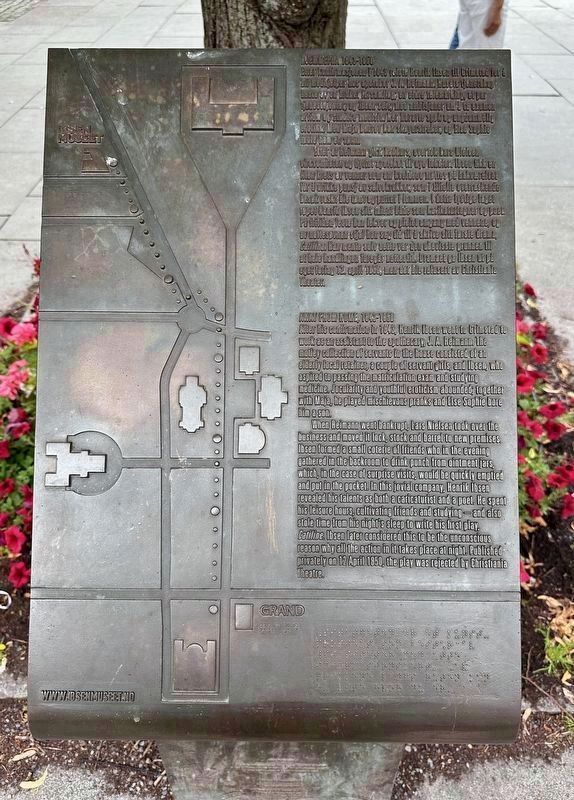
Etter konfirmasjonen i 1840 reiste Henrik Ibsen til Grimstad for å bli medhjelper hos apoteker J. A. Reimann. Husets tjenetskap besto av en broker forsamling; en eldre telemarking, et par tjenestejenter, og Ibsen selv, med ambisjoner om å ta examen artium og studere medisin. Her florerte spøk og ungdommelig erotikk. Med Maja bedrev han skøyerstreker, ut Else Sophie fødte ham en sønn.
Etter at Heiman gikk konkurs, overtok Lars Nielsen virksomheten og flyttet apoteket til nye lokaler. Ibsen fikk en liten krets av venner som om kveldene møttes på bakværelset for å drikke punsj av salvekrukker, som i tilfelle overraskende besøk raskt ble tømt og puttet i lommen. I dette lystige laget røpet Henrik Ibsen sitt talent både som karikaturtegner og poet. På fritiden leste han lekser og pleiet omgang med vennene, og av nattesøvnen stjal han seg tid til å skrive sitt første drama, Catilina. Han mente selv dette var den ubevisste grunnen til at hele handlingen foregår nattestid. Dramaet ga Ibsen ut på eget forlag 12. april 1850, men det ble refusert av Christiania Theater.
After
this page online
When Reimann went bankrupt, Lars Nielsen took over the business and moved it lock, stock and barrel to new premises. Ibsen formed a small coterie of friends who in the evening gathered in the backroom to drink punch from ointment jars which, in the case of surprise visits, would be quickly emptied and put in the pocket. In this jovial company, Henrik Ibsen revealed his talents as both a caricaturist and a poet. He spent his leisure hours, cultivating friends and studying-and also stole time from his night's sleep to write his first play, Catiline. Ibsen later considered this to be the unconscious reasonn why all the action in it takes place at night. Published privately on 12 April 1851,

Photographed by Andrew Ruppenstein, June 24, 2025
2. Away from Home, 1843-1850 Marker - wide view
Erected 2006.
Topics. This historical marker is listed in this topic list: Arts, Letters, Music. A significant historical date for this entry is April 12, 1851.
Location. 59° 54.844′ N, 10° 44.254′ E. Marker is in Oslo. It is in Sentrum. It is on Karl Johans gate, on the left when traveling west. Touch for map. Marker is at or near this postal address: Karl Johans gate 37 - 43, Oslo 0162, Norway. Touch for directions.

Regionally, it is in the North Atlantic Region, on the Atlantic Arc, in Europe, in Atlantic Europe, in Scandinavia, in the Nordic Countries, in the Schengen Area, and in the Western World.
Other nearby markers. At least 8 other markers are within walking distance of this marker: Thorvald Meyer (a few steps from this marker); Regnbueplassen / Rainbow Square (about 90 meters away, measured in a direct line); Kinematograf Teatret / Cinematograph Theatre (about 90 meters away); Lukket på Grunn av Glede / Closed Due to Joy (about 90 meters away); Hollænder Gaarden / Holland Building (about 90 meters away); Det Norske Studentersamfund / The Norwegian Students’ Society (about
Photographed by Andrew Ruppenstein, June 25, 2025
3. Henrik Ibsen statue
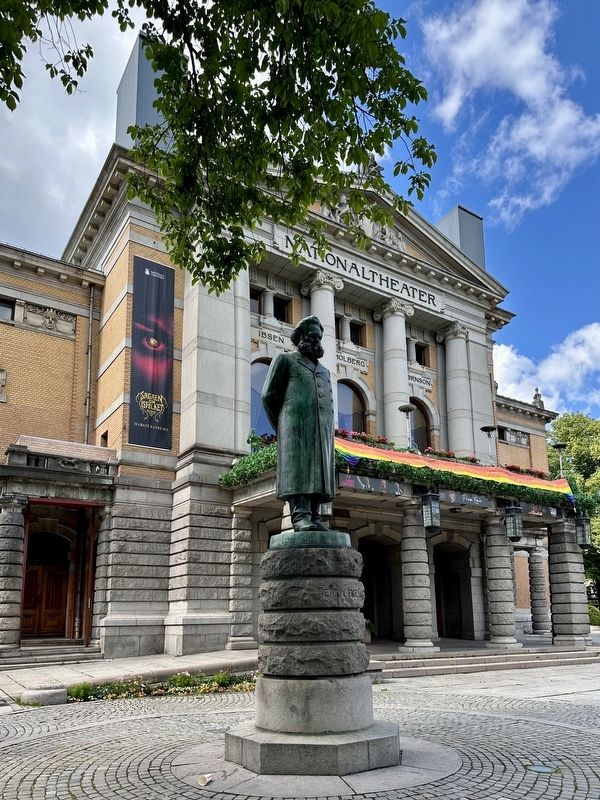
About 80 meters to the west on the grounds of the Nationaltheatret there is a statue of Ibsen.
Related markers. Click here for a list of markers that are related to this marker.
Also see . . . Henrik Ibsen (Wikipedia). Excerpts:
Henrik Johan Ibsen (20 March 1828 – 23 May 1906) was a Norwegian playwright. He is considered one of the world's pre-eminent writers of the 19th century and is often referred to as "the father of modern drama." He pioneered theatrical realism but also wrote lyrical epic works. His major works include Brand, Peer Gynt, Emperor and Galilean, A Doll's House, Ghosts, An Enemy of the People, The Wild Duck, Rosmersholm, Hedda Gabler, The Master Builder, and When We Dead Awaken. Ibsen is the most frequently performed dramatist in the world after Shakespeare. Store norske leksikon describes him as "the center of the Norwegian literary canon."(Submitted on January 25, 2026.)
1846–1859: Grimstad years - At fifteen, Ibsen left school. He moved to the small town of Grimstad to become an apprentice pharmacist. At that time he began writing plays. In 1846, when Ibsen was 18, he had a liaison with Else Sophie Jensdatter Birkedalen which produced a son, Hans Jacob Hendrichsen Birkdalen, whose upbringing Ibsen paid for until the boy was fourteen, though Ibsen never saw the child. Ibsen went to Christiania (later spelled Kristiania and then renamed Oslo) intending to matriculate at the university. He soon rejected the idea (his earlier attempts at entering university were blocked as he did not pass all his entrance exams), preferring to commit himself to writing. His first play, the tragedy Catilina (1850), was published under the pseudonym "Brynjolf Bjarme", when he was only 22, but it was not performed. His first play to be staged, The Burial Mound (1850), received little attention. Still, Ibsen was determined to be a playwright, although the numerous plays he wrote in the following years remained unsuccessful.…
Credits. This page was last revised on January 25, 2026. It was originally submitted on January 25, 2026, by Andrew Ruppenstein of Lamorinda, California. This page has been viewed 36 times since then. Photos: 1, 2, 3. submitted on January 25, 2026, by Andrew Ruppenstein of Lamorinda, California.
