The Colorado-Yule Marble Company
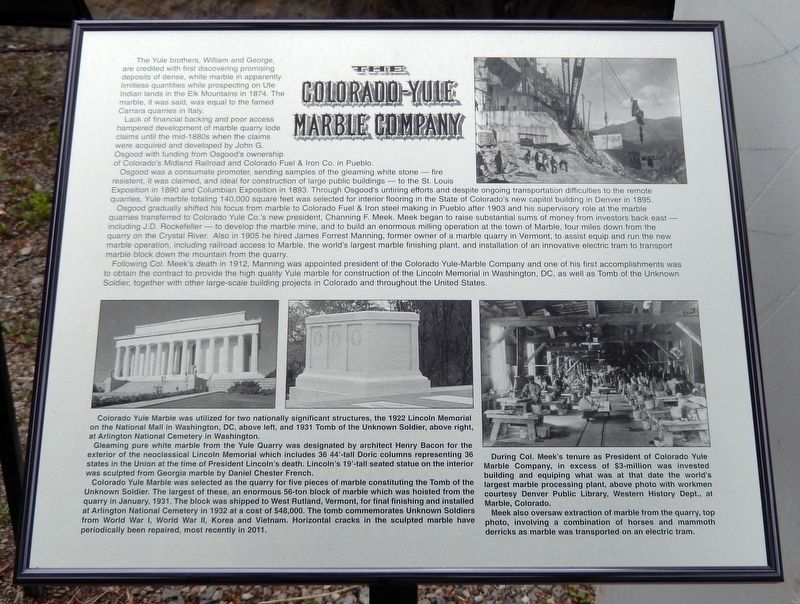
The Yule brothers, William and George, are credited with first discovering promising deposits of dense, white marble in apparently limitless quantities while prospecting on Ute Indian lands in the Elk Mountains in 1874. The marble, it was said, was equal to the famed Carrara quarries in Italy.
Lack of financial backing and poor access hampered development of marble quarry lode claims until the mid-1880s when the claims were acquired and developed by John G. Osgood with funding from Osgood's ownership of Colorado's Midland Railroad and Colorado Fuel & Iron Co. in Pueblo.
Osgood was a consummate promoter, sending samples of the gleaming white stone — fire resistant, it was claimed, and ideal for construction of large public buildings — to the St. Louis Exposition in 1890 and Columbian Exposition in 1893. Through Osgood's untiring efforts and despite ongoing transportation difficulties to the remote quarries, Yule marble totaling 140,000 square feet was selected for interior flooring in the State of Colorado's new capitol building in Denver in 1895.
Osgood gradually shifted his focus from marble to Colorado Fuel & Iron steel
this page online
Following Col. Meek's death in 1912, Manning was appointed president of the Colorado Yule-Marble Company and one of his first accomplishments was to obtain the contract to provide the high quality Yule marble for construction of the Lincoln Memorial in Washington, DC, as well as Tomb of the Unknown Soldier, together with other large-scale building projects in Colorado and throughout the United States.
Topics. This historical
Location. 38° 1.656′ N, 107° 19.059′ W. Marker is in Lake City, Colorado, in Hinsdale County. It can be reached from the intersection of Silver Street and 2nd Street (County Road 20), on the right when traveling north. The marker is near the northwest corner of the Hinsdale County Museum grounds. Touch for map. Marker is at or near this postal address: 130 Silver Street, Lake City CO 81235, United States of America. Touch for directions.

Regionally, this marker is in the Colorado High Rockies. It is also in the American Mountain West. Globally, it is in North America, the Rocky Mountains, the Western Hemisphere, the Western World, and the Anglosphere.
Other nearby markers. At least 8 other markers are within walking distance of this marker: Bachelor Cabins, Carson (here, next to this marker); Colonel Channing Franklin Meek (here, next to this marker); Finley Block — Built 1877 (a few steps from this marker); Lake City Played a Significant Role in the Development of Western Colorado
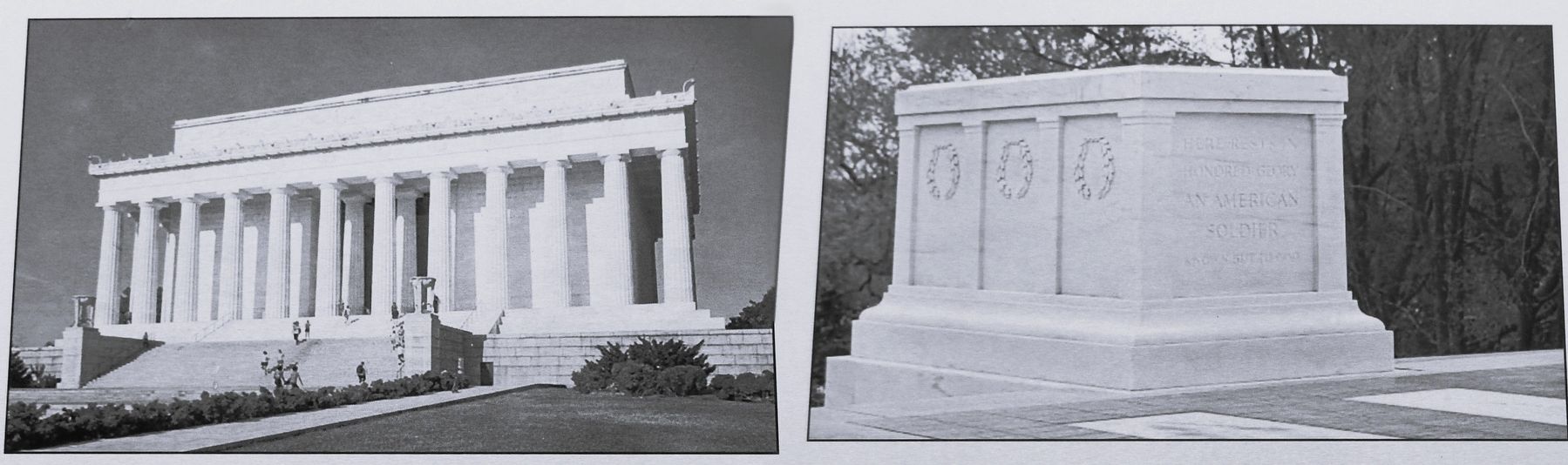
Gleaming pure white marble from the Yule Quarry was designated by architect Henry Bacon for the exterior of the neoclassical Lincoln Memorial which includes 36 44'-tall Doric columns representing 36 states in the Union at the time of President Lincoln's death. Lincoln's 19'-tall seated statue on the interior was sculpted from Georgia marble by Daniel Chester French.
Colorado Yule Marble was selected as the quarry for five pieces of marble constituting the Tomb of the Unknown Soldier. The largest of these, an enormous 56-ton block of marble which was hoisted from the quarry in January, 1931. The block was shipped to West Rutland, Vermont, for final finishing and installed at Arlington National Cemetery in 1932 at a cost of $48,000. The tomb commemorates Unknown Soldiers from World War I, World War II, Korea and Vietnam. Horizontal cracks in the sculpted marble have periodically been repaired, most recently in 2011.
Related markers. Click here for a list of markers that are related to this marker.
Also see . . . Marble Mill Site (History Colorado).
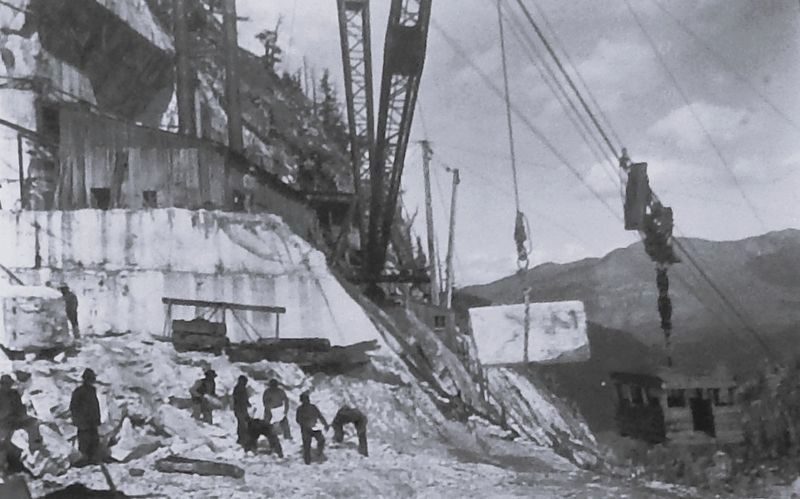
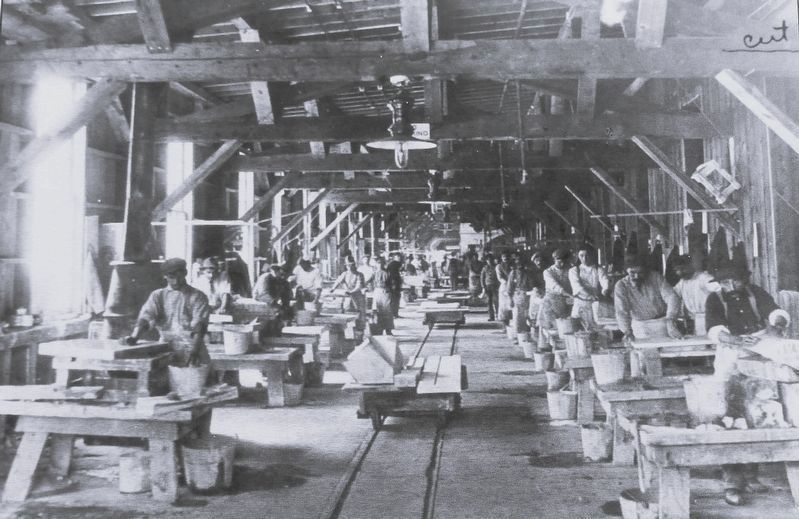
Excerpt: The towns of Marble and Clarence were established in 1881. Soon miners in the area were reporting that the roofs of their mines were made of fine white marble. The first marble quarry in the Crystal River valley was established in 1884. The turning point in Marble’s history came in 1905, when the former president of the Colorado Coal and Iron Company, Channing F. Meek, came to town. He brought the capital and transportation infrastructure that allowed the town to boom. Meek bought large tracts of land in and around Marble and consolidated several smaller marble companies into the Colorado Yule Marble Company. He spent $3 million developing(Submitted on January 30, 2026, by Cosmos Mariner of Cape Canaveral, Florida.)quarries, building the Crystal River and San Juan Railroad — which reached Marble in November 1906 — and constructing the world’s largest marble-finishing mill. Other marble companies continued to exist in the area, but from then on Meek’s Colorado Yule Marble Company was the dominant marble concern in the Crystal River valley.Denver Public Library, Western History Dept.4. Marker detail: Colorado Yule Marble CompanyDuring Col. Meek's tenure as President of Colorado Yule Marble Company, in excess of S3 million was invested building and equipping what was at that date the world's largest marble processing plant.
By the summer of 1907, Marble had a new railroad, marble mill, and power plant, but the Colorado Yule Marble Company still had not secured a major contract. Finally, in October, the company won a $500,000 contract to supply marble for the Cuyahoga County Courthouse in Cleveland. That large contract and several smaller ones were enough to get the quarry into full operation and even required an expansion of the new mill. By the end of the year, more than 700 people had arrived to work in Marble.
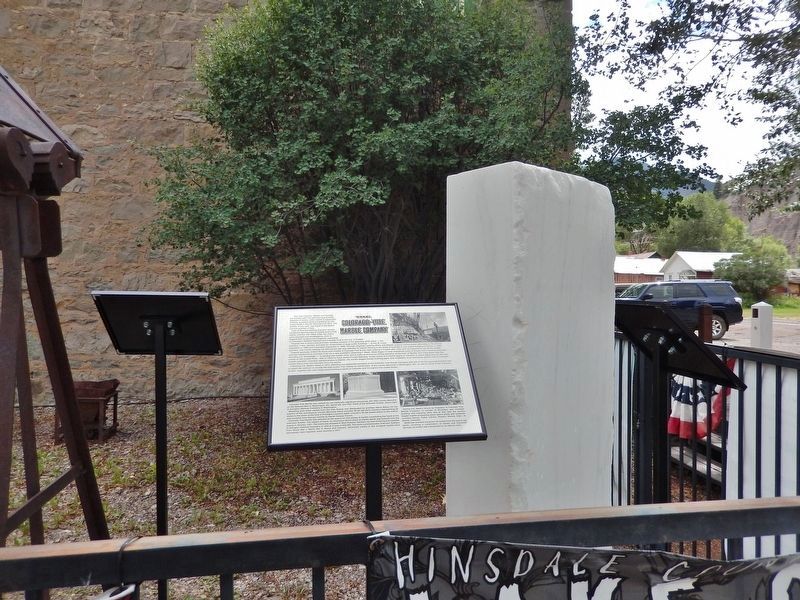
In 1908 the Colorado Yule Marble Company received another big contract for an Ohio county courthouse, this time in Mahoning County, and had to expand the mill again. Soon the plant had 900 workers. The company built fifty new four-room houses to ease the town’s housing shortage, installed a telephone system, and began tosupply electricity to the town.Photographed by Cosmos Mariner, July 21, 20255. The Colorado-Yule Marble Company MarkerLooking south. The northwest corner of the Hinsdale County Museum is in the background. A 2,300-lb. marble slab from Colorado Yule Marble Quarry is on exhibit on the right side of the marker.
By the early 1910s, the large mill complex on the south side of Marble encompassed about 100,000 square feet and included four interconnected shop buildings, two mills, and a large stone yard. It could process 40,000 cubic feet of marble per month. With only one major marble quarry, Colorado ranked third in the country in marble production, behind only Vermont and Georgia.
Credits. This page was last revised on January 30, 2026. It was originally submitted on January 25, 2026, by Cosmos Mariner of Cape Canaveral, Florida. This page has been viewed 35 times since then. Photos: 1, 2, 3, 4, 5. submitted on January 30, 2026, by Cosmos Mariner of Cape Canaveral, Florida.
