Bremen-Mitte in Mitte, Germany — Central Europe
Die Gluckhenne
⎯⎯⎯
The Broody Hen
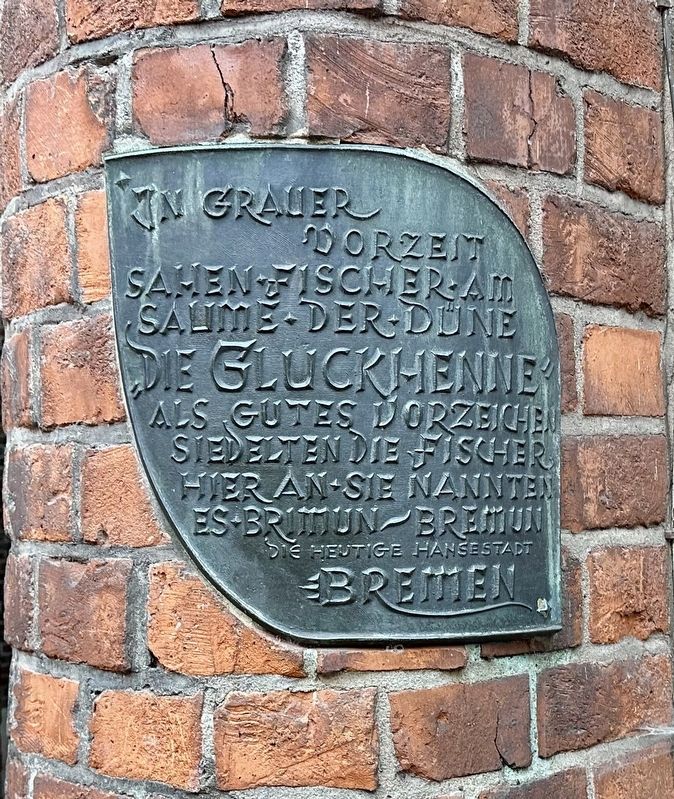
Photographed by Andrew Ruppenstein, May 19, 2025
1. Die Gluckhenne / The Broody Hen Marker

Vorzeit
sahen Fischer am
Saume der Düne
„die Gluckhenne“
als gutes Vorzeichen
siedelten die Fischer
hier an sie nannten es Brimun ~ Bremun
die heutige Hansestadt Bremen
In ancient times, fishermen saw the "broody hen" at the edge of the dune as a good omen, so they settled here and called it “Brimun” or “Bremun”, now the Hansestadt Bremen.
Topics. This historical marker is listed in this topic list: Settlements & Settlers.
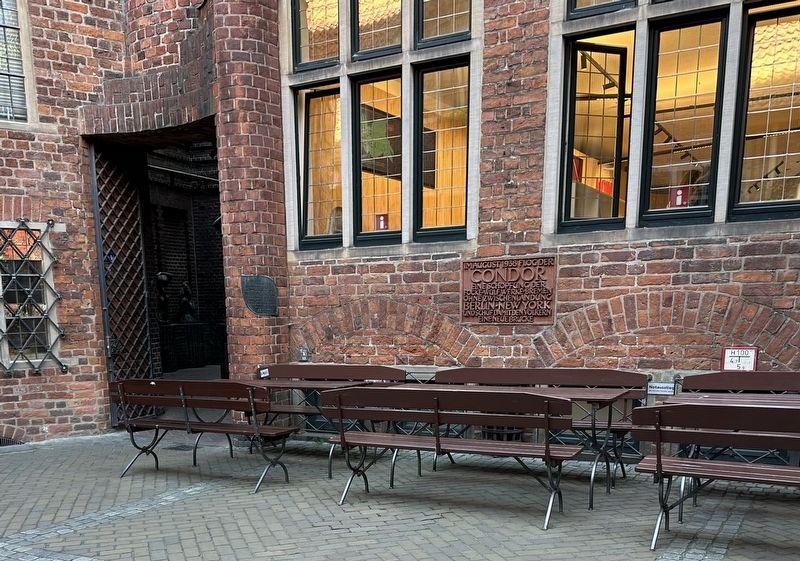
Location. 53° 4.498′ N, 8° 48.346′ E. Marker is in Bremen, in Mitte. It is in Bremen-Mitte. It is on Böttcherstraße, on the left when traveling south. Touch for map. Marker is at or near this postal address: Böttcherstraße 4-6, Bremen 28195, Germany. Touch for directions.

Regionally, it is in Europe, the European Union, Atlantic Europe, Central Europe, the Schengen Area, Western Europe, and the Western World. Historically, it finds itself in what was once the Holy Roman Empire.
Other nearby markers. At least 8 other markers are within walking distance of this marker: Condor Rekordflug / Condor Record Flight
this page online
Also see . . . Sage von der Bremer Gluckhenne (Wikipedia, in German). The marker provides in shortened form the legend of Bremen’s founding. The legend, in more extended form (in translation):
The legend is best known in its original form, recorded by the Bremen author Friedrich Wagenfeld in his 1844 book, *Bremen's Folk Tales*. Its content can be summarized as follows:(Submitted on January 27, 2026.)
Once upon a time, a small group of homeless families were traveling down the Weser River in their boats. They lived by fishingand had fled attacks from their powerful neighbors. Now they had nothing left but their boats and nets, as well as some materials for building wooden huts. They would have been willing to give up their last possessions, as they could easily replace them. But they clung to one thing above all else – their freedom.Photographed by Andrew Ruppenstein, May 19, 20252. Die Gluckhenne / The Broody Hen Marker - wide view
So they lay at anchor in the marshland of the river's wide lower reaches. Toward evening, a storm arose, and the people didn't know where to turn. Desperately, they waited for a sign from "the spirits of the land," for they didn't want to move on so quickly, as the water in that place was teeming with fish. In the last glimmer of evening light, the fishermen spotted a hen with her chicks, seeking shelter for the night and protection from the approaching storm on a high dune on the right bank of the river. Taking this as a sign, they followed the bird. The mother hen and her chicks eventually hid in the heather. The refugees saw their own situation reflected in this scene and decided to settle on the dune as well, since it seemed to offer safety. From then on, the dune on the Weser River would become a haven of freedom. Huts were built, the first buildings of what would later become Bremen.
Additional keywords. Gedenktafel
Credits. This page was last revised on January 27, 2026. It was originally submitted on January 26, 2026, by Andrew Ruppenstein of Lamorinda, California. This page has been viewed 30 times since then. Photos: 1. submitted on January 26, 2026, by Andrew Ruppenstein of Lamorinda, California. 2. submitted on January 27, 2026, by Andrew Ruppenstein of Lamorinda, California.
