Lake City in Hinsdale County, Colorado — The American Mountains (Southwest)
Slag Cart
Crooke Mining & Smelting Company, c.1877
Photographed by Cosmos Mariner, July 21, 2025
1. Slag Cart Marker
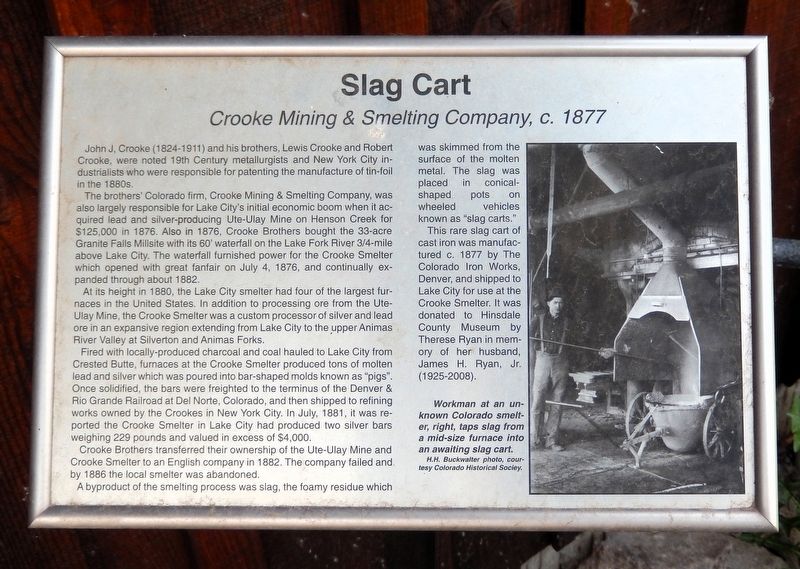
John J. Crooke (1824-1911) and his brothers, Lewis Crooke and Robert Crooke, were noted 19th Century metallurgists and New York City industrialists who were responsible for patenting the manufacture of tin-foil in the 1880s.
The brothers' Colorado firm, Crooke Mining & Smelting Company, was also largely responsible for Lake City's initial economic boom when it acquired lead and silver-producing Ute-Ulay Mine on Henson Creek for $125,000 in 1876. Also in 1876, Crooke Brothers bought the 33-acre Granite Falls Millsite with its 60' waterfall on the Lake Fork River ¾-mile above Lake City. The waterfall furnished power for the Crooke Smelter which opened with great fanfair on July 4, 1876, and continually expanded through about 1882.
At its height in 1880, the Lake City smelter had four of the largest furnaces in the United States. In addition to processing ore from the Ute-Ulay Mine, the Crooke Smelter was a custom processor of silver and lead ore in an expansive region extending from Lake City to the upper Animas River Valley at Silverton and Animas Forks.
Fired with locally-produced charcoal and coal hauled to Lake City from
this page online
Crooke Brothers transferred their ownership of the Ute-Ulay Mine and Crooke Smelter to an English company in 1882. The company failed and by 1886 the local smelter was abandoned.
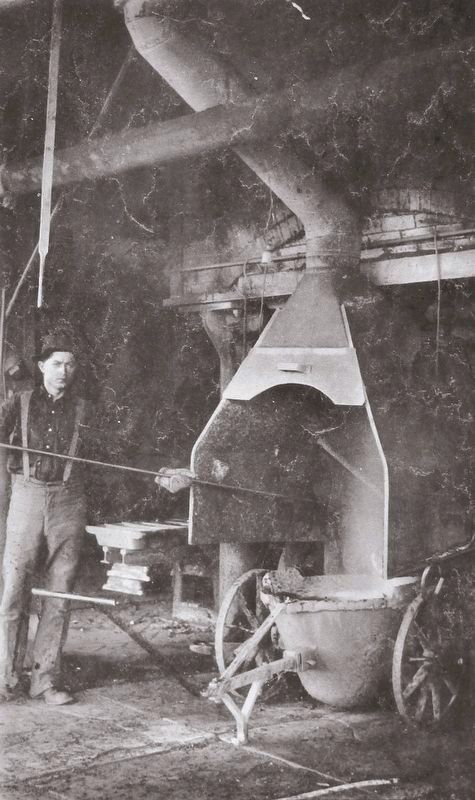
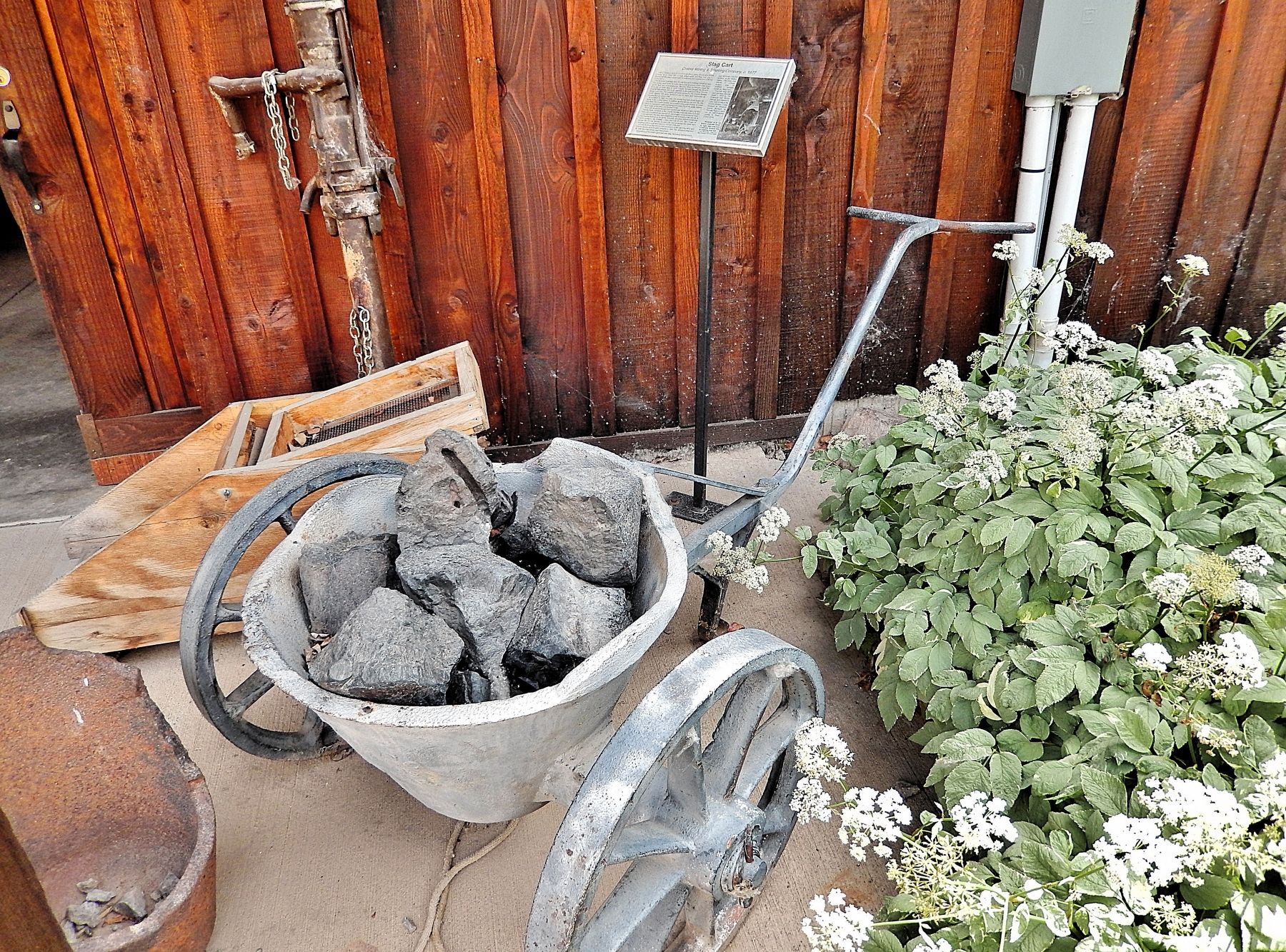
A byproduct of the smelting process was slag, the foamy residue which was skimmed from the surface of the molten metal. The slag was placed in conical-shaped pots on wheeled vehicles known as “slag carts.”
This rare slag cart of cast iron was manufactured c. 1877 by The Colorado Iron Works, Denver, and shipped to Lake City for use at the Crooke Smelter. It was donated to Hinsdale County Museum by Therese Ryan in memory of her husband, James H. Ryan, Jr. (1925-2008).
Topics. This historical
H. H. Buckwalter photo, Courtesy Colorado Historical Society
2. Marker detail: Workman and Slag Cart
Workman at an unknown Colorado smelter taps slag from a mid-size furnace into an awaiting slag cart.
Location. 38° 1.638′ N, 107° 19.057′ W. Marker is in Lake City, Colorado, in Hinsdale County. It can be reached from the intersection of Silver Street and 2nd Street (County Road 20), on the right when traveling north. The marker is near the center of the Hinsdale County Museum grounds. Touch for map. Marker is at or near this postal address: 130 Silver Street, Lake City CO 81235, United States of America. Touch for directions.

Regionally, this marker is in the Colorado High Rockies. It is also in the American Mountain West. Globally, it is in North America, the Rocky Mountains, the Western Hemisphere, the Western World, and the Anglosphere.
Other nearby markers. At least 8 other markers are within walking distance of this marker: Gaskill Hydrant (here, next to this marker); Caboose 588 (a few steps from this marker); Car 211 (a few steps from this marker); Curtis Planer (a few steps from this marker); Lake City Played a Significant Role in the Development of Western Colorado (a few steps from this marker); Finley Block — Built 1877
Photographed by Cosmos Mariner, July 21, 2025
3. Slag Cart & Marker
Also see . . .
1. John Jeremy Crooke (National Park Service).
Excerpt: John Jeremy Crooke was born January 22, 1824, in the town of Stuyvesant on the Hudson. A year later, he moved to New York City with his parents. Crooke entered Yale at 20, but only remained two years, as he had become interested in the smelting of gold and silver.(Submitted on February 1, 2026, by Cosmos Mariner of Cape Canaveral, Florida.)
In 1845, he founded the John J. Crooke Company in NYC, with a second factory established later in Chicago, IL. Crooke soon produced the first tin foil, including designing and building most of the machinery used in that process.
In the 1860's, he went to Colorado, where he became one of the most extensive miners there, with several gold and silver mines. Crooke also built several smelters for refining those ores into bullion. He forged an empire out of the gold and silver his mines and smelters produced, along with numerous patents for the processes and equipment he created.
2. Lake City, Colorado (Wikipedia).
Excerpt: With the completion of the first road into the mountains in this region, Lake City served as a supply center for the many miners and prospectors flooding into the area. As a supply center, the town boomed to as many as 3,000 to 5,000 settlers. But as the first-discovered deposits were found to be only moderately productive and no new extensive or rich deposits of minerals were found, by 1879 the boom had subsided. With the arrival of the Denver & Rio Grande Railroad in 1889, Lake City saw a second upturn in the economy that lasted into the 1890s. The railroad cut the cost of shipping gold and silver ores to smelters, reduced the cost of shipping supplies into Lake City.(Submitted on February 1, 2026, by Cosmos Mariner of Cape Canaveral, Florida.)
Credits. This page was last revised on February 1, 2026. It was originally submitted on January 27, 2026, by Cosmos Mariner of Cape Canaveral, Florida. This page has been viewed 38 times since then. Photos: 1, 2, 3. submitted on February 1, 2026, by Cosmos Mariner of Cape Canaveral, Florida.
