Midtown - Downtown in Columbia in Richland County, South Carolina — The American South (South Atlantic)
Wesley Methodist Church
Photographed by Mike Stroud, 2010
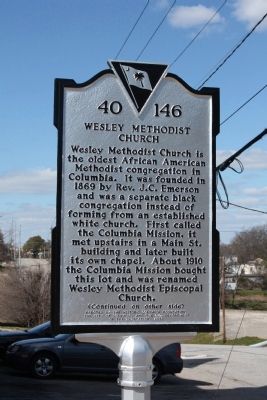
1. Wesley Methodist Church Marker
Wesley Methodist Church is the oldest African American Methodist congregation in Columbia. It was founded in 1869 by Rev. J.C. Emerson and was a separate black congregation instead of forming from an established white church. First called the Columbia Mission, it met upstairs in a Main St. building and later built its own chapel. About 1910 the Columbia Mission bought this lot and was renamed Wesley Methodist Episcopal Church.
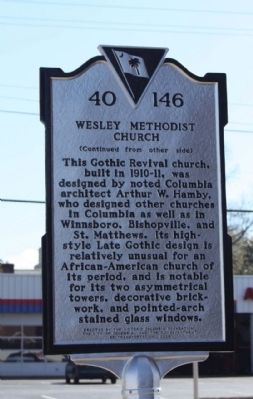
(Reverse text)
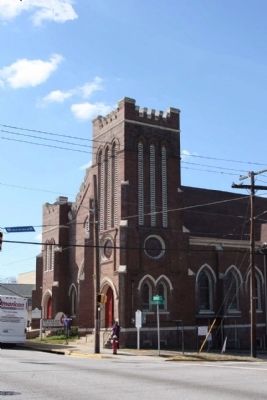
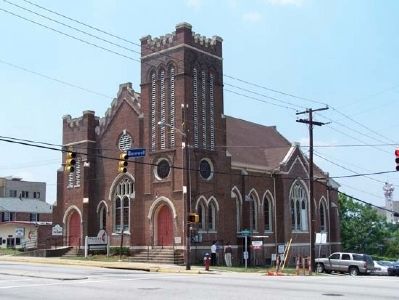
This Gothic Revival church, built in 1910-11, was designed by noted Columbia architect Arthur W. Hamby, who designed other churches in Columbia as well as in Winnsboro, Bishopville, and St. Matthews. Its high-style Late Gothic design is relatively unusual for an African-American church of its period, and is notable for its two asymmetrical towers, decorative brickwork, and pointed-arch stained glass windows.
Erected 2008 by The Historic Columbia Foundation, the City of Columbia, and the S.C. Department of Transportation. (Marker Number 40-146.)
Topics. This historical marker is listed in these topic lists: African Americans • Religion & Religious Structures. A significant historical year for this entry is 1869.
Location. 34° 0.264′ N, 81° 1.452′ W. Marker is in Columbia, South Carolina, in Richland County. It is in Midtown - Downtown. It is at the intersection of Gervais Street (US 1, US 76, US 378) and Barnwell Street, on the right when traveling west on Gervais Street (US 1, US 76, US 378). Touch for map. Marker is in this post office area: Columbia SC 29201, United States of America. Touch for directions.

Regionally, this marker is in the Midlands. It is also in the American South and specifically in the Deep South. Globally, it is in North America, the Western Hemisphere, the Western World, and the Anglosphere. Historically, it finds
this page online
Other nearby markers. At least 8 other markers are within walking distance of this marker: Barnwell Street (within shouting distance of this marker); Alston House (within shouting distance of this marker); Gregg Street (about 500 feet away, measured in a direct line); Henderson Street (about 600 feet away); Last Home of Wade Hampton (about 700 feet away); S.C. Education Associaton (approx. 0.2 miles away); Fair-Rutherford House / Rutherford House (approx. 0.2 miles away); Horry-Guignard House (approx. ¼ mile away). Touch for a list and map of all markers in Columbia.
Other markers no longer nearby. Sherman's Headquarters (was about 700 feet away but has been confirmed missing); Pickens Street (was approx. 0.2 miles away but has been confirmed missing).
Regarding Wesley Methodist Church. Wesley Methodist Church, built in 1910-11, illustrates the impact of segregation in the lives of African Americans during the Jim Crow era in Columbia. Because
Photographed by Mike Stroud, February 28, 2010
2. Wesley Methodist Church Marker, reverse side
Photographed by Mike Stroud, February 28, 2010
3. Wesley Methodist Church and Marker
Also see . . . National Register of Historic Places Registration Form. (Submitted on March 29, 2010, by Mike Stroud of Bluffton, South Carolina.)
S.C. Dept . of Archives and History
4. Wesley Methodist Church
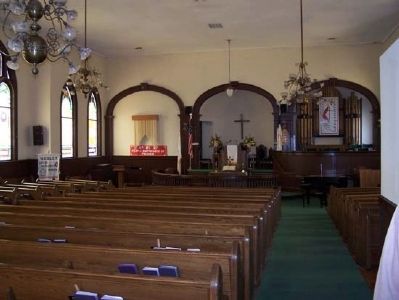
S.C. Dept. of Archives and History
5. Wesley Methodist Church
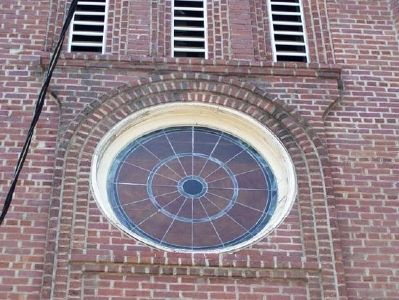
S.C. Dept. of Archives and History
6. Wesley Methodist Church
Credits. This page was last revised on February 16, 2023. It was originally submitted on March 29, 2010, by Mike Stroud of Bluffton, South Carolina. This page has been viewed 1,016 times since then and 23 times this year. Photos: 1, 2, 3, 4, 5, 6. submitted on March 29, 2010, by Mike Stroud of Bluffton, South Carolina. • Bill Pfingsten was the editor who published this page.
