Near Ophir in San Miguel County, Colorado — The American Mountains (Southwest)
Keeping the Trains Running
Photographed by Cosmos Mariner, July 18, 2025
1. Keeping the Trains Running Marker
Rio Grande Southern Railroad
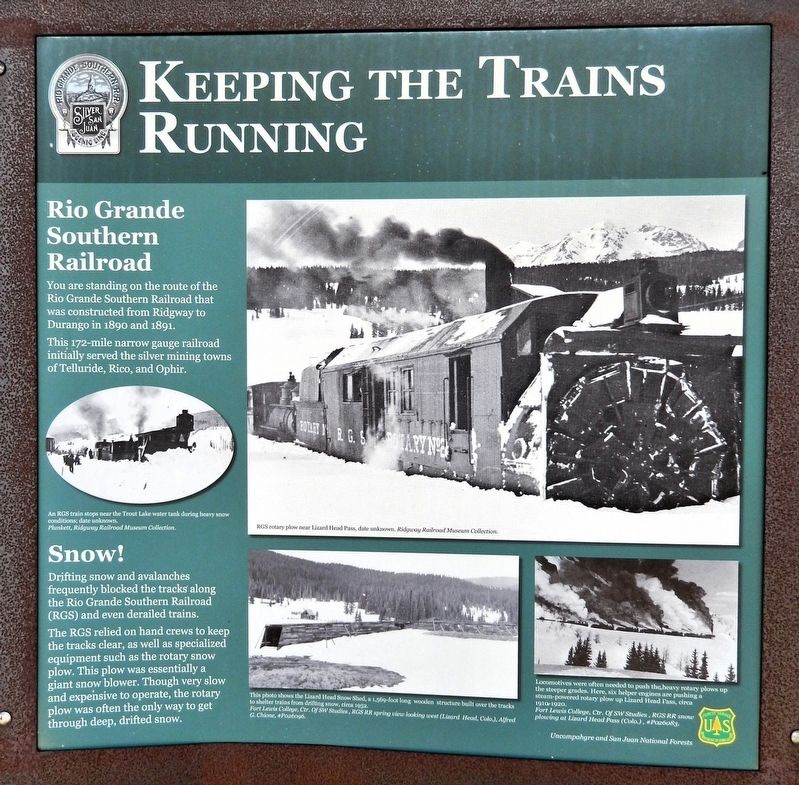
You are standing on the route of the Rio Grande Southern Railroad that was constructed from Ridgway to Durango in 1890 and 1891. This 172-mile narrow gauge railroad initially served the silver mining towns of Telluride, Rico, and Ophir.
Snow!
Drifting snow and avalanches frequently blocked the tracks along the Rio Grande Southern Railroad (RGS) and even derailed trains.
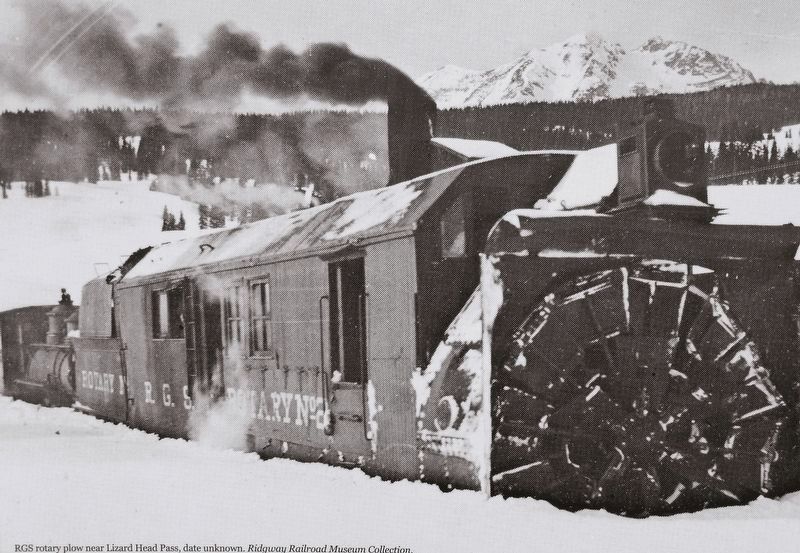
The RGS relied on hand crews to keep the tracks clear, as well as specialized equipment such as the rotary snow plow. This plow was essentially a giant snow blower. Though very slow and expensive to operate, the rotary plow was often the only way to get through deep, drifted snow.
[photo caption]
• An RGS train stops near the Trout Lake water tank during heavy snow conditions; date unknown.
Erected by Forest Service, U.S. Department of Agriculture.
Topics. This historical marker is listed in these topic lists: Industry & Commerce • Railroads & Streetcars. A significant historical year for this entry is 1890.
Location. 37° 48.65′ N, 107° 54.485′ W. Marker is near Ophir, Colorado, in San Miguel County. It is on Highway 145
this page online

Regionally, this marker is in the Western Slope. It is also in the American Mountain West, on the Colorado Plateau, and at the Four Corners. Globally, it is in North America, the Rocky Mountains, the Western Hemisphere, the Western World, and the Anglosphere. Historically, it finds itself in what was once Mexico’s Alta California.
Other nearby markers. At least 8 other markers are within 11 miles of this marker, measured as the crow flies: Winter on a Mountain Pass (approx. 0.2 miles away); Sheep and Cattle Grazing in the High Country (approx. 0.2 miles away); Early History and Railroad Development (approx. 0.2 miles away); Flushing Out the Gold (approx. 9.6 miles away); Hear that Lonesome Whistle Blow (approx. 9.6 miles away); San Miguel Valley Bank Robbery (approx. 9.6 miles away); a different marker also named San Miguel Valley Bank Robbery (approx. 9.6 miles
Ridgway Railroad Museum Collection
2. Marker detail: RGS rotary plow near Lizard Head Pass
Also see . . . Rio Grande Southern Railroad (Wikipedia).
Excerpt: The Rio Grande Southern Railroad (reporting mark RGS, also referred to as “The Southern”) was a 3 ft narrow-gauge railroad which ran in the southwestern region of the US state of Colorado, from the towns of Durango to Ridgway, routed via Lizard Head Pass. Built by German immigrant and Colorado toll road builder Otto Mears, the RGS operated from 1891 through 1951 and was built with the intent to transport immense amounts of silver mineral traffic that were being produced by the mining communities of Rico and Telluride. On both ends of the railroad, there were interchanges with The Denver and Rio Grande Railroad (reporting mark D&RG(W), later known as the Denver and Rio Grande Western), which would ship the traffic the RGS hauled elsewhere like the San Juan Smelter in Durango.(Submitted on February 3, 2026, by Cosmos Mariner of Cape Canaveral, Florida.)
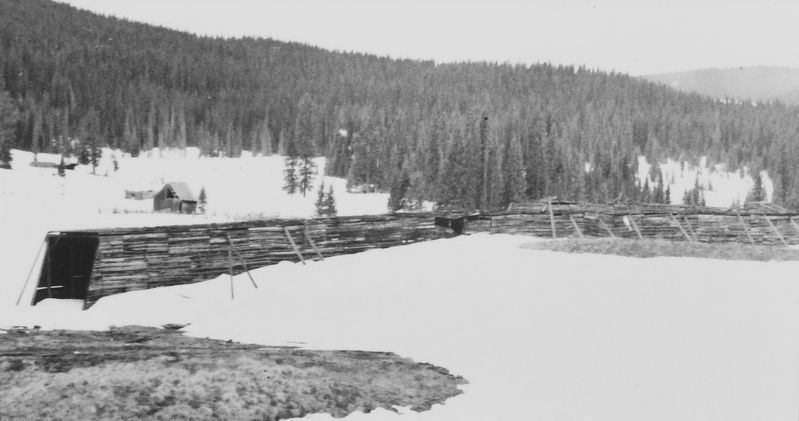
For the first few years of its life, the RGS would have fallen under the definition of a “Bonanza Railroad” which meant it was an instant success, quickly generating more than enough money for the investors and covering costsspent to build the railroad, but their wealth would not last long due to the Silver Panic of 1893, which would permanently cripple the railroad's finances.Courtesy Fort Lewis College, Alfred G. Chione, #P0260963. Marker detail: Lizard Head Snow Shed, circa 1952This photo shows the Lizard Head Snow Shed, a 1,569-foot-long wooden structure built over the tracks to shelter trains from drifting snow. RGS Railroad, spring view, looking west.
The RGS closed down and was dismantled in 1952–1953, but it is well known as one of the most rugged and iconic narrow-gauge mountain railroads in the history of Colorado.
Courtesy Fort Lewis College, Ctr. Of SW Studies, #P026083
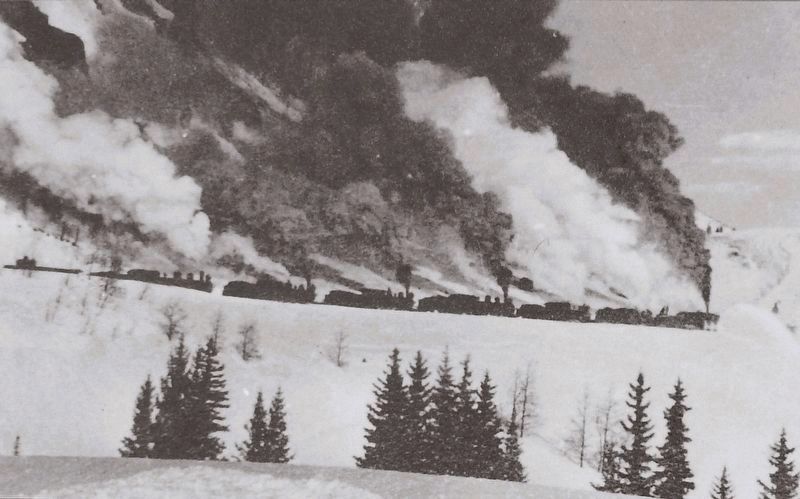
4. Marker detail: Six Engines Push Rotary Plow up Lizard Head Pass
Locomotives were often needed to push the heavy rotary plows up steeper grades. Here, six helper engines are pushing a steam-powered rotary plow up Lizard Head Pass, circa 1910-1920.
Ridgway Railroad Museum Collection
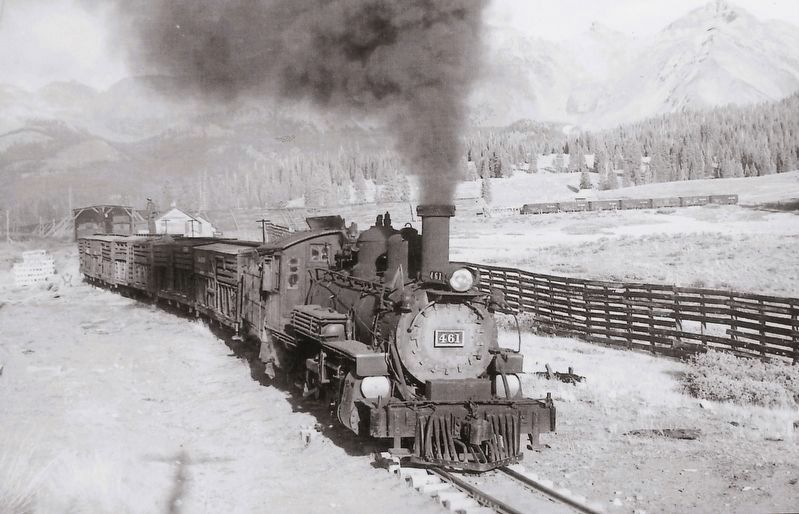
5. Marker detail: An RGS train, pulling stock cars, travels south over Lizard Head Pass, circa 1951
Photographed by Cosmos Mariner, July 18, 2025
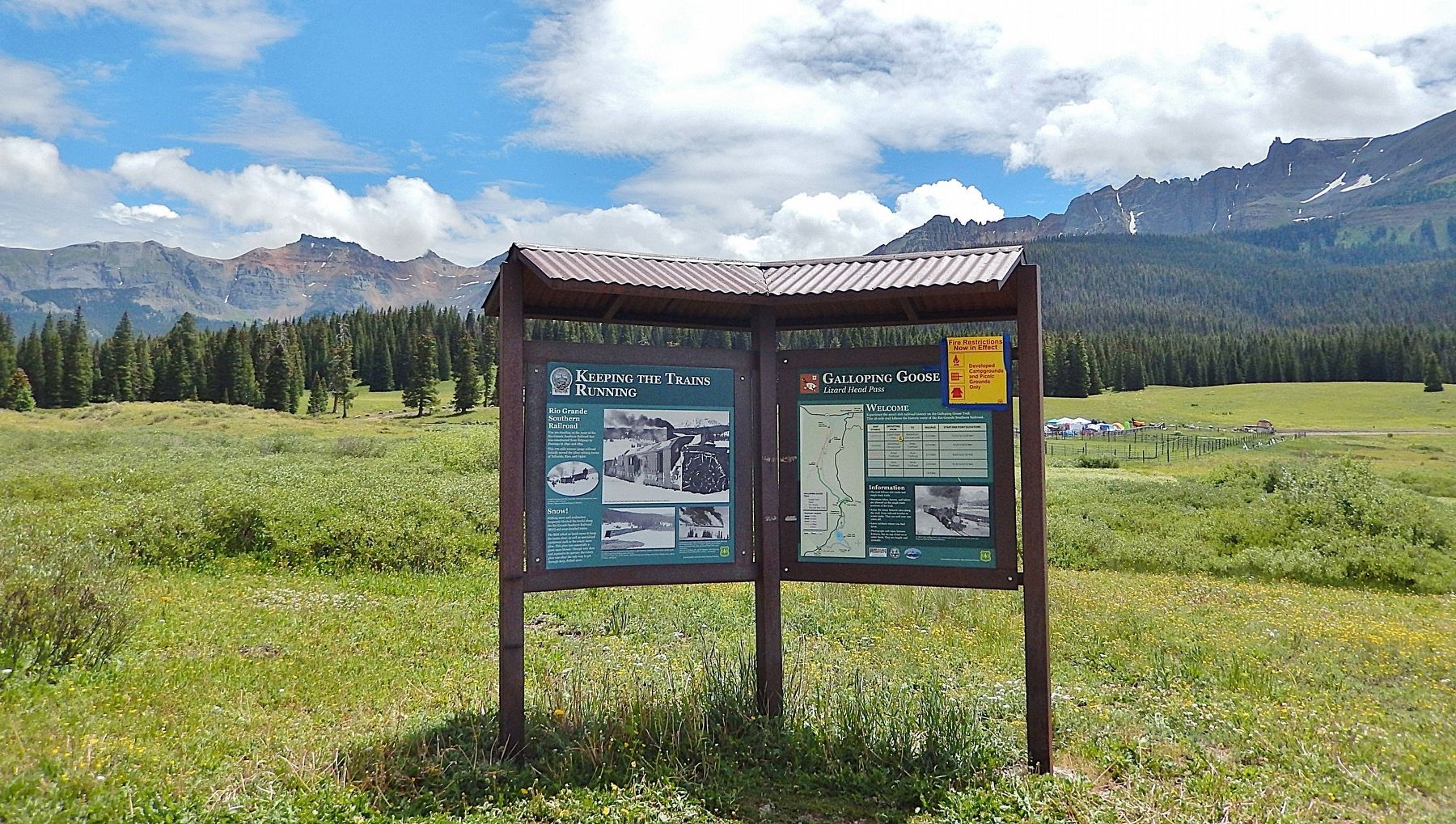
6. Galloping Goose Trailhead Kiosk
Looking southeast from the Colorado Highway 145 Lizard Head Pass wayside, this marker is the leftmost of two interpretive panels in the Galloping Goose Trailhead Kiosk.
Credits. This page was last revised on February 3, 2026. It was originally submitted on January 30, 2026, by Cosmos Mariner of Cape Canaveral, Florida. This page has been viewed 38 times since then. Photos: 1, 2, 3, 4, 5, 6. submitted on February 3, 2026, by Cosmos Mariner of Cape Canaveral, Florida.
