Le Plateau-Mont-Royal in Montréal, Québec — Central Canada (French-Canadian)
Église Saint-Jean-Baptiste
⎯⎯⎯
Saint-Jean-Baptiste Church
Photographed by Caroline Record, February 1, 2026
1. Église Saint-Jean-Baptiste Marker

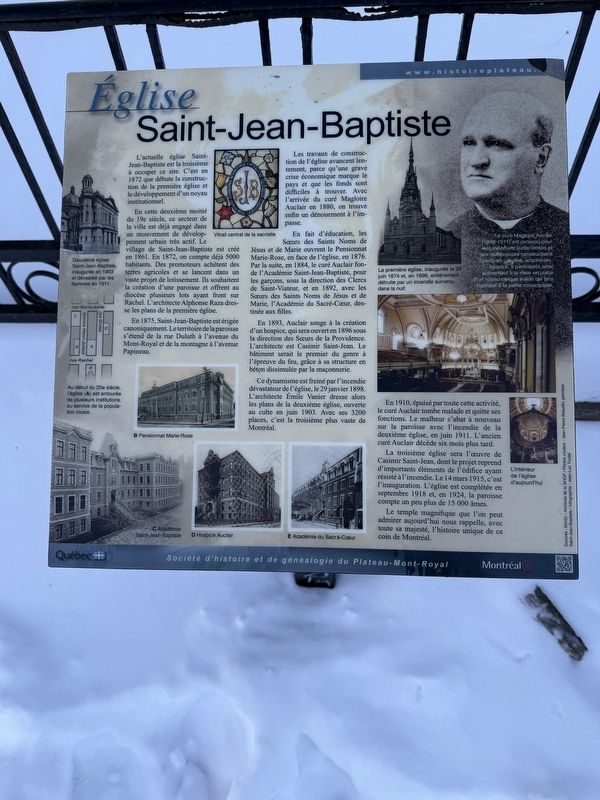
L'actuelle église Saint-Jean-Baptiste est la troisième à occuper ce site. C'est en 1872 que débute la construction de la première église et le développement d'un noyau institutionnel.
En cette deuxième moitié du 19e siècle, ce secteur de la ville est déjà engagé dans un mouvement de développement urbain très actif. Le village de Saint-Jean-Baptiste est créé en 1861. En 1872, on compte déjà 5000 habitants. Des promoteurs achètent des terres agricoles et se lancent dans un vaste projet de lotissement. Ils souhaitent la création d'une paroisse et offrent au diocèse plusieurs lots ayant front sur Rachel. L'architecte Alphonse Raza dresse les plans de la première église.
En 1875, Saint-Jean-Baptiste est érigée canoniquement. Le territoire de la paroisse s'étend de la rue Duluth à l'avenue du Mont-Royal et de la montagne à l'avenue Papineau.
Les travaux de construction de l'église avancent len-tement, parce qu'une grave crise économique marque le pays et que les fonds sont difficiles à trouver. Avec l'arrivée du curé Magloire Auclair en 1880, on trouve enfin un dénouement à l'impasse.
En
this page online
En 1893, Auclair songe à la création d'un hospice, qui sera ouvert en 1896 sous la direction des Sœurs de la Providence. L'architecte est Casimir Saint-Jean. Le bâtiment serait le premier du genre à l'épreuve du feu, grâce à sa structure en béton dissimulée par la maçonnerie.
Ce dynamisme est freiné par l'incendie dévastateur de l'église, le 29 janvier 1898. L'architecte Émile Vanier dresse alors les plans de la deuxième église, ouverte au culte en juin 1903. Avec ses 3200 places, c'est la troisième plus vaste de Montréal.
En 1910, épuisé par toute cette activité, le curé Auclair tombe malade et quitte ses fonctions. Le malheur s'abat à nouveau sur la paroisse avec l'incendie de la deuxième église, en juin 1911. L'ancien curé Auclair décède six mois
Photographed by Caroline Record, February 1, 2026
2. Église Saint-Jean-Baptiste Marker
La troisième église sera l'œuvre de Casimir Saint-Jean, dont le projet reprend d'importants éléments de l'édifice ayant résisté à l'incendie. Le 14 mars 1915, c'est l'inauguration. L'église est complétée en septembre 1918 et, en 1924, la paroisse compte un peu plus de 15 000 âmes.
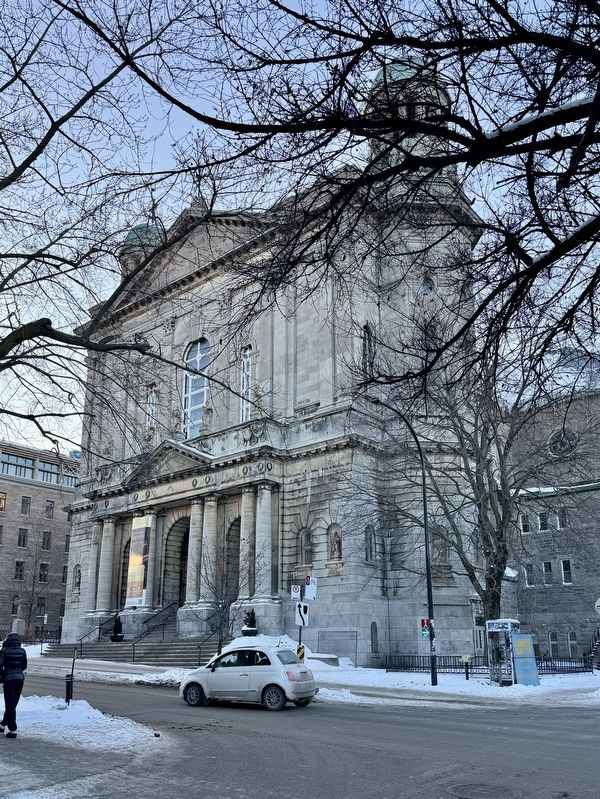
Le temple magnifique que l'on peut admirer aujourd'hui nous rappelle, avec toute sa majesté, l'histoire unique de ce coin de Montréal.
Saint-Jean-Baptiste Church
The current church Saint-Jean-Baptiste is the third to occupy this site. Construction of the first church and the development of an institutional core began in 1872.
In the second half of the 19th century, this area of the city was already experiencing very active urban development. The village of Saint-Jean-Baptiste was established in 1861. By 1872, it had already grown to 5,000 inhabitants. Developers purchased farmland and embarked on a vast subdivision project. They wanted to create a parish and offered the diocese several lots fronting Rachel Street. The architect Alphonse Raza drew up the plans for the first church.
In 1875,
Photographed by Montreal Import Co., Montreal, circa 1910
3. L’Église Saint-Jean-Baptiste
Construction of the church progressed slowly because a severe economic crisis was gripping the country and funds were hard to come by. With the arrival of Father Magloire Auclair in 1880, a solution was finally found to the impasse.
Regarding education, the Sisters of the Holy Names of Jesus and Mary opened the Marie-Rose Boarding School opposite the church in 1876.
Later, in 1884, Father Auclair founded the Saint-Jean-Baptiste Academy for boys, under the direction of the Clerics of Saint Viator, and in 1892, with the Sisters of the Holy Names of Jesus and Mary, the Sacred Heart Academy for girls.
In 1893, Auclair considered the creation of a hospice, which would open in 1896 under the direction of the Sisters of Providence.
The architect was Casimir Saint-Jean. The building was said to be the first of its kind to be fireproof, thanks to its concrete structure concealed by masonry.
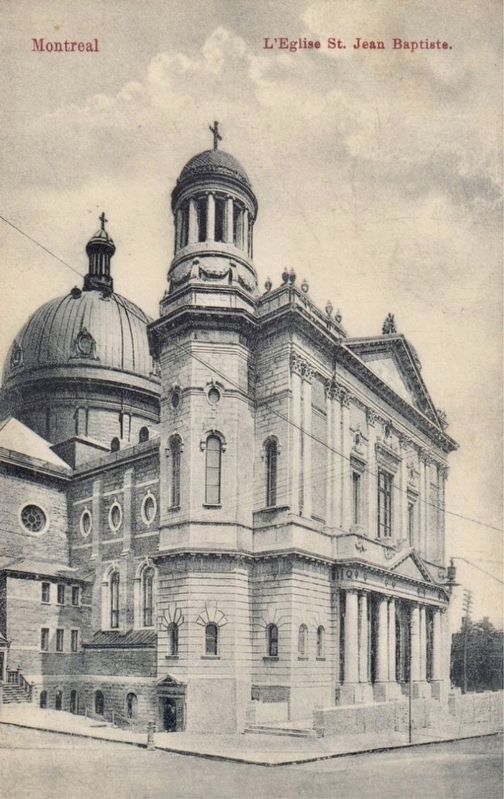
This momentum was halted by the devastating fire that destroyed the church on January 29, 1898. Architect Émile Vanier then drew up the plans for the second church, which opened for worship in June 1903. With its 3,200 seats, it was the third largest in Montreal.
In 1910, exhausted by all this activity, Father Auclair fell ill and left his duties. Misfortune struck the parish again with the fire that destroyed the second church in June 1911. Father Auclair died six months later. The third church would be the work of Casimir Saint-Jean, whose design incorporated significant elements of the building that had survived the fire. The church was inaugurated on March 14, 1915. It was completed in September 1918, and by 1924, the parish had grown to just over 15,000 members. The magnificent church we can admire today, in all its majesty, reminds us of the unique history of this corner of Montreal.
Erected by Societe d'histoire et de généalogie du Plateau-Mont-Royal.
Topics. This historical marker is listed in this topic list: Religion & Religious Structures. A significant historical year for this entry is 1872.
Location. 45° 31.273′ N, 73° 34.733′ W. Marker is in Montréal, Québec. It is in Le Plateau-Mont-Royal. It is at the intersection of Rue Rachel and Drolet Street on Rue Rachel. Touch for map. Marker is at or near this postal address: 309 Rue Rachel E, Montréal QC H2W 2L6, Canada. Touch for directions.

Regionally, this marker is in Central Canada. Globally, it is in North America, the Western Hemisphere, and the Western World. Historically, it finds itself in what was once a British colony, the Viceroyalty of New France, the Haudenosaunee (Iroquois) Confederacy, and Rupert’s Land.
Other nearby markers. At least 8 other markers are within 2 kilometers of this marker, measured as the crow flies: Le Coteau Saint-Louis (approx. 0.7 kilometers away); Le Petit Village Des Pieds-Noirs (approx. 0.7 kilometers away); L’Ancien Chemin Des Carrieres (approx. 0.8 kilometers away); Le Manège Militaire du Black Watch (Royal Highland Regiment) du Canada (approx. 1.6 kilometers away); Presbyterian College Montreal (approx. 1.7 kilometers away); L'avant-garde artistique au rendez-vous Chez Tranquille (approx. 1.7 kilometers away); La passion partagée de la littérature à la Librairie Tranquille (approx. 1.7 kilometers away); La Librairie Tranquille (approx. 1.7 kilometers away). Touch for a list and map of all markers in Montréal.
Also see . . . Saint-Jean-Baptiste Church (Montreal) (Wikipedia). (Submitted on February 5, 2026.)
Credits. This page was last revised on February 5, 2026. It was originally submitted on February 1, 2026, by Caroline Record of Montréal, Québec. This page has been viewed 60 times since then. Photos: 1, 2. submitted on February 1, 2026, by Caroline Record of Montréal, Québec. 3. submitted on February 5, 2026. • Andrew Ruppenstein was the editor who published this page.
